


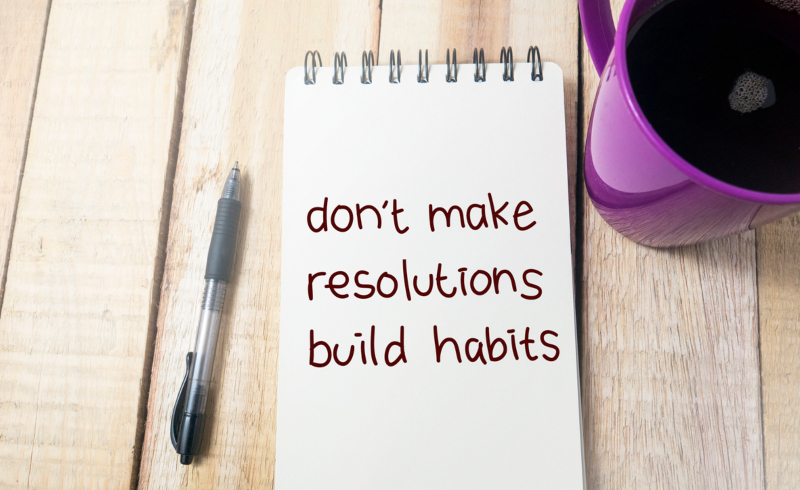
If you are like most people, this year like last year, you will resolve to either lose weight, create a widget, quit smoking, love better, get a new job, or work on being a better person. And, if you are like most people, by mid-January you modify the resolutions or flush them down the toilet believing old habits are hard to break or you do not have enough willpower. Loser? Never!
While resolutions to alter your Universe or take a complete 180 in life are difficult, nothing is impossible. However, it is important to understand why you are resolving to change your patterns. Are you listening to negative self-talk or are you genuinely looking to make a change that inspires you? Is judgment guiding your decision or are you finally fed up with a bad habit? Is there an emotional connection to this goal or are you trying to fit a cultural mold? Be clear why you are wanting to achieve this goal.
If you are going to set a resolution, it is best to start early. Attempting to create a goal on January 1, 2017 at 12:01am after a few champagnes will end in failure. Great goals require planning and A SMARTER framework.
In the business world, we created SMART goals. However, personal goals need a couple more steps because humans are more complicated and we need the focus. If you think back to your last set of resolutions, you probably had broad, overarching goals. For example, in 2016, did you want to be healthy? Or did you want to be more organized? Whatever the goal, most likely, you set yourself for failure because you focused on an Area, not a goal. Obviously, an Area is important, but how can you set a goal to be healthy? You can’t.
Real goals are Specific. Once you identify your Area, you want to break it down into manageable chunks. Let’s pretend you want to be healthy—your Area. What do you specifically mean by healthy? Weight loss? Exercise more? Eat organic? Clothing size?
Once you create a Specific goal, we need it to be Measurable. How much weight? How many sizes? How much exercise? You need a number. You must have a yardstick to measure your goal, otherwise how will you know if you are accomplishing it?
The next step is to ensure your goal is Action Oriented. Basically, can you put your goal into action? When you are writing the goal, are you doing it, or is it a list of things to do? Does the language inspire you to accomplish your goal? Use verbs in the goal. Don’t just list things. Create a paragraph or a couple of statements about the goal. For example, easily and effortlessly melt pounds away to fit into my size six dress from a size eight.
Is your goal Realistic? If you want to go from a size XXL shirt to a size S, is it reasonable to do that in 6 months? Do you have the frame for it? Unless you are having surgery, NOPE! So be realistic. Another dose of realism relates to your current skills. If you want to build a drone from scratch in three weeks and if you don’t know how to use a screwdriver, the goal isn’t very realistic. (Change the goal to take classes to help you build a drone.)
Do you have a Timeframe for your goal, which also aligns with a realistic goal?
Realistically, how long it will take you to achieve your goal? In many cases, I encourage my clients to chunk the goal into smaller timeframes. What is the three-month goal? What is the six-month goal? What is the nine-month goal? Smaller timeframes with realistic goals will boost your confidence and help you stay on track.
Every goal has an Emotional component. Remember earlier when I asked if you have an emotional connection to your goal? If we go all left-brain analytical on this stuff, we are removing the passion, the drive, the will to complete the mission. We need to bring in the emotions. When writing up your goals, include how are you going to feel when you achieve the goal. Additionally, how do you feel about creating the goal. “I’m so excited to do this-this. When I get there, I will feel light, happy, free, etc.”
The last but most forgotten step in creating A SMARTER goal is the Reward. Why would anyone subject themselves to a goal if there is no reward? Identify your reward, and if you are chunking the goal, you will need multiple rewards along the way. These rewards are your celebrations along the way to achieve your goal. New articles of clothing? A massage? Anything you want that keeps you motivated like asking me to give you bear hugs, which I will glad do.
When we identify our real goals, and define them in A SMARTER way, the process of achieving our aspirations is easier, more focused, more rewarding and, ultimately, more successful.
—
This post is republished on Medium.
—
Photo credit: iStock

