


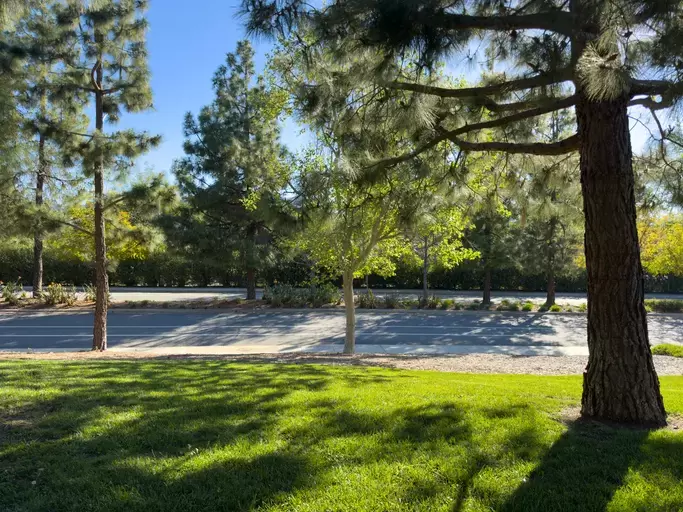
A little while back, a friend of mine uprooted his lovely family to a new subdivision in an attempt to escape the “rat race” of the place they’d moved into about five years earlier. That move was also an attempt to deal with their neighborhood claustrophobia, which had encroached on their 3-bedroom, 2-bath bungalow in the “at-one-time-place-to-be.” But this new home was nestled out in the undiscovered country, full of skateboard-ready sidewalks, halogen streetlamps, savory tranquility, and so much promise of the idyllic home life that it would make even Laura Ingalls Wilder raise an eyebrow.
And when they arrived at their new manor, it was wrapped in a Stepford smile—that warm welcome that feels reassuring until you realize it doesn’t blink. Something more cryptic, more ominous awaited them just beyond it.
On the morning of their first Saturday in the home, both my friend and his wife felt compelled to run to Pottery Barn and return with a rustic “WELCOME” vertical leaner, a rocking chair, and a few toss pillows to create the illusion of front-porch leisure. This was needed for their first post to the subdivision’s private Facebook group to stage a “stop by anytime” vibe, even though, in practice, they were staunch introverts.
My friend soon discovered that fleeing the urban core meant trading a fifteen-minute gridlock through an unavoidable school zone for a 90-minute grind along a two-lane state road known mostly for its popularity among farmers relocating their field equipment. They’d innocently—and incorrectly—assumed farmers all played their tractor musical chairs before sunrise, before milking their cows, or whatever it was that farmers did. Experience proved to be a great teacher—albeit one who liked to use clogged, shoulderless two-lane highways as metaphors.
But the real test of these pastoral illusions wasn’t just his; it was landing squarely on me now, as I was the weekend visitor drafted into deciphering the changing language of neo-suburban America. My friend shared his new address with the relaxed certainty of someone who thought a smartphone could navigate anything existential. He called it “The Shoals at Whispering Pines.”
I pulled up my Google Maps app and punched it in. Google replied, “Showing results for ‘Whispering Pines’” instead. This was a local campground about 20 miles in the wrong direction. That was obviously wrong—Google’s hubris notwithstanding. This time I typed my search with quotation marks; the equivalent of “Hey, Dummy! I’m talking to you, not your algorithm! Pay attention!”
Google Maps was completely unmoved. It not only lacked directional assistance, but the imagination to conceive of “The Shoals at Whispering Pines” existing anywhere outside a watercolor brochure in the Model Home office—a suburban seduction rendered as if Norman Rockwell had mastered Photoshop. Upon repeated attempts, each with varying nuance, my app, usually a flawless digital Sherpa, steadfastly refused to acknowledge its existence. It couldn’t find it, and I was beginning to doubt it ever would.
I couldn’t blame the software. The name itself was misleading—a pair of geographical falsehoods crafted by a marketing firm to treat a psychological ailment. There were no whispering pines; the developers had bulldozed every tree within two miles to clear a runway for cement trucks pouring postage-stamp slabs. And it definitely wasn’t an “enclave,” unless an enclave is defined as two hundred identical Hardie board-sided homes, with stone accents, flanked by two symmetrical, builder-grade shrubs, all clustered together in mutual dependence.
And that, of course, was precisely the point. “Whispering Pines” wasn’t just a subdivision name; it was part of a much larger habit of using geography as emotional marketing.
We’ve turned street names into a kind of cultural narcotic—soft, soothing fictions designed not to guide us anywhere, but to dull the growing discomfort between the lives we imagined and the ones we actually inhabit.
Street names used to be reliable indicators of where you were, not recommendations on how to feel. Even the world of Classic TV—The Andy Griffith Show, Leave It To Beaver, etc.—had “Streets” and “Avenues” that formed predictable and utilitarian grids. Professionally surveyed 90-degree corners defined neighborhoods with an almost claustrophobic precision. That old clarity and squeeze is what sent my friend (and thousands like him) out past the county line in search of something softer, more aspirational.
Because the street signs aren’t for navigation. Not anymore. They don’t exist to orient you as much as to reassure you. They’re less about coordinates than prescriptions—little green placards dispensing micro-doses of dopamine to commuters crawling along roads that promise escape but arrive nowhere new. It’s all part of “The Great Nomenclature Game.”
Nowadays, we transform street signs into social cues—cheap therapy substitutes for our cultural anxieties. Urban arteries sometimes get rebranded as “Martin Luther King Jr. Boulevard” in a desperate attempt to soften the grim realities along their corridors. We label a flat, concrete expanse a “Vista” or a “View” to distract from the panorama of the long platoon of curbside trash receptacles.
The language itself subtly conveys meaning. A “Lane” derives from Old English, denoting a narrow, intimate path. And real estate agents gently emphasize this, as if whispering “cozy” or “elite” into the buyer’s ear. Meanwhile, “Court” comes from the Latin cohors (an enclosed yard), suggesting that suffixes alone can manufacture a sense of seclusion and privacy into a community.
“The Preserve” insists, despite the evidence, that something has been protected rather than clear-cut, flattened, and colonized. This functions much like stage lighting in an underfunded production: it doesn’t enhance the scene, but it casts a warmer glow over the plywood and hides the duct tape.
Even “Shoals” and “Whispering Pines” function as geographical incantations, ironically calling forth schools of fish to an arid plain, and ancient forests that were conveniently bulldozed weeks before the parade of concrete mixers arrived. Thus, the utilitarian names gave way to something more aspirational and less grounded in experience.
We’ve adopted a whole new vocabulary to facilitate escape. We started moving to “Groves,” and “Ridges,” and “Terraces” with the hope that carefully branded geography might somehow regenerate the kind of community that once formed organically—before neighbors needed private Facebook groups to breathlessly announce they were “finally slowing down.” A hope that if we just called a dead-end road “Trail,” we’d all become “pioneers,” not merely county-line-jumping “settlers” hell-bent on minimizing our property taxes.
We’re disillusioned with man’s rigid engineering; the crisscrossed straight roads, cookie-cutter square blocks, and the maxim that “the shortest distance between two points is a straight line.” We keep trying to shoehorn warmth, community, and rootedness back into systems designed primarily for efficiency, then wonder why the results feel synthetic.
We’re strangely surprised that the 90-minute commute wasn’t a shortcut after all. We discovered nature prefers crookedness and paths of least resistance, and began to rethink our campaigns against through traffic. And just like that—poof!—we invented the “cul de sac.” Never mind that we paid top dollar just so our kids can play “at the bottom of a sack.” Somehow, saying it in French makes it seem palatable, almost romantic.
So, there I was, head on a swivel, checking my mirrors frequently for oncoming cars, searching for navigational clues. I crept along, getting nowhere fast, so I stopped. I idled at a crossroads where a “Boulevard” abruptly narrowed to a “Circle,” staring at my smartphone that wasn’t living up to its moniker.
I called my friend to tell him he’d stumped the Google Band. Nonchalantly, he said, “Oh, you have to use Waze,” as if I was the last one in the dark. Of course, I thought. I downloaded the app, punched in the address, and “voilà!” Turns out the problem wasn’t the transportation grid; it was the psycho-therapeutic babble we were painting on the signs. Marx would’ve called it “opium of the suffixes.”
Eventually, I found their house—only three blocks from where I’d stopped earlier, staring at a “Circle” that didn’t lead anywhere new. When I arrived, the DoorDash driver was blocking the driveway. If I’d known we were ordering in, I would’ve just followed him.
My friend still loves his new “Shoals at Whispering Pines.” The HOA recently voted to install more halogen lamps—the hum, they say, will offset the noisy crickets. The sidewalks remain mostly empty, save for the occasional jogger—still in pursuit of tranquility, I assume—wearing noise-canceling headphones and a Fitbit to log their mileage. The real distance, however, can’t be measured in miles or even in soothing suffixes. It’s measured in the ever-widening space between what we name things and what they actually are.
—
This post was previously published on Dan McAnally’s blog.
***
You may also like these posts on The Good Men Project:
 White Fragility: Talking to White People About Racism White Fragility: Talking to White People About Racism |
 Escape the “Act Like a Man” Box Escape the “Act Like a Man” Box |
 |
 |

If you believe in the work we are doing here at The Good Men Project, please join us as a Premium Member today.
All Premium Members get to view The Good Men Project with NO ADS.
Need more info? A complete list of benefits is here.
Photo credit: iStock

