



Once, when I was a young police chief at a community event, a miniature pony stepped out of a parked minivan and ambled over to me.
The owner of the pony parked his van at a nearby gas station. He ran up to me and said, “Sorry, she doesn’t always listen. Would you mind holding her, I just need to fill up the van.”
“Well, sure,” I said.
Our city was hosting a Special Olympics Torch Run, and our officers and members of the California Highway Patrol were there to provide traffic and pedestrian safety.
“Chief, looks like you’ve got your assignment for today, so we’ll let you carry on,” one of the officers said with a chuckle. I had to laugh, too.It’s not every day a miniature pony pops out of a van and trots over to say hello.
I stroked the pony’s mane, and the scent of her fur brought back fond memories of Garrod Farms in Saratoga, California, where my sister used to take riding lessons when we were kids. As a little boy, I used to watch her ride, and I loved the horses, dust, dogs, stables, and country ambiance.
If you visit the Garrod Farms website, you’ll read the following:
Garrod Farms was established in 1893 with the purchase of 65 acres from the Mt. Eden Orchard and Vineyard Company. Around 129+ years and 5 generations later, it continues to be a family agriculture operation today. Alongside the horse operation, we now have 28 acres of vineyards here on the property. We are also proud to say that we were one of the first wineries in the state of California to become Certified Sustainable in our farming practices.
Even as a little boy, I was attracted to the quiet beauty of Garrod Farms.
My sister took her riding lessons in the summer, so it was always blue skies and sunshine at the stables. There were men and women in cowboy hats. Horses whinnied, the scent of manure wafted through the air, and the aroma of nearby oak trees and summer grasses floated on the breeze.
It made me feel like I was back in a simpler time and place.
And it felt peaceful.
The skies had emptied of birds and their windblown song
All these memories returned to me last week as I finished reading James Rebanks’ lovely book, “Pastoral Song: A Farmer’s Journey.”
Rebanks is not only a fine writer, he also runs his family-owned farm in England’s Lake District. His book poetically shares how his beloved grandfather taught him farming the old way. Back when they did rotational farming, with patchworks of crops and meadows, grazing livestock, and hedgerows teeming with diverse wildlife.
But then modernity arrived, with its fertilizers, antibiotics, advanced machinery, and new, more efficient ways of producing crops.
The inside jacket of James Rebanks’ book notes:
But by the time James inherited the farm, it was barely recognizable. The men and women had vanished from the fields; the old stone barns had crumbled; the skies had emptied of birds and their windblown song.
“Advancements” in farming may have led to an abundance of affordable food, but there was a cost to the ecology and health of the land. Rebanks chronicles how rural landscapes around the world came close to collapse.
His book is a kind of elegy to the old ways when work, weather, and community went hand in hand with a slower, ecologically healthier approach to farming. It’s an approach that Rebanks has slowly returned to, even though his income is less than the big, modern, soulless farms.
Rebanks shares stories of listening to his grandfather and fellow farmers, as they sat beside a crackling fire in old armchairs, drinking tea or beer, discussing the price of sheep, farming, and how their world of small farms was being eroded by modernity.
They spoke of selling cattle, clipping sheep, laying hedges, mending roads, building walls, and more. They were hardworking, decent, self-sufficient, kind farming folk.
Reading all this, I thought of Garrod Farms during my childhood.
Their voices were rarely heard, because they sought no audience
Garrod Farms in the early 1970s wasn’t like the ones Rebanks describes in England, but they did possess the same, ineffable quality of simplicity, hard work, community, dignity, and peace.
There’s a paragraph in Rebanks’ book describing the old farmers and their way of life that resonated with me:
These people lived insular, often deeply private lives focused on their work. Their voices were rarely heard, because they sought no audience. Their identities were constructed from things that couldn’t be bought in shops. They wore old clothes and only went shopping occasionally for essentials. They held ‘shop-bought’ things in great contempt. They preferred cash to credit, and would mend anything that broke, piling up old things to use again someday, rather than throwing them away. They had hobbies and interests that cost nothing, turning their necessary tasks, like catching rats or foxes, into sport. Their friendships were built around their work, and the breeds of cattle and sheep they kept. They rarely took holidays or bought new cars. And it wasn’t all work—a lot of time was spent on farm-related activities that were communal and more relaxed, or in the simple enjoyment of wild things. My grandfather called this way of life ‘living quietly.’
Contrast the above way of life with today’s.
Now we commute to jobs or slump catatonic in front of blinking screens. We are completely removed from the land and source of our food (which is increasingly processed). We have an epidemic of stress, obesity, diabetes, and heart disease. Not to mention broken families, addictions, and suicides. Kids are glued to social media and aspire to be influencers. They want money and fame, not quiet lives.
Many people today feel like their lives have little meaning.
No doubt, the farmers of the past had difficult lives, and we mustn’t romanticize every facet of their agrarian world. But they had a deep sense of purpose and pride in their work. Also, their physical labor provided exercise, which helps with sound sleep and overall health.
The two things I’m most attracted to when I read of these old-school farmers are purpose and quiet living.
Purpose and quiet living
There was a recent obituary in the Wall Street Journal about a bespoke tailor named Martin Greenfield.
Greenfield was born to a Jewish family in 1928 in former Czechoslovakia (now western Ukraine). The obituary notes:
Greenfield’s immediate family was wiped out during the Holocaust. Orphaned, he was assigned to wash clothes at the Auschwitz concentration camp. One day, Greenfield ripped an officer’s shirt and after he was beaten, a fellow prisoner taught him how to mend the collar. In the most dire conditions, Greenfield made his first unforeseen attempt at stitching.
Greenfield survived the Holocaust, moved to America, and despite being an orphan, found one remaining aunt to live with. He became a “floor boy” at a clothing factory where he did grunt work.
But he learned about tailoring.
Greenfield went on to purchase his own factory, called “Martin Greenfield Clothiers.” It’s a niche operation in an old, unremarkable building. But it’s where he built a successful business and a name for himself crafting handmade suits.
Martin Greenfield and James Rebanks have a few things in common. They both found purpose and quiet living in their work. These may be simple things, but they can provide fulfillment and happiness.
The obituary for Greenfield adds:
Greenfield didn’t have a computer or email, preferring to do business in person or over the phone. He would come in six days a week, stepping away only in recent years, and allowing his two sons, Jay and Tod, to take over the business.
James Rebanks has children, too, who help him on his small farm. He writes movingly of an afternoon when he held his daughter close at dusk on their ATV as they watched an owl rise and fall in the sky above their land.
Perhaps Rebanks’ children will take over the farm someday and carry on their father’s legacy, just like Greenfield’s sons will carry on the legacy of their father’s clothier business.
And what about the rest of us?
We are all part of a grand narrative
Must we adopt all of modernity, with its screens, technology, noise, and assaults on our humanity? Or can we carve out some purpose and quiet living?
Perhaps we can’t run away from our jobs and responsibilities, but we can slowly craft more meaning, purpose, and serenity into our days. I do this by setting aside quiet time for books, writing, and relaxation with my wife in the garden.
We are all part of a grand narrative.
My life is possible because of the love, sacrifices, and support of my parents and family before me. And I spend as much quality time as I can with my son, discussing ideas, books, and what it means to live a good life.
The good man my son has become is part of the story of our family, and who he inspires and helps in his life is part of how we’re all connected.And the more we invest in purpose and quiet living, the more our lives will help inspire others to find their purpose and quiet living.
James Rebanks’ grandfather thought, perhaps harshly, “that modern people were like children, free to play, but bereft of meaning in their lives and disconnected from the things that mattered.”
If we are to find contentment in our lives, we must embrace the things that bring us meaning, purpose, and connection with what matters most. Like family, friends, faith/philosophical insight, and passions.
Near the end of “Pastoral Song: A Farmer’s Journey,” James Rebanks writes the following:
The distinction between me and this place blurs until I become part of it, and when they set me in the earth here, it will be the conclusion of a lifelong story of return. The “I” and the “me” fade away, erode with each passing day, until it is an effort to remember who I am and why I am supposed to matter. The modern world worships the idea of the self, the individual, but it is a gilded cage: there is another kind of freedom in becoming absorbed in a little life on the land. In a noisy age, I think perhaps trying to live quietly might be a virtue.
I think it’s a mistake to allow too much noise and modernity in our lives.
I believe that living quietly is a virtue.
We don’t have to become independent farmers or bespoke tailors. Each of us must find our own worlds where purpose and quiet living can restore our spirits, calm our hearts, and save our souls.
But once we find those worlds, what a splendid life it will be.
Before you go
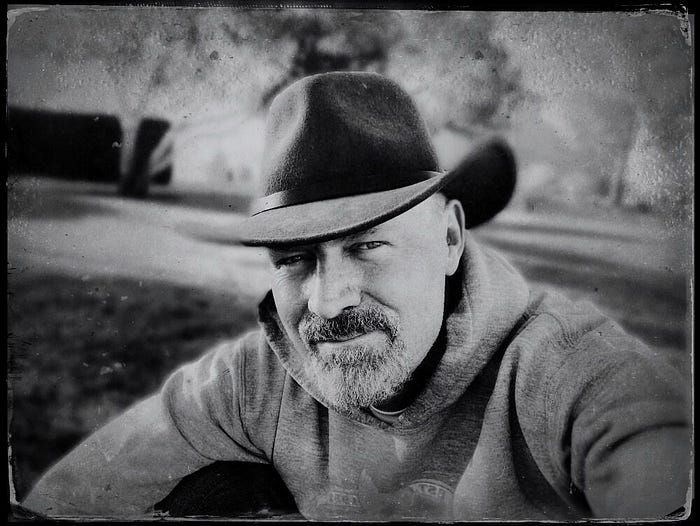
John Patrick Weiss writes stories and essays about life, often illustrated with his black and white photography. Visit JohnPatrickWeiss.com.
—
This post was previously published on Medium.com.
—
The Good Men Project is a mission-driven men’s media platform. A major platform for stories about men, identity, fatherhood, and emotional intelligence—and a trusted home for the national conversation about masculinity.
The Good Men Project accepts paid guest posts and provides bulk guest post packages for SEO agencies and resellers.

If you believe in the work we are doing here at The Good Men Project, please join us as a Premium Member today.
All Premium Members get to view The Good Men Project with NO ADS.
Need more info? A complete list of benefits is here.
Photo credit: Johnpweiss.com

