



A few years ago I decided to get serious about my photography.
I used an iPhone to take pictures, but then a friend suggested I upgrade to a proper camera. He used words like depth of field, aperture, bokeh, the exposure triangle, etc.
I went to my local camera shop and poked around.
One of the sales guys started showing me a variety of cameras and lenses. He explained the difference between a full-frame camera and an APSC camera. I settled on a relatively small Sony A6600 with a 35mm lens.
It was a lovely camera and capable of taking beautiful photographs and videos. All I had to do was learn how to use the camera.
I got home, turned the thing on, and started exploring the buttons and features. Then I flipped out the screen and started clicking through the menu options.
Endless menu options.
I got on YouTube and found a tutorial for my camera. The earnest fellow on the video made it sound so easy as he bounced around from one menu feature to another. It was all a bit overwhelming, and I thought, “Why is this so complicated?”
It reminded me of a guy I met in Italy who was trying to figure out the menu on his new travel camera. “The menus on this thing are endless and confusing! All I want to do is take a damn picture,” he said.
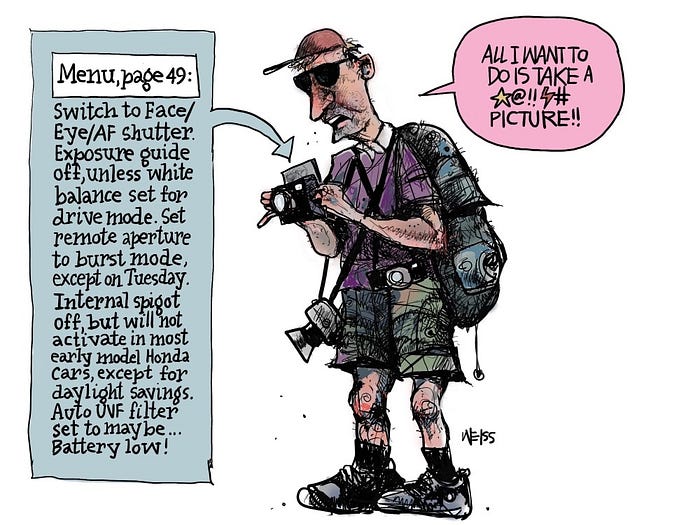
I complained to my friend about the complexity of my new camera.
“You should have told me before you bought the Sony,” he said, adding, “I would have encouraged you to buy a Leica Q2 instead.”
“What’s a Leica?” I asked him.
“Leica is a German company. They manufacture cameras, optical lenses, photographic lenses, binoculars, and rifle scopes. Their rangefinder-style cameras are elegantly designed, minimalistic, and take amazing pictures. Also, the camera menu systems are simple,” my friend said.
“So you recommend the Leica Q2?” I asked.
“Yes, it’s a compact, full-frame, 47-megapixel, point-and-shoot camera with a fixed 28mm F 1.7 lens. Super easy to use, and because it’s a fixed lens, you eliminate having to buy different lenses. The camera is an all-in-one photographer’s dream. It’s elegant and minimalistic,” he told me.
“Wow, that sounds awesome. Maybe I should trade my Sony and get the Leica Q2. How much does it cost?” I asked.
“Five thousand dollars,” he said.
So I kept my Sony.
We insist on making it complicated
Take a good look at your smartphone screen.
Look at all those apps and features. Good Lord. We’ve got everything on our phones these days. From banking and travel arrangements to shopping and social media. No wonder everyone is forever scrolling through their phones.
My photos sync with the cloud, so when I switch from my phone to my equally complicated computer, everything is there. But then, just like my phone, there are endless updates, notifications, and distractions.
I get that it’s all designed to make our lives “easier,” but in many ways, technology has made life more complex.
Early in my career, when I left work my time was my own. I’d return on Monday and check the messages in my mailbox. Then we got pagers and took turns being on call on weekends.
It was an electronic leash.
Fast forward to the advent of smartphones, and soon everyone had one, and the dividing line between work and days off began to blur. Suddenly we were flooded with emails, phone calls, and text messages. If the pager was an electronic leash, then the smartphone became an electronic prison.
Life is really simple, but we insist on making it complicated. — Confucius
They say technology made us more efficient and productive, but I’m not sure. Sometimes I think it just made us distracted, busier, and the quality of our work hasn’t improved that much. In some ways, it’s become less original and more derivative. How did Michelangelo manage to create so many masterpieces like his David sculpture? He didn’t even have electric chisels. Not to mention those prolific Russian writers like Tolstoy and Dostoevsky.
Where are today’s Michelangelos, Tolstoys, and Dostoevskys? I’m sure there are still prolific artists and writers, but it doesn’t feel like the art being produced is as grand as those old masters who worked without today’s technology. It feels like today’s digital distractions and technological advances make our lives more convenient, but also more complex.
Increasingly, I find myself looking for ways to decomplexify my life.
And I’m not alone.
Performing like hypnotized monkeys
Have you heard of the Light Phone?
It’s a super basic, e-ink display cell phone designed to free you from all the distractions of a regular smartphone. It only has a few essential tools, like calls, texting, a wakeup alarm, and directions. With the Light Phone, you can’t surf the Internet or download external apps.
Talk about decomplexifying your life.
The Light Phone has been through a few upgrades, and the latest model added a few more features. But it’s still a minimalistic cell phone designed to help you escape the tyranny of social media and endless distractions.
I don’t own one but I keep considering it.
I think the reason the Light Phone exists is that people are looking for ways to simplify their lives. They’re waking up to the fact that there’s far more to life than being glued to a screen, performing like hypnotized monkeys for predatory algorithms pedaling piffle.
Since I grew up before the Internet and smartphones, I know I’m a relic and biased towards the simpler days. No doubt, today’s technology has enabled me to do many things faster and more easily.
And yet.
I find myself shedding as many apps and unnecessary distractions as possible. I adopt the simplest solutions over all the complex ones.
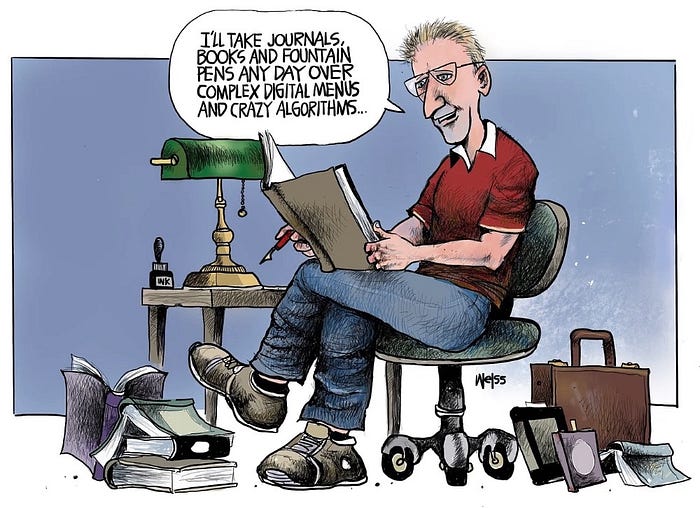
For example, I carry around little pocket-sized field notes to write down ideas, quotes, and observations, and to draw little sketches. At home, I write in journals with my fountain pens. There’s a tactile joy in this, and somehow the slower process of handwriting on paper forces me to take my time and think more deeply.
I’ve been writing letters lately, to surprise friends with unexpected salutations in their mailboxes instead of their inboxes.
The less complexity we create in our lives, the more space remains to embrace our loved ones and the creative passions we care most about.
Don’t let complexity rule your life
I got into minimalism a few years back, which inspired me to strip away as much unnecessary complexity from my life as possible.
I watch less and less TV because the commercials drive me crazy and most of the content is uninspiring. I took a break from social media because I realized it was utterly superficial and algorithm-driven. As a result, I’m back to reading more books and spending more time writing and creating artwork.
I bought a new, fuel-efficient car last year, a model without all the upgrades. For example, to move my seat back, I simply pull a lever. Same with the rear hatch. No motors to malfunction. Simple. Old school.
I simplified my wardrobe and sold, donated, or trashed possessions I didn’t need.
The latest thing I’m doing is a digital declutter. How the heck did I amass over six thousand photos on my iPhone? Why am I paying for additional storage? So, I’m culling and will move the remaining images to an external hard drive. Then I plan to select the best photos for a photo book I can create and put on my bookshelf. And after that, who knows? Maybe I’ll get that Lightphone?
I know it’s probably a losing battle.
Complexity is here to stay, and it will probably get worse. But the more I decomplexify my life, the happier I am.
Oh, about that Sony camera. I traded it in for a Fuji X-Pro3 rangefinder-style camera. The menus aren’t much better than the Sony, but the camera looks a little like the Leica Q2. Until I can afford a Leica, the Fuji camera will do.
Don’t let complexity rule your life.
Say no to unnecessary commitments. Get rid of stuff you don’t need. Find simpler technology solutions.Take your dog on more walks outdoors. Consider a great book instead of mindless TikTok videos.
Simplify your life, create more than you consume, and rediscover why less is more.
Before you go

John Patrick Weiss writes stories and essays about life, often illustrated with his black and white photography. Visit JohnPatrickWeiss.com.
—
This post was previously published on Medium.com.
—
The Good Men Project is a mission-driven men’s media platform. A major platform for stories about men, identity, fatherhood, and emotional intelligence—and a trusted home for the national conversation about masculinity.
The Good Men Project accepts paid guest posts and provides bulk guest post packages for SEO agencies and resellers.

If you believe in the work we are doing here at The Good Men Project, please join us as a Premium Member today.
All Premium Members get to view The Good Men Project with NO ADS.
Need more info? A complete list of benefits is here.
Photo credit: John P. Weiss

