


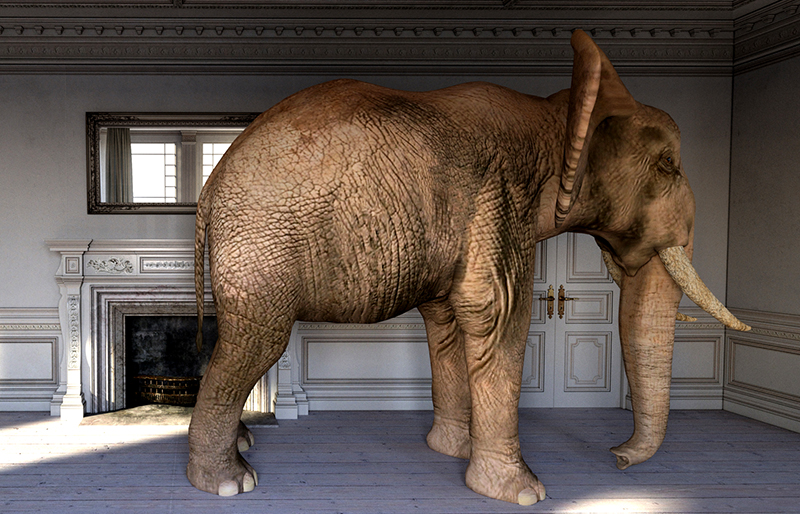
Once Jackie Summers realized he was black, he found an elephant in the room wherever he went.
—
RSVP for #StopRacism Weekly Calls
—
I had no idea I was black, until my first day of first grade.
In 1953, when my parents first moved into their home in Jamaica, Queens, they were the only black family on the block. At the time, segregation was still legal. By 1964–the year the Civil Rights Act was passed–only one white family remained in the neighborhood.
In 1967–the year I was born–interracial marriage was still illegal.
In 1971, more than a dozen years after the infamous “Little Rock Nine,” the Supreme Court upheld busing as a means of achieving public school integration. The decision was met with violent opposition.
One year later I began attending public school in Bayside Queens. My bus was late, and my arrival disrupted Mrs. Schulman’s speech; I assumed this explained why everyone was staring at me. With my name-tag properly affixed to my favorite Garanimals t-shirt, students were encouraged to wander about the classroom and get to know our fellow classmates. For as long as I live, I will never forget doe-eyed Valerie making a bee-line to me, gape-mouthed and looking me in the eye as she ran her fingers gingerly across the back of my hand, as if to see if I was real.
I looked at her as if she was crazy.
My confusion registered as offense to her, for which she was immediately contrite. Her response to my shock may be the singular most innocent thing anyone’s ever said to me:
“I don’t mean to be rude. It’s just that I’ve never seen a black person before in real life, only in the movies and on TV.”
When I got home from school that day, my mother asked me what I’d learned. “Guess what Mommy,” I said. “I’m black. How come you never told me?”
My utter lack of racial identity was not because I was a dullard–I’d actually entered public school reading on a twelfth-grade level. The youngest of five kids, I had one brother and sister lighter than myself and one brother and sister darker than myself. I just assumed people came in all shades.
Color simply didn’t matter, being a good person did.
You can imagine my surprise at finding myself in the principal’s office in my first week of school. In my eagerness to make friends, I’d offered a student Tic-Tacs; he told the teacher I was trying to give him drugs.
I was six years old and had no idea what drugs were.
Equally as enlightening was the reaction the first time I changed for gym class. “Dude, you’re black all over!” Apparently, little Jimmy expected me to have a white underbelly, like a monkey.
Ultimately we shared the same source of ignorance: our parents. To me, my blackness was incidental; it didn’t grant or deny me any special privilege. I was as unaware of my own pigmentation, as I was of everyone else’s.
To others, the color of my skin was fundamental, a factor that could determine, with a precursory glance, my social status, intelligence, and whether or not I was a potential source of danger.
♦◊♦
What Tom experienced on safari is not dissimilar to my experiences in corporate America, except without the warm welcomes in hope of a good tip. I’ve been dependent on the kindness of strangers in a potentially hostile environment where no one looked like me. From my Wall St. days to my time in advertising to the many years I spent in magazine publishing–not including the guys who delivered my mail or worked in security–I could count the number of times I’d worked with another black male on one hand. On the rare occasions I did work with another person of color, I felt obliged to challenge them to a duel; as Highlander taught us, there can be only one.
A black male in the upper echelons of corporate America is far more rare–and harder to spot–than any leopard in the wilds of Africa.
While there have always been some with the innate ability to see beyond my color to my qualifications, reality has proved them a minority. Once, after spending several hours on the phone with someone who was clearly impressed with my resume, I was asked to come in for an interview. Suit and tie, I waited patiently in the lobby for my potential employer to arrive. She made no attempt to hide her chagrin upon seeing me for the first time. “My god,” she gasped, “I had no idea you were black.”
My first response–in my mind–was to reprise the classic scene from The Jerk, starring Steve Martin, and assure her that I was not going to stay that color. My second response–again in my mind–was to express equal shock and disappointment at her not being black. My actual response was: “I hope you’re pleasantly surprised and that it won’t have a bearing on this interview.”
Needless to say, I didn’t get the job.
Then there was the time, during my tenure on Wall St., when a white co-worker waited until after hours to go into my desk to retrieve a copy of my resume. He then cut the resume up into pieces, taped the cut pieces of my address to an official business envelope–terrorist-style–and mailed threatening letters to my home. When I reported this to my human resources department I was asked to take a week off—with pay—while they attended to the situation.
By the time I returned to work, my antagonist had been fired. When I asked the director of HR–a Latin woman–why they’d wanted me off premises, she closed the door and spoke candidly: they were afraid of me.
Apparently the potential for an angry black man was a greater threat to security than a clearly psychotic white guy.
As you climb the corporate ladder this problem is exacerbated by being given authority over white subordinates. Many have never had occasion to associate with a black man in their daily lives, much less take directives from one. Never was this more obvious than the day one of my employees at a glossy woman’s magazine attempted to circumvent the chain of command, choosing to address my superior instead of me with a matter which clearly fell within the realm of my jurisdiction. When in closed-door meetings she was asked why she tried to undermine my authority, she confessed: she simply didn’t feel comfortable having to answer to me.
“You claim it isn’t easy for you, but you’re unaware of all of the advantages you have in this industry” I told her “simply for being a white female. Look around you” I said “and try to imagine how I feel. There are forty-seven people in this office, forty-three of whom are white females. Let’s turn it around: what if you were the only white female in an office full of black males–how comfortable would you feel then?”
“Totally uncomfortable” she mumbled. “But still more comfortable than having this conversation.”
♦◊♦
One of the reasons discussions on race have become increasingly difficult is homogeneity: there are certain questions you simply never bother to ask if everyone around you looks just like you. Too many people who were born on third base actually believe they’ve hit a triple.
It’s like trying to explain water to fish.
As I grew into the awareness that there would always be people who would make assumptions about the nature of my character based solely on the color of my skin, I came to understand that their preconceptions spoke far more about them than they ever could about me.
Twenty-five years of working within the system taught me that nothing diffuses the discomfort surrounding race relations more than having a good sense of humor. Candid discussions on race make grown people squirm, and since the subject is considered taboo, everyone simply tries to ignore the elephant in the room.
That’s usually about the time I pop out a (metaphorical) elephant gun.
“What is your exact title?” the thin blonde asked, in a thin drawl. “I’m placing an order for your business cards today.”
“Director of Print and Digital” I replied to my new assistant. “Or you could just call me ‘That Black Guy.’ At least that way, everyone will know who you’re talking about.”
Translation: yes, I just started working for a company with over 12,000 employees in six cities, and yes, I happen to be the first person of color appointed to the office of Director in the history of this company. Now that we’re beyond that, how about we have as much fun as we can with this job without compromising the seriousness of our work?
Of course, this technique is less effective with “superiors” than subordinates.
“If you’re going to make a black man work on Martin Luther King Day,” I proclaimed, as I entered my office on the holiday, “someone better be buying me a bucket of Kentucky Fried Chicken. Extra crispy, with biscuits, and gravy.”
The large cowboy who considered himself my boss laughed nervously. “If I said something like that,” he said, “I’d be fired.”
“If you said something like that,” I shot back, “it’d be about the least offensive thing you’ve ever said in these offices.”
I’ve always believed a fair measure of character is the ability to laugh at oneself when the joke’s on you. Sadly, the big cowboy did not share my sentiments.
♦◊♦
My mom still lives in Jamaica, Queens in the house I grew up in. From my apartment in Brooklyn I have to take two trains and a bus to visit her. Recently, when returning from one of my visits, I took a seat on the subway, only to feel my well-honed instinct for trouble tingling. I looked immediately to my left; there sat a large, intimidating black guy. We’d made eye contact; I couldn’t look away without appearing cowed. Subtly, almost imperceptibly, he nodded his head in my direction: the slightest token of respect. I responded in kind. Just to my right sat another equally menacing looking black guy, who repeated this ritual of acknowledgement; again, without breaking eye contact I returned the most meager of nods.
Safety secured, I relaxed and looked straight ahead, to see a black man in aviator glasses, a black bandana, a hooded sweatshirt and Harley Davidson motorcycle boots.
It was my own reflection in the window.
That’s when I realized: I’m a big scary black guy. This is people’s first perception of me. No one sees my Scottish grandmother, or my half-Italian grandfather. No one sees an artist, a musician, an entrepreneur, an autodidact, a devoted son. To those that know me, the idea that anyone (who didn’t have a legitimate reason to be afraid of me) could perceive me as a threat, is laughable.
To everyone else, I’m just some black guy.
♦◊♦
Today my social circle is comprised of a veritable smorgasbord of ethnicities. Equally diverse is my taste in women: I married (and divorced) a black woman. Subsequently, I had major relationships with Israeli, Venezuelan, Dominican, Filipino, Austrian, and Egyptian women. In between serious relationships, the palate of women who’ve adorned my dating life has had more colors than a bowl of Trix cereal.
I’m simply more concerned with the quality of your humanity than the color of your skin. Like everyone else I’m not without my prejudices. If I’m playing pick-up basketball at Marcy projects on a Sunday morning, and I have to choose between teaming with a tall, muscular black guy and a short white guy, the choice is obvious: I pick the short white guy, every time. He’s clearly the biggest badass out there, or he wouldn’t have bothered to set foot on the court.
My specific prejudice is against assholes. Fortunately, no one segment has managed to corner the market on being an asshole; they still come in every gender, sexual preference, creed, and ethnicity.
I don’t claim to speak for all black people any more than I claim to speak for all men; the human experience is too unique to be encapsulated by any one individual. I believe it’s important to think of race as a social construct; an idea designed to justify maintaining economic inequality. From a worldview, whites and blacks are a minority; even combined, Asians still outnumber us two-to-one. People of color are a minority in the same way that women are a minority: in power, not in actual population.
By coincidence, the Good Men Project is–despite the best intentions–a microcosm of the disparity that still exists. The mission behind GMP is to discuss what it means to be a good man. Of the over 120 regular contributors, only two are black: myself and Damon Young. Is this because there no good black men, or are good black men either unwilling or unable to discuss intelligently the innate nature of goodness? Whether by default or design, the determination of what is good is still being made by white males.
The difference in melanin from the whitest white person to the blackest black person is less than 1/10,000 of one ounce. Tom, the next time you’re in town, come to Harlem and we’ll hang out. Better yet, come to Brooklyn: we’ll bring our laptops to Bed Stuy cafe and swap stories. I’m willing to bet we have more commonalities than superficial differences: we both believe in and want to live in a meritocracy. If a world where racial and gender equality is ever going to exist, it will begin with conversations like this, between men like us.
Because ultimately, color doesn’t matter; being a good man does.
—
RSVP for #StopRacism Weekly Calls
—
—
We are proud of our SOCIAL INTEREST GROUPS—WEEKLY PHONE CALLS to help discuss and help solve some of the most difficult challenges the world has today. Calls are for Members Only (although you can join the first call for free). Not yet a member of The Good Men Project? Join now!
—
What Now? Participate. Take Action. Join The Good Men Project Community.
The $50 Platinum Level is an ALL-ACCESS PASS—join as many groups and classes as you want for the entire year. The $25 Gold Level gives you access to any ONE Social Interest Group and ONE Class–and other benefits listed below the form. Or…for $12, join as a Bronze Member and support our mission.
*Payment is by PayPal or Stripe, if you prefer.
Please note: If you are already a writer/contributor at The Good Men Project, log in here before registering. (Request new password if needed).
◊♦◊
Your ANNUAL PLATINUM membership includes:
1. Free and UNLIMITED ACCESS to participate in ANY of our new Social Interest Groups. We have active communities of like-minded individuals working to change the world on important issues. Weekly facilitated calls that lead to execution of real world strategies for change. Complete schedule here, with new ones starting all the time. We now offer 500 calls a year!
2. Free and UNLIMITED ACCESS to ALL LIVE CLASSES. Learn how build your own platform, be a better writer, become an edit or create social change. Check out our training sessions. As a Platinum member, you can take them all.
3. Access to our PREMIUM MEMBER LIBRARY with our recorded ConvoCasts and classes. ConvoCasts are a new form of media—and you are in them! Only Platinum Members get access to our recordings. And recordings of our classes are really valuable for those who do not have time to take the live classes or just want to review.
4. An ad-free experience. No banner, pop-up, or video ads when you log in.
5. Weekly conference calls with the publisher and other community members. Our weekly calls discuss the issues we see happening in the world of men in a friendly group setting.
6. PLATINUM member commenting badge. Your comments on our website will appear with a platinum member badge, signifying you are a part of our core community.
Price for ANNUAL PLATINUM membership is $50/year.
♦◊♦
Your ANNUAL GOLD membership will include:
1. Free access to any ONE Social Interest Groups.Try them out! We have active communities of like-minded individuals working to change the world on important issues. Weekly facilitated calls that lead to execution of real world strategies for change. Complete schedule here, with new ones starting all the time.
2. Free access to any ONE of our live classes. Each month, we have the following: Learn how to be a Rising Star in media, build your own platform, become an advanced writer, become an editor or create social change. Check out our classes here. RSVP for any one class—if you want to take more, just upgrade to an Annual Platinum Membership.
3. Invitation to all Friday calls with the Publisher and community. Connect with other members online and by phone!
4. An ad-free experience. No banner, pop-up, or video ads when you are logged in—as long as your membership is active.
5. GOLD commenting badge. Your comments on our website will appear with a gold member badge, signifying you are a part of our core community.
Price for ANNUAL GOLD membership is $25/year.
♦◊♦
Your ANNUAL BRONZE membership will include:
1. Invitation to the MEMBER-ONLY Good Men Project Community on Facebook and weekly conference calls with the publisher and community. Connect with other members, network and carry the conversation no one else is having one step further.
2. An ad-free experience. No banner, pop-up, or video ads when you are logged in—as long as your membership is active.
3. BRONZE member commenting badge. Your comments on our website will appear with a bronze member badge, signifying you are a part of our core community.
Price for ANNUAL BRONZE membership is $12/year.
♦◊♦
We have pioneered the largest worldwide conversation about what it means to be a good man in the 21st century. Your support of our work is inspiring and invaluable.
◊♦◊
“Here’s the thing about The Good Men Project. We are trying to create big, sweeping, societal changes—–overturn stereotypes, eliminate racism, sexism, homophobia, be a positive force for good for things like education reform and the environment. And we’re also giving individuals the tools they need to make individual change—-with their own relationships, with the way they parent, with their ability to be more conscious, more mindful, and more insightful. For some people, that could get overwhelming. But for those of us here at The Good Men Project, it is not overwhelming. It is simply something we do—–every day. We do it with teamwork, with compassion, with an understanding of systems and how they work, and with shared insights from a diversity of viewpoints.” —– Lisa Hickey, Publisher of The Good Men Project and CEO of Good Men Media Inc.
—
More articles On Race:
On Race
White Boy in a Black Land
‘Why I Don’t Want to Talk About Race’
Eating While Black


I sort of have a different view of a similar story but I have never discussed it. I have always wanted to write a blog about my perspective on busing in the early 1970’s. I was raised by very loving, open and dare I say in this politically charged environment rather liberal parents. My parents are the kind of people I wish most would aspire to become. When I went to school in the early 1970’s busing was a big deal. My mom told me ahead of time that children that looked much different than me would be coming to… Read more »
When I was in early grade school I had my first experience with the whole race issue. I had been bullied by a group of girls during recess, and was telling the teacher watching us who was teasing me. It was the first day and I only remembered one of the girls, who happened to be black – something that didn’t strike me as significant except as a way to identify her. I told the teacher that the girl who bullied me was “the black girl who had green bows” in her hair. I wasn’t going to say she had… Read more »
I know this article was written ages ago, but I enjoyed it so much I had to answer anyway! I’m a white Australian raising three quite obviously black boys…I seriously wish I had a dollar for every time I’ve been asked ‘Oh, are they your kids?’ by all different people, and then watched the attitude change as a result! Living in Australia, the bias is often very, very subtle…it’s accepted that black people do have influential jobs, but not common. I didn’t realise, until I started dating the boy’s dad, how white Australia really was. Raising the boys with a… Read more »
Sources…
[…]here are some links to sites that we link to because we think they are worth visiting[…]…
Growing up around mostly whites, I remember not realizing I was black until we watched a documentary in fourth grade about MLK Jr. Really opened my eyes and made me aware of how other people perceived me in different settings.
My granddaughter receives the same colour prejudice because she has beautiful red hair ,get red of prejudice is about education and responsibility.
Just thought I should point out that I lol’d about choosing the badass white guy when playing basketball. It’s a good point.
ps:- I had the same lack of racial awareness when I was a kid. Which is I think a pretty good indication that race really is a social construct.
I bet that these people all remembered they were black when they filled out college applications in an effort to receive undeserved racial set-asides.
Once upon a time in America, in order to become a lawyer all you had to do was pass the bar. Somewhere around 1896, a black man did just that and became the first person of color to practice law legally in the United States. The response of the academic community was to mandate that a bachelor’s degree was required before anyone could pass the bar. The few people of color who could afford higher education took their new BAs to the their bar exams, and when they passed, a new mandate was set forth that only people who’d acquired… Read more »
“Apparently the potential for an angry black man was a greater threat to security than a clearly psychotic white guy.” “clearly psychotic white guy” How do you know that? He’s visibly psychotic because the media and his parents tricked him into thinking you were dangerous? That makes him psychotic? “If I’m playing pick-up basketball at Marcy projects on a Sunday morning, and I have to choose between teaming with a tall, muscular black guy and a short white guy, the choice is obvious: I pick the short white guy, every time. ” See? Everyone forms an opinion based on appearance.… Read more »
“afsdfadsf” Regardless of what either the media or bad parenting had convinced this former co-worker, sending unprovoked, threatening letters with my address cut from a stolen resume and taped to an envelope, WAS PSYCHO. As for my choices on the basketball court, that’s from years of playing pick-up basketball in NYC. Clearly racism isn’t limited to white people, any more than sexism is limited to men or classism is limited to the rich. Does everyone make snap judgements? Sure, but that’s the very definition of prejudice: preconceived opinions not based on reason or experience. Does this mean that you can… Read more »
My niece, who is white, had a similar experience discovering racial difference. As a pre-schooler she, of course, knew that there were people with different levels of melanin in their skin but it never occurred to her to use this as a social distinction and to define and categorize people based on it. She didn’t learn that there was a category for darker skinned people and she was not part of it until she was in school and they celebrated “Black History Month.” She came home pleased with what she had learned, “That is a black person. President Obama is… Read more »
Laura what a beautiful experience. I think it’s important for adults to help shape their perceptions as they achieve these realizations, so that differences can be recognized without becoming prejudices.
JFB
Taking a 90 degree turn here: If I may ask, how did you find your giftedness affected your school career? You entered grade school with a reading level equivalent to those leaving grade school. I typically read 3-4 years ahead of grade level and it had a profound effect on me. I would love to hear from your extremely gifted point of view – could any of the textbooks challenge you? Did you skip any grades? What did you read? How did your teachers manage to keep you occupied and involved? Did you find favorite authors? What was your preference,… Read more »
Kitty, this is an excellent question. At first, because other kids my age couldn’t read, I thought they’d made a mistake and put me in a “special” class. When I realized that curriculums were designed to accomodate slow learning, I became bored and disruptive. This was rightly classified as “problem behavior,” especially after I was assigned to an advance placement class.
What I found frustrating was not textbooks, but teachers. Few had the temerity–or patience–to deal with a child who challenged the status quo.
Then at 13, I discovered girls. It was all downhill academically from there.
JFB
Classic! I have known many, many class disruptors of just your ilk! Also, I can state from experience that white girls also faced many teachers who couldn’t handle a challenge. 🙂
HA!! I think that happened to all of us at age 13. (Well, for me it was boys.)
Kitty, I’m certain the struggles of women and black to achieve equality have many similar parallels. As for the discovery of the opposite sex? Tis the downfall of us all.
JFB
Question for you, Jackie. If you see a woman avoid you on the street in some way- say she switches her purse to the opposite arm, detours a little bit to put some distance between you, or whatever- does this register on your radar at all?
If so, what does it mean to you? For example, are you thinking, this is because I’m black, or this is because I’m a man, or this is because of my intimidatingly buff biceps, or… ?
Kirsten, of course it registers; I may even be hyper-aware of slight behavioral shifts in others. This may be a situation-analysis mechanism I’ve developed from having lived my entire life in New York City, where awareness is crucial. At times it’s clear that it’s a fear response; other times not so much. In either case, my thoughts are usually a mix of annoyance and amusement, as I find preconceptions of me based on how strangers interpret my physical presence a reflection on their own psyche.
JFB
A reflection on their own psyche is a really good description. I was visiting Seattle about a month ago, and somewhat inadvertently had one of these moments. Late one night I was standing in a large parking lot in a poorly lit mostly residential neighborhood outside a restaurant I just had dinner at with two women friends. Erin was to my left, Lisa was across from me. The entire lot was empty except for our cars and a couple others that probably belonged to the staff inside closing up. We were standing under a street light, but there were a… Read more »
Kristen, you make an incredibly valid point: if the person you stared down while protecting your friend took offense, it was a direct reflection on HIS psyche. The only times I’ve ever had a gun pointed in my face were NYPD, as I’ve been pulled over and had my vehicle searched umpteen times for “driving while black,” hence, my predisposition to distrust cops. CONTEXT, is everything.
Which is why we’re trying to have the most honest conversation possible. THANK YOU for sharing.
JFB
The only times I’ve ever had a gun pointed in my face were NYPD, as I’ve been pulled over and had my vehicle searched umpteen times for “driving while black,” If this is not too intrusive, would you mind talking a bit about how this affects you mentally and how you deal with it? I know how this experience messed with me when (a) I wasn’t even there, and (b) it was a sort of random thing. It’s hard to try and wrap my head around what it must be like to be the one actually facing the gun, and… Read more »
Kirsten I’ve lived with the awareness that when you’re perceived as threatening regardless of your behavior, it’s best to err on the side of respect. NYPD have an incredibly hard job, being belligerent because I’ve been targeted isn’t going to make their life easier, or mine.
I had no idea the situation had become so bad in AZ. Unfortunately you can’t turn TO the law ABOUT those entrusted to enforce the law.
JFB
I always find it incredibly odd and offensive when it’s suggested that color doesn’t matter. Color does matter, specifically to Black Americans. Generally, it denotes a shared culture, history, and experiences. Are we saying culture doesn’t matter? Because for Blacks, culture IS tied to color. A society who doesn’t think color matters is not the ideal we should be working toward. A society that acknowledges color, culture, and history WITHOUT qualifying them as greater than or less than. Race, color, and culture aren’t the problem- qualification and ranking of them are. We seem to keep missing that. We don’t all… Read more »
Sassy, I think the realm of cultures covered by what people consider “black” is too wide to fit under a single umbrella. My heritage is Caribbean; this is certainly a different history than black of African descent. By no means was I trying to imply we shouldn’t acknowledge our differences; merely that they are secondary to what we actually have in common. As for the women I’ve dated, noting their ethnic differences was meant to highlight the thing they had in common: they were all extraordinary.
JFB
So I used the term “Black Americans” deliberately. I don’t know what other way to distinguish Black Americans (let’s just define this as someone who traces their roots back to American slaves) from others (African Americans, Caribbean Americans, etc.). In discussions like this, that distinction DOES need to be made. There is in fact a Black American culture (that other Blacks seem to opt into when we’re talking about Black American accomplishments and opt out of when we’re talking about supposed Black pathologies as it suits them, but that’s another discussion for another post)- music, literature, styles of writing, walking,… Read more »
We must all BE the change we wish to see in the world – I believe that belongs to Ghandi
I have so many thoughts and I do not have your eloquence to do them justice here. I’ll thank you again for your candor and for sharing your gift that enables you to be able to weave words together so brilliantly that I can *see* your emotions and feel your story. I could share that I have family that is black and growing up, I wasn’t allowed to get to know them due to the *grown-ups* being estranged over it and how it shaped my thinking as an adult. Or the enormous irritation I had with all people in general… Read more »
Sage, I’ve had similar experiences, as most of my mother’s family passes for white, and my mother’s parent’s generation had a huge scism–based on race–which kept the family apart for decades. If we’re unwilling to engage in these conversations, we isolate ourselves, and entropy wins.
JFB
I had my own experience of racism in Nigeria. I’m a white woman, and Nigerian men passing me on the pavement assumed I would move into the street to let them pass (and I did – they were big guys). It made me suddenly aware of what it must be like to live in a society where this attitude was the norm. I’m not even sure if those men were racist or sexist – I truly believe they just didn’t see me. I was invisible to them. Off the radar. Thanks, Jackie for being so prepared to write about this.… Read more »
Gabi it is ESSENTIAL that we have those conversations. If we don’t we end up with assumptions, and the Odd Couple told us years ago what happens when people assume.
If you find yourself facing the elephant in the room, pull out the elephant gun of HUMOR. People who take offense quickly are probably taking themselves too seriously, and letting the air out of a blimp with a self-effacing joke can ease unnecessary tension. As for being PC? I wouldn’t know anything about that, I’m a Mac guy myself.
JFB
Jackie… You did it again!!!!
And I would have gotten away with it too, if it weren’t for those meddling kids!
JFB
Thank you for this truthful, candid account. I am the adopted white mother of a black son. He came to us as a very young infant. The system was not kind to us…or to the biological mother. We fought the good fight to make sure he was raised up knowing her….he is a fine healthy intelligent young black man, but not a day goes by that we are faced with some kind of ignorance. I appreciate your article…I appreciate your sharing some of the strange things human beings say to one another. We are a long way from being “one… Read more »
Roseann, as long as people like yourself continue to stride towards equality–regardless of obstacles–I will choose to believe that better things await IF we are willing to live by our ideals.
JFB
As a person of color & a fellow Brooklyn-ite, I enjoyed reading this article. One reason is – it reminded me of my own experiences. Another reason is – what Jackie said at the end represents the world as it should be… But we all know that we do live in a world where color matters very much. Bravo Black Guy!
SUJulie, may I just preface this by saying: IS BROOKLYN IN THE HOUSE?!
There, got that out of my system. The world as it should be: a great concept. This is how every great invention begins, in the imagination of its creators. If a better world is ever going to exist, we’re going to have to imagine it first, then work our @$$es off to make it a reality.
JFB
Damn Jacks – I actually AM with you here. I want to take people as I find them and for the most part I do. I know you to be intelligent, cultured, educated and sincere along with having many other sterling qualities. I know this because we talk and because I read what your heart writes. Now it’s two am and I’m getting into a subway car on my way to visit your mom, who I think must be at least as awesome as my own Gram, My dads mom who was (May the IS love her soul as much… Read more »
Terry, it doesn’t surprise me at all that your experiences reflect my own. The monkeys outnumber us by a factor of magnitude, but our forces are gathering momentum. Sooner or later, we’ll drag everyone up to speed, kicking and screaming if we have to.
JFB
Amen brother mine
“On the rare occasions I did work with another person of color, I felt obliged to challenge them to a duel; as Highlander taught us, there can be only one.” What a gift you are; this was hilarious, and I love tackling these matters with humor. As a white female, I don’t pretend that race doesn’t exist; just like gender, it’s a construct, but it’s as real as any brick wall that would break your skull if you ran headfirst into it. What I do, instead of worrying about whether I’m either coming across as “race neutral” enough, or whether… Read more »
Alex, humor is the WD-40 of social lubricants. I agree that we have to acknowledge the reality of our constructs–it’s the only way we’ll ever disassemble them. And laughter is great medicine.
JFB
Loved reading articles that make me think. I have to tell you about my experience, which has some similarities. When I was 12 years old, my family and I moved to Guatemala, Central America. When I arrived for the first day in school, I was also stared at, and I too, chalked it up to being the new girl in class. I sat (not realizing it at the time), with my milky white skin, freckles, and red-tinged curly hair among a sea of brown skinned students topped with jet-black, poker-straight hair. I also towered over them by 6 inches. My… Read more »
Norma thank you for sharing this. Your story doesn’t discount mine; rather it validates it. Valerie was not racist; what happened our schools was innocent, and that’s why as adults it’s important to discuss these issues with children. If not, they carry those ideas into adulthood and manifest and the seeds of segregation grow into racist attitudes.
JFB
Exactly.
Jack – you have a way with words ! You blow me away. I hope everyone who reads this can take a lil’ something back with them and share it with those around them. It’s conversations like these that people should be having; that parents should be educating and informing their children – that the bottom line is people are just that – people; there is no race, gender, religion or skin colour. Everyone is the same at the end of the day. I was fortunate enough to grow up in a very multicultural environment and attended an international school.… Read more »
DD you nail the conundrum on the head: we may all be different races, genders, religions, etc. But at the end of the day, the things that bring us together matter more than those that keep us separate.
JFB
What a fine post you have crafted, Jackie. I know it’s so easy for me to say, that I can’t imagine a world where color is such an issue for so many, but I grew up the only white girl on my block and the exchange you had on your first day of school would never have happened for me. This makes me think of “The Bluest Eye,” a fine book, really, and the girl who convinced herself she was white and had the bluest eyes imaginable. I have met you on a few occasions and would never think of… Read more »
Charlotte, I really am only scary to people who have a reason to be afraid. In either case, I think you’d be pretty awesome no matter where you grew up; you had great parents and you’re an extraordinary human being.
No apologies for my workplace encounters; it’s all helped to shape my world perspective! Everything helps you to move forward if you let it!
JFB
As always, great post, Jackie. I refrain from speaking more, as I am one of those white females. I can’t possibly speak to your experiences, but I can understand them. I like to think I don’t see race, and that I’m with you: “Because ultimately, color doesn’t matter; being a good man does.” However, being a woman means we still deal with our shit too. Racism is not dead, and neither is sexism (but we can try to send them on their way as best we can). Of course, I can tell you it’s interesting being bisexual – kind of… Read more »
Actually Nikki it’s essential that you NOT refrain; the greater a chorus of voices engaged in intelligent conversation, the greater a chance of us making progress together. None of the “isms” are going away by osmosis, we have to actively create change.
As for your question of if economic inequality is maintained, the answer is a definitive YES. Women in corporate America make 7 cents for every dime (white) men make; the same ratio as black men.
JFB