


Last night, I was going through my usual bedtime rituals of swallowing vitamins and meds, brushing my teeth, and tracking my receding hairline in between my iPhone notifications. But my concentration kept breaking; I couldn’t shake the relentless realization that I had lost a good friend.
Don’t shed a tear just yet. There aren’t any imminent funerals—at least none I’m aware of. No, I’m not talking about the flesh-and-blood friend whose mortality finally catches up with them. Nor is it the high school buddy who drifts away because of time or distance, or something dreadful.
This “friend” is my capacity for undivided attention, genuine amusement, and the simple joy of unpolished connection. (So that you don’t feel left out, I’ll frame this as something more universal and speak in the “plural” moving forward.) In today’s hyper-connected world, we’ve distanced ourselves from this friend and replaced them with an unrelenting torrent of digital distractions. We’ve exchanged the warmth of a shared laugh over a clumsy joke—that didn’t quite stick the landing—for the carefully selected and polished viral soundbites of a Netflix comedy stand-up routine. And in doing so, we’ve diluted the everyday magic that once bound us together.
Forget my bedtime routine. Imagine waking up without being barraged by a symphony of pings: emails, texts, news alerts about geopolitical crises, weather warnings, and social media notifications tagging you in memes. Or the series of app alarms and reminders urging you to “stay hydrated,” “get your steps in,” or “take out the trash.” Each of these competes with the others for your muscle memory to beat yesterday’s Wordle score, or solve the NYT Mini-Crossword, or obey Duolingo—while you rehearse, in your heavily accented Russian, the cost of ballet tickets at the Bolshoi. The silence might feel less like peace and more like withdrawal.
This is the reality for billions of us. Our devices, once a tool for powerful communication, have become portals to an infinite stream of “input bites”—snippets of information from every corner of the globe, ranging from quantum physics to celebrity breakups… the sort of stuff I skim while I wait for my macchiato to cool. Because who can start their day without an update on a pampered actor’s battle with carbs?
A 2023 study from the University of California, Irvine (“Go, Anteaters!”) estimated that the average person checks their phones more than 150 times a day, each glance sucking them into a vortex of fragmented content.
This constant bombardment isn’t just annoying—evidenced by our perpetual pursuit of “blocking” and “reporting suspected spam”—it’s transformative. Our brains, wired for novelty, adapt to this banquet of material by craving even more flashy inputs. The platforms know this, of course. Their algorithms quietly study what holds our gaze and serve us a steady diet of whatever keeps us scrolling. Faster. Condensed. Dumbed-down.
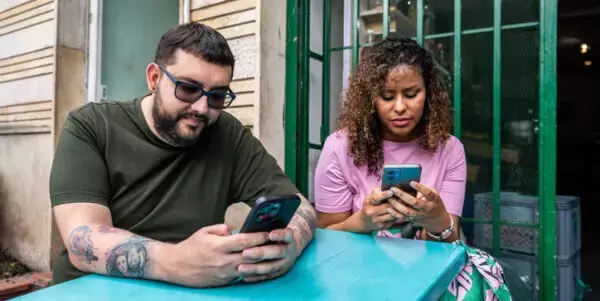
And over time, that steady diet of the exceptional recalibrates our baseline. What used to be a leisurely conversation with a companion now competes with the allure of doomscrolling through hundreds of posts, videos, and articles. Result? We’ve lost the ability to be fully present. That good friend—our patience for the mundane—slips away, replaced by an unquenchable thirst for the next dopamine hit. Meaningful relationships suffer as we half-listen, our eyes darting to screens to avoid being three seconds behind the latest trend or tidbit.
Nowhere is this loss more poignant than in the realm of humor. Remember your “Uncle Boots,” that affable war veteran whose tumbler of Diet Coke had a mysterious kick? Your mom’s genial older brother, whose corny puns and dad jokes could light up a family get-together? In the “Era of Endless Entertainment,” his quips no longer land. Why? Because we’re spoiled by access to every comedian in history on platforms like TikTok, YouTube, and Netflix. We’ve got legends like Norm MacDonald (rest his soul), whose deadpan observations and life stories redefined absurd wit; Bill Maher, whose razor-sharp political satire provokes engaging debate; and Aaron Sorkin scripts, further evidence that the invention of the rewind button may be the strongest argument yet for intelligent design.
These professionals, the Top 5% in their field, set impossibly high standards and maintain the status quo through the sheer volume of downloads, shares, and Likes. Your roommates’ playful ribbing about your butchered haircut can’t hold a candle to Norm’s surgical dismantling of a heckler, or Maher’s takedown of a politician spewing irreconcilable hypocrisies.
We’ve become connoisseurs of rigorously crafted, highly polished comedy. We demand studio-level refinement from a casual acquaintance during that serendipitous 7-floor elevator ride. “Uncle Boots’s” jokes don’t stand a chance anymore because they haven’t been engineered by a band of writers on a Comedy Central Roast. They’re too raw, too personal, too imperfect. In today’s landscape, if you’re not tapping into the rare genius of one of these icons, people will “change your channel” in search of something more gripping.
Our relationship currency is meted out in units of attention. And we don’t want to waste our “fun money” on amateurs.
Sadly, the exchange rate is deceptive. We think the value lies in the laughter when it’s actually in connection. When we diss a friend for their subpar humor, we signal that their “unrefined” self is insufficient—“Come back after you’ve focus-grouped your material.” And in the process, we’ve lost another good friend—our willingness to appreciate the ordinary, the organic, the homegrown. Instead, we chase after the extraordinary like Elon Musk chases multi-planetary contingencies.
Perhaps the greatest tragedy in all of this is that the wound is self-inflicted.
We’re not victims anymore. We’re converts.
The promises made by technology evangelists didn’t bring us closer together, after all. But we are not helpless. Our destinies aren’t sealed. We can still shake off our premature mourning and revive this good friend. We can start by setting boundaries.
When in the company of other carbon-based lifeforms (myself included), we can act as if they are there and we are present. Using our own standards, we can create “safe spaces” where scrolling will just have to wait. Where we can focus on “them,” for a change.
We can dig through our phones and enable those hard-to-find features we demand from the developers but rarely implement. The ones that manage interruptions during times when we need to focus on the people in front of us—dinner, playgrounds, church, or ballgames whose TV feed is delayed by 7 seconds. “I need to know who scored in real-time!”
We need to encourage others to bring their offerings not because they’re brilliant by global standards, but because they’re theirs. We can pause Whitney Houston’s rendition of “The National Anthem” while our niece sings for us at the family piano. We can stop comparing them to the ever-shifting All-Time Top-10 lists and instead use that energy to discern their precious invitations to include us in their lives.
Why do we really display refrigerator art?
In the end, the loss of this good friend reminds us of a lynchpin of human connection: the space between the noise. The space where that flesh-and-blood buddy shows up, in person, to share your burdens, your problems, your joys. If we can find the will to curtail the digital deluge, we might just rediscover those simple pleasures that make life fulfilling.
But, hey, if your uncle was Norm MacDonald, this is probably falling on deaf eyes. The rest of us? We’ll have to lower the bar… so our friends don’t trip over it.
Previously Published on substack
iStock image

