


For eight of the last 10 weeks, I have run 100 miles a week, running about 15 to 16 hours and climbing a couple of thousand feet every week in elevation. I have done this while working full-time as a lawyer at a big law firm while commuting three and a half to three hours on days I go into the office, which is a big feat in itself. However, I have benefited from a much slower period at work than I had earlier in the year.
In March, I ran a 2:34 marathon after averaging 80 miles a week for a while. I was proud of the way I ran the race — my pace was strong until around mile 20, where I fell apart for a few miles, before recovering. This meant it could have been much worse and I salvaged the day with a personal record, which was great.
But I knew I could do better and wanted to do better, so I knew I had to level up my training to run faster. Most of the very serious marathoners I know and professional marathoners run 100 miles a week or well over 100 miles a week, and I knew this would be hard but not impossible for me, given my baseline of 80 miles a week from before.
Since I follow the Arthur Lydiard model, a training method that requires very high mileage and then more specific periodization for hills and speed when you get closer to the miles, it made sense that to get better, I needed to run more miles and level up my aerobic base.
And so I wanted to dream and take the next step. I could not guarantee that I would hit a goal of running a 2:20-something marathon, but I was going to follow a process to do so and work hard and be consistent. I won’t know until late in the fall if I run 2:25, but I have accomplished this process-related goal, which has done big wonders for my confidence and breaking mental hurdles.
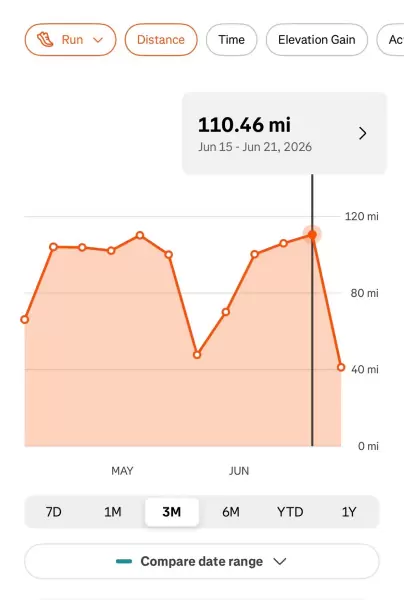
Screenshot from the author on Strava
I had two down weeks. There was one week I had to run only 47 miles — I got my wisdom teeth taken out mid-week. I took my oral surgeon’s advice not to run for about five days. The next week, I ran 70 miles a week.
I wouldn’t recommend it to other people — I don’t think new marathoners need to run 100 miles a week consistently. But balancing the miles with my job and day-to-day life has been an additional challenge, so I wanted to talk about what it looks like.
. . .
During the first two weeks of 100 miles a week, and I was very tired. I struggled to keep up energy during the day and I would often feel sluggish on runs. I think it would take three weeks before I was fully used to it, given that it was more miles than I had done before. But I fortunately was in a slow period at work after several months of being very busy, so I had more time to run.
Running 100 or more miles a week means I have to run twice a day at least three times a week. It is theoretically possible to run 100 miles in only single runs, but this would mean averaging around a little over 14 miles every run. With running twice a day a couple of times a week, I can spread this out to an average of 9 or 10 miles. Not only is this a bit mentally easier, but the injury risk goes down since some runs can legitimately just be short recovery runs, while others are longer efforts.
But it’s a lot easier said than done to fit two runs in my day, given my schedule as a lawyer. If I can fit the run around lunch, I do, or I might run once in the morning and then run again later in the evening. If I can take a nap after 5 p.m. to have energy for a later run, I do. I have the type of job that is flexible enough to be able to step out for runs, so it’s not like I have to be glued to my desk for 10 hours a day, but if I do get pinged to do something urgent, I have to get to it.
On busier days, I might have to skip the run as a whole or do the run on the treadmill so I can step back to my desk to work on something within five minutes. I also tack on miles by running to get to the store when possible — I will often run to the mechanic rather than take an Uber if I need to pick up my car. If I have a light grocery store run, I will now try to run to the grocery store, too, and carry the groceries back (if possible).
On the weekends, I can catch up substantially on miles. There are no longer the stressors of a long workday, long commute, and the mental drain of looking at a computer screen for eight or nine hours a day. I always do my long runs on the weekend for this reason. This long run is usually anywhere from 20–24 miles. I did not get here overnight — in college, running 15 or 16 miles was a really big deal. But as I got more developed in my marathon training, it did become a bit more normal over several years.
I don’t recommend it, but there are plenty of weeks I have run not much from Monday to Friday and then turned around with a 40 mile weekend. I can nap and sleep to recover, but a long run plus a double of 12 miles in the morning then 6 miles in the evening the next day does the trick.
Beyond the logistics of getting runs in, they can be pretty time-consuming and energy-demanding. I need to sleep well and make sure to hydrate, especially in the summer, and bring gels if I need to fuel in the middle of the run.
If I’m running for a really long time, like 90 minutes to three hours, then it can also get kind of boring. I need to find ways to pass the time. I usually listen to podcasts I’ve been meaning to catch up on — sports, legal, and politics podcasts. If I’m on the treadmill, I’ll watch a TV show. I try to break up the run into 10–20 minute segments to switch up the mental stimulus.
However, if I’m running any faster than 6:30 mile pace, I need significantly more stimulation. I need to put on music and put on more intense songs to get going, as listening to podcasts while running paces like 5:45 per mile just doesn’t go together, so it takes some creativity to get through some runs.
Because of my schedule and a long commute to the office, during the week, it is very hard for me to find people to run with. I do run with some colleagues, but it is one run of the week out of what is (sometimes) almost a dozen. Running with people makes passing the time a lot easier because we can talk about whatever is on our minds, which I try to do on the weekend. But now that I am mostly solo, yeah, it can be pretty mentally tough to get through some runs.
It’s especially tough when there’s both mental and physical fatigue. The first two weeks, I was just tired all the time. Not only was I running 100 easy miles a week, but I usually mixed in a long run with several miles at my goal marathon pace and a longer, aerobic workout in the middle of the week. This would leave some easy runs where I was just destroyed and 9 minute miles were hard to hit.
I don’t know how I got through 10-mile runs when I was feeling this bad other than knowing it would get better throughout the run. The first mile was almost always the worst as my body warmed up, and it normally would not be indicative of how the rest of the run would feel. Sometimes, this was the first three miles. Sometimes, I just never felt good on a run. That was okay, and it would usually mean I would need to cut this run short a bit.
This, I’ve learned, is pretty common when running high mileage. It’s especially common with summer, mid-Atlantic heat and humidity, as there have been days I have run 10 miles or so in 90 degree Fahrenheit and humid weather, but I know the difficulty of the runs now will pay off in the fall.
I learned that doing the volume is one thing. But volume plus intensity are another. Some of the workouts I tried to do early on were too hard, too fast. I’m not training for a mile, 5k, or 10k, so I needed to do longer efforts at marathon pace. And if the workout was just way too hard on the day and I didn’t have it in me? I just scrapped the workout. This would have freaked me out and I would have thought I just lost my fitness. But now, I just know it’s par for the course, and as a marathoner, 100 easy miles a week with a quality long run is better than crushing mile repeats at a fast pace.
In running, adown week is a week where you run less miles and do less intense workouts than usual. These down weeks have become very, very necessary for my recovery and for fitness weeks to kick in. This summer, I plan to take a down week every three to four weeks. This down week is still around 85 miles, but it would mean climbing my miles from 100 to 105 to 110, then coming back down to 85.
. . .
Consistently running 100 miles a week was daunting at first, but now it’s just part of my consistent routine, and the novelty has worn off. This process-oriented goal has made me a lot more confident, not only in running, but other parts of life.
I could not only handle running 100 miles a week. I could do it while working a full-time, mostly very busy job. I did it with a very long commute. I have proved to myself I can manage my time well and not compromise on my goals. I learned to not put aside my dreams just because “I don’t have time” because, sometimes, there is a way to make time if something is enough of a priority.
On my down week of now running only 85 miles this week, and it is a much-needed break — I feel like I am barely running at all. This has given me a lot of energy in other areas of my life, like spending time with my wife, socializing, and working. The fact 85 miles feels like it’s a rest week would have sounded crazy to me a couple years ago, but now I’m happy that I’ve leveled up.
It’s one thing to do the work. It’s another thing to believe. I am doing the work to run a huge personal best and run a 2:25 marathon. But do I really believe I can? I don’t really know. I’m someone who has to see to believe, who needs concrete evidence — especially as a runner. I think being overconfident is a way of jinxing myself. Ambition in outcomes is great, but in running, it often leads to trouble during a race. It can lead to going out too fast, not coordinating with the conditions of the day, especially the heat and humidity.
So I’ll swing, but I’ll try to do it strategically, and it might be a hit and it might be a miss. But no matter what, I’ll be proud of the process I took to get there.
—
This post was previously published on The Partnered Pen.
***
You may also like these posts on The Good Men Project:
 White Fragility: Talking to White People About Racism |
 Escape the “Act Like a Man” Box |
 The Lack of Gentle Platonic Touch in Men’s Lives is a Killer |
 |

If you believe in the work we are doing here at The Good Men Project, please join us as a Premium Member today.
All Premium Members get to view The Good Men Project with NO ADS.
Need more info? A complete list of benefits is here.
Photo credit: iStock

