


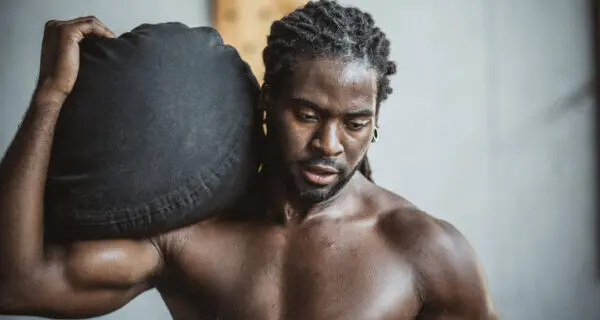
There is an expectation that comes with being a man.
We are expected to exude strength. We don’t show vulnerability. We don’t break. We carry the weight, and somehow, we’re supposed to make carrying it look easy.
As a Black man, I have also experienced another layer of that expectation. In many of the messages about masculinity that surrounded me, emotional expression wasn’t always encouraged. Strength often meant enduring, providing and continuing forward. Somewhere along the way, many of us learned to associate strength with being almost emotionless.
I think about something as simple as a little boy falling down.
He falls. He hurts himself. Naturally, he begins to cry.
Then the male figure in his life looks at him and says:
“Get up. Man up.”
But I’ve often wondered: What does “man up” actually mean?
Too often, the message underneath those words is that being a man means I shouldn’t cry. Pain shouldn’t hurt. Fear shouldn’t frighten me. And when life becomes overwhelming, I’m supposed to swallow whatever I’m feeling, get back on my feet, and keep moving as though nothing happened.
If that’s what we teach boys about manhood, we shouldn’t be surprised when some of those boys become men who don’t know how to tell us they’re hurting.
The Men Who Taught Us to Be Men
I think about the lack of “I love yous” that existed for many men of previous generations.
I don’t say that to place blame.
My father’s generation often didn’t receive those words from their fathers either. Their fathers may not have received them from theirs.
For generations, many men were taught that their responsibility was fairly straightforward:
Work. Provide. Protect.
Get up every morning. Go to work. Put food on the table. Keep a roof over your family’s head. Take care of your responsibilities.
And there is honor in that.
But there is something missing.
In that definition of manhood, we rarely teach a man how to say, “I’m hurting.” “I’m afraid.” “I need help.”
We teach him how to provide love through what he does, but not necessarily how to receive love when he is the one who needs care.
A man can spend his entire life learning how to carry everyone else and never learn what to do when the weight becomes too heavy for him.
When Strength Becomes a Prison
There is a point when strength can become its own kind of prison.
People become accustomed to seeing you carry things.
You solve problems. You lead. You provide. You protect. You make decisions. You show up.
Eventually, everyone assumes you can carry whatever is placed on your shoulders.
Sometimes you begin believing it too.
So you carry one thing.
Then another.
And another.
Until one day, the weight becomes overwhelming.
But because vulnerability was never included in your definition of strength, you don’t know what to do with that feeling. You don’t know how to say:
“This is too heavy.”
That’s where I believe we have to begin redefining strength.
Vulnerability is not the opposite of strength.
Vulnerability requires strength.
It takes strength for a man to admit that something hurts. It takes strength to cry. It takes strength to say, “I don’t know.” It takes strength to ask for help.
And it takes tremendous strength to allow another person to see the parts of you that aren’t completely put together.
Find People Who Can Help Carry the Weight
But there is another part of this conversation that I have learned for myself.
It isn’t enough to become comfortable with vulnerability.
We also have to become discerning about where we place it.
Not everyone deserves access to the vulnerable parts of us.
We need people around us who create safe spaces for our humanity—people who can recognize when something is overwhelming us and, rather than judging us for struggling beneath the weight, are willing to help us carry it.
I’ve often said that when it comes to a potential partner for my life, he has to be able to carry the weight of who I am.
I’ve reached a place where I will no longer make excuses or provisions for who I am.
I am who God called me to be.
My life has weight.
My purpose has weight.
My responsibilities have weight.
The public-facing nature of my work has weight.
And whoever chooses to walk beside me has to possess enough security within himself not to be intimidated by that weight.
That doesn’t mean I expect another person to carry my life for me.
It means I expect partnership.
There is a difference.
I know how to carry things. I’ve spent much of my life doing exactly that.
What I no longer desire is a relationship in which I have to carry myself and make myself smaller so the person beside me can feel bigger.
Maybe “Man Up” Needs a New Definition
Maybe we’ve been defining “man up” incorrectly.
Perhaps manning up isn’t wiping the tears away before anyone sees them. It isn’t pretending something doesn’t hurt. It isn’t carrying everything alone.
Sometimes, manning up may mean having enough courage to say:
I am tired.
I am hurting.
I need help.
I love you.
I need you.
Those words don’t diminish manhood.
They expand it.
And one of the greatest things we can do for the next generation of boys is allow them to discover that before they become grown men trying to unlearn everything we taught them.
So the next time that little boy falls down, perhaps we don’t immediately tell him to stop crying.
Perhaps we let him cry.
We ask him where it hurts.
We help him back onto his feet.
And then we teach him something very different about being a man:
You can be strong and still feel.
Being a man was never supposed to mean being emotionless.
And strength was never supposed to mean carrying everything alone.
—
iStock image

