


—
It was 1972, I was 14, my sister 12. My parents’ marriage was quite shaky (they would separate a few months later) and my mother was looking for a way to bring all of us together. Perhaps a much-needed summer family vacation would do the trick. As the school year was nearing its end, Mom read about a two-day white water rafting trip designed for families. Two days of riding the rapids on the majestic Snake River in Idaho, through some of the most beautiful canyons in the west. One night camping out along the shore of the Snake.
Two weeks before we were to embark on the road trip to land us at the rafting entrance, my mother announced that she had found a family movie about white-water boating and we were all going this upcoming Saturday. It was playing at the nearby Drive-In on Sepulveda Boulevard in Culver City.
A few days later, as the sun was setting in SoCal pinks and oranges, we all piled into my father’s white Oldsmobile Cutlass Supreme and headed east to the auto theater near the legendary MGM lot. As darkness enveloped the giant field of asphalt that fanned out in front of the massive screen, my sister and I huddled together in the back seat. My dad was manning the beige painted metal speaker, wedging it into a crack in the driver’s side window, my mom relaxing her lanky frame into the passenger seat to the right. The giant white screen lit up and the film began to roll, the credits splashing across our windshield. Although already a bit of a film nerd, the stars of this film, Jon Voight, Ned Beatty, and Burt Reynolds were foreign to me. We watched as four friends went bounding down a dirt road in the backwoods of the Appalachians, banjo music playing on the soundtrack.
If you haven’t caught on by now, the film we were watching together as a family was (the now iconic) DELIVERANCE. My 12-year-old sister and I were clueless to the subtext happening on screen, as we were transfixed by the dangerous white-water sequences in canoes. It wasn’t until the (now) oft-repeated line “You have a purty mouth” that my younger sibling and I began to realize that something was very wrong. My father began to squirm uncomfortably in his seat, frequently darting furtive glances back at the audience behind him. My mother slid down the vinyl upholstered front and hid in the space below the dashboard. My sister and I exchanged WTF glances to each other as the scene before us continued through the moment Ned Beatty’s character was sodomized. We were clueless as to what was happening, but that didn’t prevent our parents from hyperventilating and trying to cover our eyes.
And thus, was my very memorable introduction to one of the great screen stars of the next several decades. Burt Reynolds.
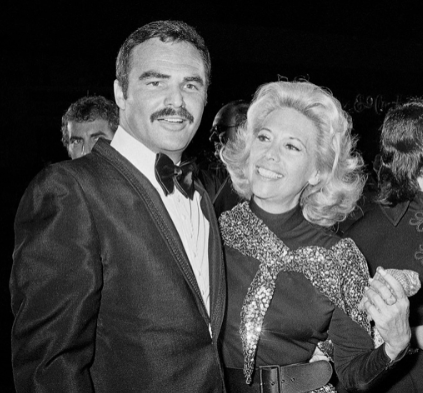

And OH, did we love his movies. From his explosive crossbow-wielding star-making role in DELIVERANCE to the underrated MAN WHO LOVED CAT DANCING to SMOKEY & THE BANDIT, BEST LITTLE WHOREHOUSE IN TEXAS, SHARKEY’S MACHINE and SEMI-TOUGH, Burt never let you down. Whether action or comedy or drama, you always got the sly smile and that charming glance that seemed like a wink, while his eyelids never moved.
For me, Burt’s film that is my favorite and in my personal top five of best sports movies ever made, is THE LONGEST YARD (the 1974 original, of course.) It’s a near-perfect script, with a flawed antihero, spectacular villains (played impeccably by Eddie Albert and Ed Lauter) and great plot twists. And, if that wasn’t enough, it’s about football. I learned so much about character development, plot creation and the language of storytelling on film, by watching this film (over and over and over.) I worshipped Paul Crewe and THE MEAN MACHINE. Nearly a quarter of a decade later, as a prolific film producer myself, I was blessed to have the opportunity to work with Ed Lauter on a Western in Spain. He regaled me with endless stories about working with Burt and Eddie Albert in the prison action comedy.
While never listed among that decade’s best films and not even among Burt’s best – THE LONGEST YARD is a gem. We shouldn’t be surprised; the pedigree was pretty impressive. The story was from the Producer of THE GODFATHER, the screenplay from the typewriter that would later author THE DEEP and THE DROWNING POOL, and the director was legendary Robert Aldrich (THE DIRTY DOZEN and WHATEVER HAPPENED TO BABY JANE.)
Burt was the best friend we all wanted — he was a Bro before there were bros. You only need watch him on his frequent guest appearances with Johnny Carson on The Tonight Show to see it. They seemed like great pals, who genuinely enjoyed ribbing each other and laughing. You could imagine them out drinking and carousing together in the Hollywood hot spots. I was in high school during their most memorable shows together. My parents were divorced by now and my mom would get into bed early, allowing me to quietly sneak into the den and turn on channel four, at 11:30, as that recognizable theme would introduce the greatest late-night show in television history. I do recall one particularly memorable moment between the two buddies.
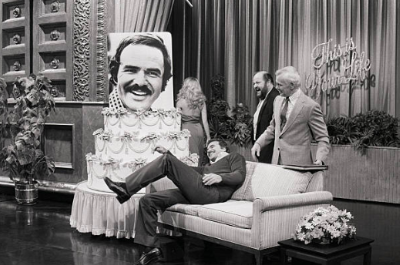
Johnny asked, “Ok, Burt, we’re friends and I need to pose the question everyone keeps asking…. ‘Is that hair yours?’
Burt replied while running his hand across the top of his head: “Of course it’s MINE. I paid for it. It’s MINE.”
Very early in my career, while running the Guber-Peters Television Company, I got the amazing news that the first project I ever conceived of and sold was being put into production at NBC. The film, BAY COVEN, starring Tim Matheson and Pamela Sue Martin, is likely only remembered as having given Woody Harrelson his first movie acting role (while he was still on CHEERS.) The production was based in Toronto and I earned my first location trip to supervise the filming. At that time, in the mid-eighties in Toronto, there was only one hotel where all of Hollywood would hang its hat: The Sutton Place Hotel downtown. When you’d checked in, it felt more like a swanky spot located on the Universal backlot, than on a nondescript street in a town in Ontario. Back then, throw a rock in the lobby (which is certainly frowned upon in Canada) and you’d hit a Hollywood star for sure.
One night, on a weekend during filming, I had made plans to take a few of the actors out for a meal. While awaiting Pamela Sue in the lobby, next to the elevators, I watched the doors to the lift nearest to me open. Striding right towards me were three stunning cinema celebrities, Margot Kidder (the star of SUPERMAN,) Tom Selleck (the biggest TV star in the universe as MAGNUM PI) and the inimitable Burt Reynolds. As the trio brushed by me, I forgot to breathe. That kind of star power was rarely seen together, and certainly not expected to be exiting a fluorescent-lit elevator car in the lobby of a hotel in the town of the Maple Leafs.
Those were stars. MEGASTARS.
At a time when there were but a choice few untouchable, giant movie and television stars, there were but seven studios and three networks, so the number of actors becoming stars or having the opportunity, was so much smaller than it is now. That evening, as it happened, Margot, Tom, and Burt ended up at the same small Italian restaurant as Pamela Sue, Susan Ruttan (also starring in my NBC thriller) and me. Every head turned as they entered together, the customers hanging on their every move. This is what it must have been like when you’d breeze into the BROWN DERBY in Hollywood and saw Clark Gable, Marilyn Monroe, and Cary Grant dining together.
When their (far) more famous trio exited our little, dimly lit, trattoria, a woman wrestled up the nerve to stop them before they reached the door. “Would you mind taking a picture with me?” came the squeaky, timid request from the middle-aged Torontonian. Tom, Burt and Margot were gracious and stopped. The woman handed her Kodak Instamatic to her husband. (While this is a mundane, all-too-common ‘selfie’ moment now, this rarely happened in 1986.). The husband took a shot, but no flash. He tried again. No flash. The woman began to panic. She fiddled with the camera while Lois Lane, Magnum and Smokey waited patiently.
Two more attempts. Nope. Nothing but darkness. With tears in her eyes, she watched the three stars disappear into the night. Moments later the woman threw her camera against the wall. I could hear her lament to her husband, while he was attempting to comfort her; “Nobody will ever believe me. Nobody…”
I’m not sure they make stars like that anymore. I’m not sure in the age of the internet, camera phones, and TMZ, that Hollywood can really create that kind of star, whose life and stardom is still a bit of a mystery — and seeing them in person (not up on the silver screen) stops you in your tracks. Not certain anyone would hurl their iPhone against a wall if their battery died while trying to take a selfie with Robert Downey or The Rock.
Burt Reynolds seemed tough, but not in a brutish, thug like way. He seemed like the kind of guy that would have your back in a bar fight, but wouldn’t have started it. Burt was that friend that would use humor to defuse a rough situation but was ready to throw down, if that’s what was required. That wisecracking, self-assured, man’s man persona was like nothing we had really seen before. Burt’s giant screen presence and career burst open the door for so many performers to follow. Without SMOKEY, HOOPER or JJ McCLURE (“Cannonball Run”) there would had never been Bruce Willis, Arnold, The Marvel Superheroes or Vin Diesel.
One of those memorable cracking-wise heroes was Sonny Hooper, in the aforementioned film with the surname title. Hooper was Smokey, if he had been a Hollywood stuntman. It was part of a wonderful trio of collaborations between Burt and legendary stuntman (and coordinator) turned director, Hal Needham. HOOPER was written by another Hollywood legend, Tom Rickman, who penned COAL MINER’S DAUGHTER and WW & THE DIXIE DANCEKINGS (which also starred Reynolds.)

I was lucky to call Tom Rickman a colleague and friend. I so admired his work, like the award-winning telefilm TRUMAN and his adaptation of my college roommate, Mitch Albom’s iconic book TUESDAYS WITH MORRIE. I was in awe. The first time we met at AFI, where we had both been students, and now found ourselves as faculty members, I was almost too nervous to speak. Our mutual pal, Bob Mandel introduced us and I found myself unable to muster up an intelligible greeting. Tom was gracious and nodded and listened as Bob spoke for me.
The next time we met was under very different conditions. Our beloved American Film Institute was in turmoil. Around 35 members of the faculty, most notably Tom and former Dean Mandel, had come together to speak as one against the direction of the school under the new Dean (that had replaced Mandel.) I was one of the 35. The entire faculty was divided and angry. Friends were now enemies and faculty meetings were tense and often fraught with vicious in-fighting. Whenever the 35 of us would meet alone, once in my living room, Tom was always the voice of reason. He was our Yoda. Already diagnosed with cancer, he would sit quietly to the side, until we needed his wisdom.
We all revered Tom. Not just for his extraordinary talents as a writer and teacher/mentor, but for his calm, thoughtful, resolute persona. With a wry smile and a biting wit, we knew when he spoke, we better give heed. He taught us to listen, to appreciate the other side and to think like them. What were their concerns and how should we address them in our complaint? At a time when our country is so terribly tribal, when you’re either with us or against us, Tom Rickman was looking for truth and for what was right. It didn’t matter your team or colors, there was a true-north morality to the driving instructions of life — and he was there to teach it to us.
During this difficult time for the historic three letter film school up on the hill bordering Los Feliz, at one particularly contentious faculty meeting, it now seemed clear that it was going to have to be either the Dean leaving or many of us would depart. That afternoon, in the library, one faculty member, who was supporting the Dean, decided to turn on Tom. Big mistake. He insulted Tom’s character and the room turned on him instantly. Every hand of the thirty-five shot up. Pick on us if you will — but don’t you DARE impugn the integrity of the finest man we knew. That faculty member, whose talent was a paper airplane in comparison to Tom’s Space Shuttle, never recovered. He’s no longer at AFI.
I don’t see another Tom Rickman coming along all too soon either. Rare is the man whose integrity transcends their ambition; especially in this Hollywood.
There aren’t the opportunities, anymore, to craft a career just writing films like COAL MINER’S DAUGHTER or TUESDAYS WITH MORRIE. Television movies are far fewer and rarely tackle tough issues — while features are nearly always confined to sequels, comics, and remakes.
We lost two giants of our industry recently. On Monday, September 3, Thomas Rickman left us. Three days later on September 6, he was followed to the heavens by Burton Leon Reynolds. The former I knew, called a friend and will miss terribly. The latter I admired and watched and loved.
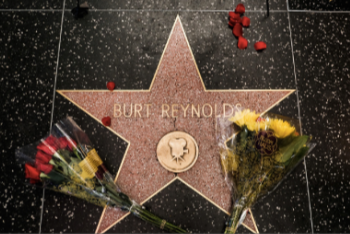
And we shan’t see men like either of them anytime soon.
Somewhere in heaven Tom and Burt are discussing HOOPER and reminiscing. Lucky is the gal or guy that happens upon them…
—

Photos:
Getty Images (top) – Burt & Dinah/AP-Harry Filan – Burt & Sally/ AP-Rene Perez
Burt & Johnny/Getty Images – Tom Rickman/Getty Images – Burt Star/Getty Images

