



—
Working at home is one thing. Working well at home is another. For a lot of people, the kitchen table or the spare bedroom eventually stops being enough. Noise, interruptions, and the inability to properly switch off at the end of the day all push in the same direction: the office needs to leave the house.
The good news is there are more ways to do that than most people realise, at a wider range of budgets and build timescales than the glossy garden-office catalogues suggest. Some take a weekend. Some take a few months. All of them solve the same underlying problem.
The options below run roughly from simplest to most permanent. They cover different budgets, different garden sizes, and different levels of daily comfort, so the right choice depends on how seriously you need the space to work, not just how good it looks in a photo.
What makes a good outdoor home office?
Before picking a format, it is worth being clear about what the space actually needs to do. A few things separate an outdoor office that works every day from one that is only comfortable in summer:
| Essentials for year-round outdoor office use
• Insulation: the single most important factor for daily comfort in UK weather • Natural light: affects mood, energy, and how long you can focus • Power and internet: a fast, reliable connection is not optional for most work • Heating: an unheated space becomes unusable from October to April • Privacy from the house: the whole point is separation, so plan the sightlines • Enough space for a proper desk, chair, and at least some storage |
The options that disappoint people most often are the ones that looked fine in photos but were not designed around those six things. Keep them in mind as you read through the list.
9 practical ways to build a home office outside the house
| 1. Convert an existing garden shed Don’t like ads? Become a supporter and enjoy The Good Men Project ad free A shed conversion works best when the existing structure is solid enough to insulate properly. A thin-walled plastic shed rarely is. If you already have a garden shed with decent timber walls and a sound roof, converting it is the fastest and cheapest route to an outdoor workspace. The starting point is already there. What it usually needs is insulation in the walls, floor, and ceiling, a power supply run from the house, better windows, and some basic interior fit-out. Done properly, a shed conversion can be genuinely comfortable for light daily use. Done on the cheap, it will be cold in winter and stuffy in summer. The quality of the insulation makes the difference, and it is worth spending here even if you cut costs elsewhere. Best for: people who already have a usable shed and want a low-cost first step into outdoor working. Worth knowing: Thin-walled sheds are hard to insulate effectively. If the structure is lightweight, a purpose-built option will often give better results for less eventual spend. |
| 2. Build a dedicated timber garden office
A purpose-built timber office is still the most popular choice for UK home workers because it fits naturally into most garden settings. A timber garden office built specifically for work is a step up from shed conversion in every practical respect. The floor plan can be designed around your actual needs, the insulation goes in from the start rather than being retrofitted, and the glazing can be positioned for the light you want rather than wherever the window happened to be. This is the mainstream solution for a reason. Timber builds sit well in residential gardens, planning requirements are manageable for most single-storey structures under a certain size, and the finish can be as simple or as polished as the budget allows. Most builders or specialist garden-office companies can deliver one within a few weeks once the groundwork is done. Best for: people who want a proper dedicated workspace and have a garden that suits a traditional timber building. Worth knowing: Lead times for good builders can stretch to several months, especially in spring and summer. Factor that in if you need the space by a specific date. |
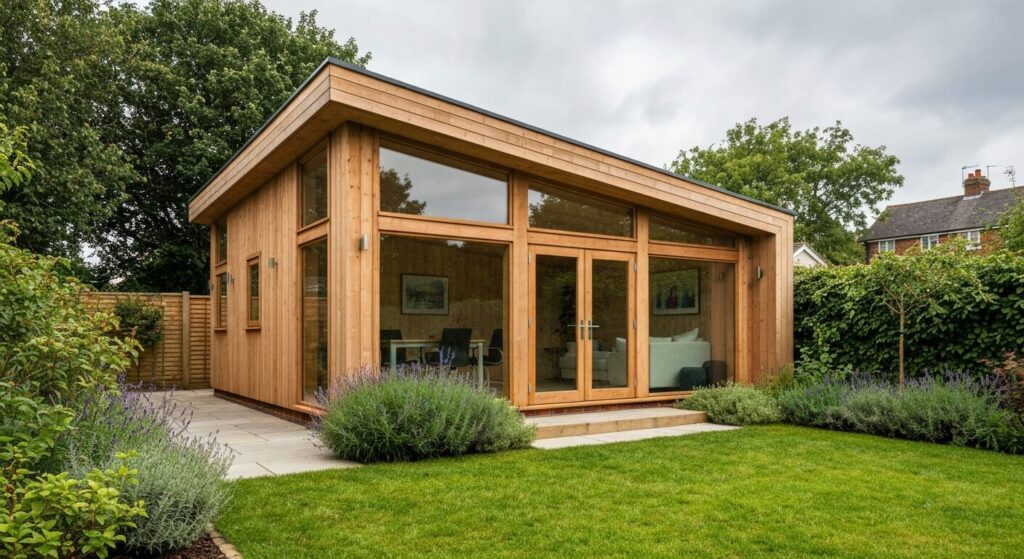
| 3. Install a prefabricated garden office pod
Pods arrive largely complete and can be placed and connected up in a day or two, which suits buyers who need the space quickly. Prefabricated garden office pods are factory-built structures that arrive ready to place, usually on a simple concrete pad or adjustable feet. Installation is typically measured in days rather than weeks, and because everything is built offsite, the quality tends to be consistent and predictable. The trade-off is less flexibility. You are choosing from a set of standard sizes and configurations rather than designing something bespoke. For most home workers who need a clean, well-insulated, well-lit space, that is not a real problem. The pods that sell well are designed around real office use, and the better ones are genuinely comfortable year-round. Best for: people who want a fast, polished result without managing a build programme. Worth knowing: Standard pod sizes may not suit every garden layout. Measure carefully and check delivery access before committing. |
| 4. Create a shipping container office
A container office combines the durability of a steel structure with the flexibility to insulate, fit out, and finish it however the project requires. A shipping container makes a genuinely good starting point for an outdoor office. The steel shell is weatherproof, structurally robust, and harder to break into than most garden buildings. Cut in the windows, insulate the walls and ceiling, run electrics through the frame, and add a proper interior fit-out, and the result is a secure, functional workspace that will last decades. Container offices work particularly well where security matters, where the site is exposed, or where the buyer wants a more industrial or contemporary aesthetic than timber allows. The modular format also means two containers can be joined if more space is needed later. For a practical example of what a finished container office can include, a Universal Containers shipping container office shows how insulation, electrics, and interior fit-out come together in a purpose-built outdoor workspace. Best for: people who want durability, security, and a more distinctive design, or who may want to expand the space in future. Worth knowing: The steel shell conducts heat and cold, so insulation quality is critical. A poorly insulated container office will be uncomfortable. Invest in it properly. |

| 5. Adapt a garage or detached outbuilding
An existing detached structure gives you a solid shell to work with, which can make the conversion faster and cheaper than building from scratch. If you have a detached garage or brick outbuilding that is not earning its space, converting it into an office is often more practical than it first looks. The footprint and structure already exist, the roof is already weatherproof, and the floor is usually solid. The main work is typically insulation, new or upgraded windows, interior finishing, and a power supply. The result can be a more substantial and weather-resistant workspace than a timber garden office, and the brick or blockwork walls are often easier to insulate to a high standard than thinner timber panels. Security tends to be better too. Best for: people who already have a solid outbuilding and want a conversion rather than a new build. Worth knowing: Older garages sometimes have damp issues, poor drainage, or structural problems worth assessing before investing in a full interior fit-out. |

| 6. Use a mobile office on wheels
The mobility is genuine, but in practice most people place a mobile office and leave it in one spot. The real advantage is not needing permanent foundations. Mobile garden offices are compact structures built on a trailer base. They do not need concrete foundations, which makes siting and planning simpler in many cases, and they can technically be relocated if circumstances change. Some owners tow them between properties; most simply place them once and use them daily like any other garden office. The interiors tend to be compact and efficient by necessity, with built-in desks and smart storage to make the most of the limited footprint. For a secondary workspace, a writing room, or a focused single-person office, they work well. They are less suited to anyone who needs a lot of screen space, video call setup, or the ability to pace around. Don’t like ads? Become a supporter and enjoy The Good Men Project ad free Best for: people who want flexibility, minimal groundwork, and a simpler planning position. Worth knowing: The smaller footprint of most mobile offices can feel cramped for full-day use. Spend time inside one before buying if you can. |

| 7. Build a hybrid office and studio space
A multi-use space is harder to design well than a single-function one. Be clear about which function takes priority before starting. Not every outdoor space justifies a single function. If the garden footprint is limited or the budget needs to stretch further, a room that is an office by day and a creative or hobby space in the evenings can make the investment work harder. The practical approach is to design for the primary use first and plan the secondary one around it. A desk and monitor setup on one side, a worktable or shelving on the other, with storage that keeps the two activities separate. The space works because the two uses share the same requirements: good lighting, power, insulation, and acoustic separation from the house. Best for: designers, makers, writers, and side-business owners who need a workspace that earns its footprint across multiple uses. Worth knowing: Multi-use spaces can feel like neither thing done properly if the design is not thought through. Avoid compromising the primary use to accommodate the secondary one. |

| 8. Create a compact office for a small garden
Small does not mean uncomfortable, but it does mean that storage, lighting, and desk layout all need more thought than in a larger space. Small urban gardens rule out nothing. A compact office with a narrow footprint, full-height glazing, and well-planned built-in storage can be genuinely comfortable for daily use despite its size. The key is designing around what you actually need rather than trying to scale down a bigger brief. In practice, that usually means one well-positioned desk along the longest wall, overhead storage rather than freestanding furniture, and glass doors that borrow visual space from the garden. A small space with good natural light feels bigger than a larger one with no windows. Prioritise glazing over floor area when the two are in tension. Best for: urban home workers with limited garden space who want a proper outdoor office rather than a shed. Worth knowing: Very small structures may fall outside permitted development limits depending on height, footprint, and proximity to boundaries. Worth checking before ordering. |

| 9. Commission a fully fitted outdoor office
The upfront cost is higher, but a well-specified professional installation tends to hold its value and requires less maintenance than a budget build. At the top end of the spectrum, a fully fitted outdoor office is designed and installed as a complete professional workspace. That means a bespoke floor plan, high-performance insulation and glazing, integrated heating and ventilation, built-in furniture, and a finish that matches the quality of a properly fitted room in the main house. For someone working from home full-time, with client calls, video meetings, and long focused days, this level of investment makes sense. The space performs better, lasts longer, and avoids the incremental costs of upgrading a budget build over several years. It is also a meaningful addition to the property value in a way that a converted shed rarely is. Best for: full-time home workers who want their outdoor office to be as comfortable and professional as an office in a commercial building. Worth knowing: The design and build process takes time. Expect several months from brief to completion for a fully specified bespoke installation. |

How to choose the right option for your home
Think about how often you will use it
An occasional admin space and a full-time daily office have very different requirements. Occasional use can tolerate more compromise on insulation and comfort. Full-time use cannot. If the space will be your main working environment, treat it like one from the start.
Decide how permanent it should be
Temporary options like mobile offices or basic shed conversions suit people who are uncertain about future plans or want to test outdoor working before committing. Mid-term garden upgrades suit most home workers who expect to be in the same property for at least a few years. A fully fitted permanent installation suits anyone who knows the space will be central to their work for the long term.
Plan for comfort first, aesthetics second
The outdoor offices people regret are almost always the ones where the look was prioritised over the practicalities. A beautiful garden building that is cold from October to April, has poor Wi-Fi, and runs out of desk space within a month is not a good investment. Insulation, power, connectivity, and a proper heating source are not optional extras. They are the foundation of a workspace that actually works.
Common mistakes worth avoiding
- Underestimating insulation: the most common reason outdoor offices become seasonal rather than year-round
- Not planning internet before the build: routing a cable or planning a wireless solution is much easier before walls go up
- Choosing style over usable desk space: a beautiful but cramped office creates frustration within weeks
- Forgetting storage: without it, the desk fills up and the space stops feeling like an office
- Skipping the planning check: most single-storey garden offices fall within permitted development, but not all, especially near boundaries, in conservation areas, or on listed properties
Finding the right fit
There is no single best way to build a home office outside the house. A converted shed suits someone who needs a quick, low-cost start. A shipping container suits someone who wants durability and security. A fully fitted garden room suits someone who needs their outdoor office to perform like a professional workspace every day.
The right choice sits at the intersection of budget, garden size, how permanently you need the space, and how seriously it needs to work. Get those four things clear before comparing options, and the decision becomes considerably easier.
FAQs
What is the cheapest way to build a home office outside the house?
Converting an existing shed is typically the lowest-cost starting point, especially if the structure is already sound. The main costs are insulation, a power supply, and basic interior fitting. A more comfortable and durable result usually requires more investment, but a good shed conversion can work well for lighter daily use.
Are garden offices warm enough to use all year?
A well-insulated garden office with a proper heating source is comfortable year-round. An under-insulated or unheated space is not, and becomes effectively unusable from autumn to spring in the UK. Insulation quality is the single most important factor in year-round usability.
Can a shipping container make a good home office?
Yes, and it makes a particularly good one for people who prioritise durability, security, or a more industrial aesthetic. The steel shell needs proper insulation and ventilation to be comfortable, but a well-converted container office is robust, secure, and very long-lasting. It can also be expanded by joining a second unit if more space is needed later.
What is the best outdoor office option for a small garden?
A compact purpose-built garden office or a narrow prefabricated pod both work well in small urban gardens. The key is prioritising full-height glazing to borrow visual space from the garden, built-in storage to avoid freestanding furniture eating into floor space, and a desk layout that uses the longest wall efficiently.
Do you need planning permission for an office outside the house?
Most single-storey garden offices fall within permitted development rights and do not require planning permission, provided they meet certain size and height limits and are not in a conservation area or attached to a listed building. More permanent structures, container offices, and buildings close to boundaries may require a check with the local planning authority. It is always worth verifying before starting any build.
—

