


—
I didn’t expect to learn anything profound.
All I wanted was to get a batch of products from China to a U.S. warehouse—simple on paper, right?
Like many men running a side hustle, I made a spreadsheet, calculated my margins, compared suppliers, and booked a 40-foot container from China to the USA. That was the easy part.
What came next—the waiting, the uncertainty, the quiet anxiety—was the part I didn’t anticipate.
And, strangely, it’s what stayed with me the longest.
Because shipping a container, it turns out, isn’t just about logistics.
It’s about how you handle the parts of life you can’t control.
From Spreadsheet to Standstill: What Waiting for a Container Taught Me
When I launched my small business, I believed I was a planner.
I knew how many units fit into a container. I knew the weight limits, the cubic meters, the port codes. I’d calculated shipping from China to USA down to the cent. I thought I was ahead of the game.
But here’s the thing: you can’t spreadsheet uncertainty.
What I didn’t plan for was silence.
No updates for days. Then: “Your container’s been bumped to the next vessel.”
Then: “Customs delay at the Port of Los Angeles.”
Then: “Still pending clearance.”
Suddenly, I was in limbo—inventory frozen somewhere across the Pacific. That waiting period taught me more than any TED Talk on patience ever could. I learned to breathe, to recalibrate timelines, and to build buffers—not just in budgets, but in expectations.
Delays, Customs, and the Art of Not Panicking
It’s humbling to admit, but I panicked—quietly.
The longer the delay stretched, the more I questioned everything. Was the paperwork filed correctly? Did I choose the wrong forwarder? Should I have gone air freight?
But in that space, I learned how to ask better questions, how to pause before reacting, and how to communicate—not just with vendors, but with myself.
International shipping doesn’t reward panic. It rewards composure, clarity, and trust in the process.
If fatherhood, entrepreneurship, or marriage has taught me anything, it’s that we all hit “delays” eventually. How we handle them says more about our growth than any milestone ever could.
Why One Container Changed How I See the Global Economy
When you import goods by sea, you begin to understand how massive—and fragile—the system really is.
Your product isn’t just on a boat. It’s part of a choreography involving factories, ports, drivers, brokers, and weather patterns. Each link in the chain carries its own risk.
Suddenly, the phrase cost of shipping a 40ft container from China to USA isn’t just a line item—it’s a window into global labor, fuel pricing, trade relations, and, yes, patience.
It made me more mindful as a business owner. And more grateful as a consumer.
I Became More Patient—Because I Had No Choice
In a strange way, the logistics process taught me something emotional.
You can’t control the sea. Or the weather. Or port congestion. Or random customs inspections.
But you can control how you respond to uncertainty.
That’s not just a freight lesson—it’s a life lesson.
Waiting for that container taught me how to let go without giving up. How to prepare without panicking. And how to see uncertainty not as punishment, but as training.
As men, we’re not always given space to process things that don’t go to plan. This experience forced me to slow down, sit with the unknown, and practice patience.
And I’m better for it.
The Masculinity of Long-Term Thinking
There’s a part of us that wants to fix everything immediately.
Solve it. Move on. Prove we’ve got it under control.
But international shipping challenges that mindset. You’re forced to think in weeks, not hours. You have to build systems that accommodate delays, risk, and the human margin of error.
And I realized something important: long-term thinking is a masculine trait we don’t talk about enough.
Not the loud kind. The quiet kind. The kind that builds, waits, adapts.
Shipping taught me that growth isn’t always aggressive. Sometimes it’s slow, deliberate, and deeply resilient.
What I’d Do Differently—And What I’d Do Again
Looking back, there are things I’d absolutely repeat—and a few I’d do differently.
What I’d do again:
- Partner with a freight forwarder who offers clear communication and DDP options
- Ship full container loads (FCL) once the volume justifies it
- Build more buffer time into my business planning
- Track my container—but emotionally detach from the timeline
What I’d change:
- Start with fewer SKUs to simplify customs
- Triple-check documentation—one small code error can cost days
- Work proactively with a U.S. customs broker
- Learn about port terminal fees beforethe invoice arrives
The learning curve is steep, but so is the reward. I didn’t just grow my business—I grew as a man.
How the Right Partner Changed Everything Mid-Shipment
I’ll be honest—I didn’t pick the cheapest freight forwarder.
I picked the one who responded first, explained things clearly, and made me feel like I wasn’t just another number.

That company was Gorto Freight, and they delivered exactly what they promised.
When delays hit, they didn’t sugarcoat anything. When I had questions, they answered in plain language. When customs flagged something unexpectedly, they told me what to expect—and what not to worry about.
Their support didn’t just save money. It saved my sanity.
If you’re planning to import your first container—especially if you’re navigating the stress of building a business solo—start with someone you trust. I’d start with Gorto Freight.
Growth, Delays, and the Container I Didn’t Expect
The container I shipped wasn’t the only one that mattered.
The real container was the one in my own head—the one filled with assumptions, false urgency, and the illusion of control.
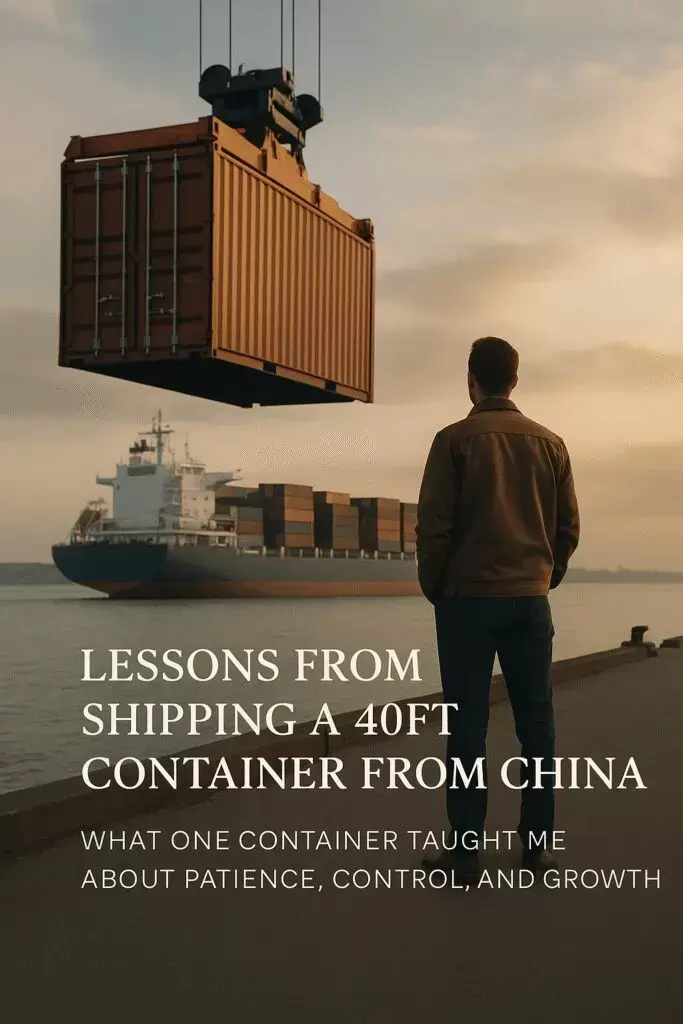
Like that 40-foot box drifting across the Pacific, I had to let it go.
I had to trust that it would arrive.
And when it did, I was more prepared than I thought.
If you’ve ever tried to build something, ship something, or grow something—then you know exactly what I mean.
Sometimes, life makes you wait.
But what shows up at the end?
Is often worth every ounce of patience.
—
This content is brought to you by Hyder Ali
Photos provided by the author.

