


A few years ago, “male self-improvement” online mostly meant optimization.
Morning routines. Cold plunges. Productivity hacks. Supplements. Financial independence before 40.
But something else has started happening in the background.
More men are traveling alone. Not for status, not for content, and not even necessarily for adventure, but because they’re trying to hear themselves think again.
Chile has unexpectedly become one of those places people disappear to for perspective.
Before heading there, many travelers now spend time researching the official entry requirements for Chile, especially as countries continue to modernize digital immigration systems and tighten documentation processes following the global tourism rebound.
But the paperwork is only part of the story.
What’s interesting is why so many men are choosing destinations like Patagonia, the Atacama Desert, or even remote parts of southern Chile in the first place.
Men Are Traveling Alone More Than Before
Solo travel is no longer dominated by gap-year backpackers.
According to recent travel industry research from American Express Travel, demand for solo travel continued to rise through 2025, with younger millennial and Gen Z men increasingly taking extended international trips centered on wellness, reflection, and life transitions.
And unlike the hyper-social hostel culture of the 2010s, many of these trips are intentionally quieter.
Less partying. More distance.
You see it in the growing popularity of:
- Remote hiking routes
- Long-distance cycling trips
- Wilderness lodges
- Meditation retreats
- Work-from-anywhere travel
- “Thinking trips” between careers or relationships
Chile fits this shift unusually well.
The country stretches across deserts, glaciers, volcanoes, forests, and coastline with a kind of geographical intensity that naturally forces people out of autopilot.
Modern Masculinity Has a Burnout Problem
There’s another layer to this trend that rarely gets discussed honestly: a lot of men are exhausted.
Not physically, but psychologically.
The pressure to constantly perform competence, confidence, ambition, emotional control, and financial stability has created a strange contradiction in modern masculinity: many men appear functional while privately feeling disconnected from themselves.
The World Health Organization has repeatedly identified burnout as a growing global health issue, and men are often less likely to seek traditional emotional support systems until stress becomes overwhelming.
For some, travel has become an alternative form of interruption. Not escape exactly; more like a temporary distance from routines that no longer make sense.
Why Chile Specifically Feels Different
There are countries people visit to consume experiences.
Chile often feels like a place people visit to confront themselves.
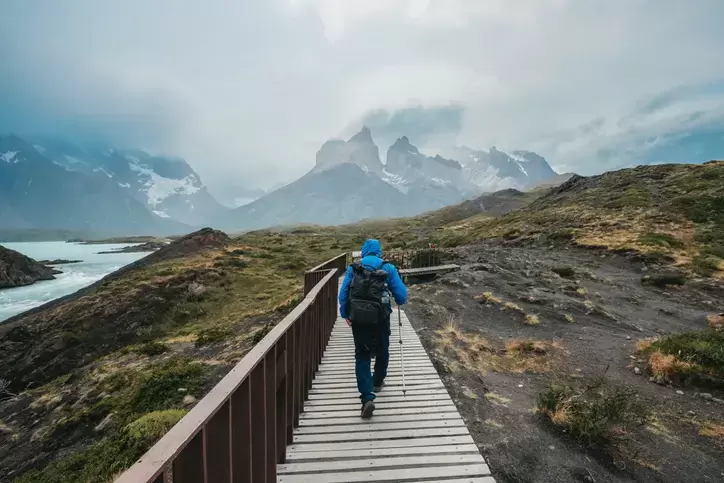
Patagonia has become almost mythological among solo travelers over the past decade. Torres del Paine National Park now attracts hundreds of thousands of visitors annually, despite its remoteness and physical demands.
And yet the appeal is rarely luxury.
It’s silence.
It’s scale.
It’s standing somewhere where your phone barely works, and realizing how much of your identity has been built around noise.
The Atacama Desert creates a similar effect in the opposite direction. Its isolation, extreme climate, and famously clear night skies attract travelers looking for perspective rather than entertainment.
In a hyper-connected culture, environments that remove constant stimulation suddenly feel radical.
Men Are Redefining What Strength Looks Like
One of the more interesting cultural shifts happening right now is that younger men increasingly value emotional self-awareness without necessarily using therapeutic language to describe it.
Travel has become one of the socially acceptable ways men process transition.
Breakups. Career collapse. Divorce. Burnout. Grief. Reinvention.
Historically, men often bonded through shared tasks or movement rather than direct emotional disclosure. Long-distance travel still creates that structure.
You walk. You adapt. You solve problems. You keep moving.
But internally, something else is happening too.
Researchers studying the psychology of solo travel have found that extended independent travel often increases self-efficacy, emotional resilience, and personal clarity, especially when travelers encounter unfamiliar environments that disrupt routine behavioral patterns.
That’s a clinical way of saying this:
Sometimes people need to leave home to hear their own thoughts clearly.
The New Version of “Success” Looks Different
There’s also growing disillusionment around older definitions of male success.
A decade ago, aspirational masculinity online often centered around wealth signaling, hyper-productivity, or social dominance.
Now, many men increasingly prioritize:
- Time autonomy
- Mental clarity
- Geographic flexibility
- Physical health
- Meaningful relationships
- Lower-stress lifestyles
This is partly why remote work and long-stay international travel continue expanding together.
Chile, with its relatively stable infrastructure, strong outdoor culture, and growing appeal to digital nomads, sits at the intersection of those changes.
Not because it promises reinvention, but because it creates conditions where reinvention becomes possible.
Travel Is No Longer Just Consumption
The old version of tourism was often passive.
Book the resort. Take the photos. Return unchanged.
The newer version, especially among solo travelers, is more intentional.
People increasingly want experiences that challenge identity rather than simply entertain them. And ironically, the more digitally saturated daily life becomes, the more valuable physical remoteness becomes.
That may explain why destinations once considered “too far” or “too difficult” are becoming emotionally attractive again.
Not despite the effort.
Because of it.
What Men Are Really Looking For
Most solo travelers won’t openly say they’re searching for meaning. They’ll say they wanted a break, a hike, better weather or a change of scenery.
But underneath that is often a quieter question: “What kind of life am I actually building?”
Remote travel doesn’t magically answer that question.
But it can create enough silence to finally hear it.
—
This post brought to you by Safdar Ali. On LinkedIN here.
Photo: iStock

