



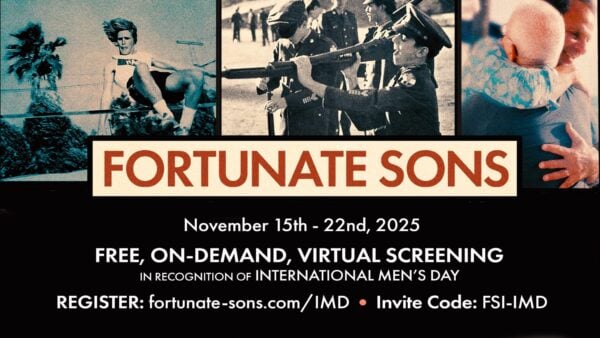
A few months ago, I interviewed the creative filmmakers of the documentary Fortunate Sons– John Manulis and Peter Jones, as it was making its debut. There will be a virtual screening of Fortunate Sons on November 19th in time for International Men’s Day. Free, Virtual, On-Demand screening for International Men’s Day and Men’s Health Month
Dates: Beginning 11/15/25 and continuing through 11/22/25
Register at: https://www.filmplatform.net/events/fortunatesons-2/
Use Invitation Code (case-sensitive): FSI-IMD
Recently, I had the fascinating experience of interviewing three of John and Peter’s classmates at the Harvard School who were featured in the film. Sit back and enjoy their in-depth responses as you go on the journey with them.
These are the words of Jon Saliba:

You seem to be a Renaissance man.
Definition…a person with many talents or areas of knowledge…or in my case, possibly a man of some talents but not mastering any…with skill levels only equaling competent. In college I would always like to engage folks in conversation and would start by asking them, “What high school did you attend?” I had learned a little something in particular about almost every high school in SoCal and was usually greeted by surprised reactions from many who were taken aback a bit by what I knew. This helped me break the ice and make new friends. At Harvard, during lunch, I would always mix up my seating. I painted, sculpted, …one day with the jocks, another with the artists, and another with the intellectuals. I never made any enemies and always grew through diverse interactions. I attempted to learn at least one instrument from every section of the orchestra, sax, trumpet, drums, and piano…with no proficiency in any. My hero is Leonardo da Vinci (does having a hero as the ultimate Renaissance person qualify me???)
You had a unique opportunity to attend The Harvard School. Can you tell us about it?
My father, who passed away at 106 attended L.A. High School, which was the public school in my district growing up as well. Unfortunately, race relations were a bit testy at the time and as the school was almost 100% Black, the white kids that lived in Hancock Park attended either Harvard or the girls school (Marlborough) as my sister did. Harvard was 35 minutes away for us and six years of commuting allowed us to truly bond on the commute both ways. I loved many of these guys then, through the years, and even more so today. The school offered me the opportunity, with a partner ceramicist, to create a large ceramic mural that was hung on an exterior wall in 1974, (looks like an abstract butterfly and appears in the group shot of our class in the final scenes of Fortunate Sons). I was a first team all-league basketball player, and have kept lifelong friends through sport and art. I initiated an off-campus psychology course with three other Harvard guys and four Westlake girls that propelled me to further my collegiate studies in Humanistic Psychology and Art Therapy. My time at Harvard was a Fortunate time for me, unfortunately, I can honestly say, unlike, most all of my school buddies, I am now closer to an Unfortunate Son. Semi-destitute, all I can give now is my time, (which I understand may be more valuable than money). I sent a Go Fund Me to the guys I grew up with in Hancock Park and who all attended Harvard (15 in all). Almost all of them contributed to me, which I took as a sign that, although I may consider myself a bit of a loser, many of my childhood buds still accept me.
How did it feel to reunite with your classmates via Zoom?
I did not miss any of our numerous Zoom calls over the years, even though they were mostly scheduled for 1am to 3am French time. I championed the mantra at every call to attend the 50th reunion. I knew we had something very special happening during these calls; honest, no-nonsense discourse with nothing but love and admiration for everyone that attended. The calls did contain some chit-chat at times, but mostly our words contained meaningful thoughts that not only brought laughs but tears as well. I loved every call.
What did you learn about what it means to be a man?
I learned a bit about discipline and teamwork (not necessarily a male only trait) through organized sport. I also learned in the 7th grade that my anti-military beliefs were accepted at the time at this military academy and I was welcomed into the marching band (which could have been construed as a “sissy” endeavor, bit I took it more as exuding my maleness). As I matured, understanding women after spending six years in an all-male environment was my new education…I went from “to be a man’ to “to be a person”. Not as easy as it sounds. Having three sisters and three daughters solved whatever “male only” beliefs that I may have had acquired during my Harvard days.
I understand that you moved to France and opened a restaurant.
On one of our class Zoom calls I did a demonstration on a few of my favorite dishes. Fresh shrimp, flambeed…lamb shank in red or white wine, and a thin crust French type pizza with a white cream sauce, local goat cheese, duck, and a myriad of toppings I imported from California, (i,e., avocado, etc.)
Interestingly, though, when people in France ask what I miss most about California, one word comes to mind immediately… SUSHI…in France, (except for in Paris) all the sushi places serve only two kinds of fish, tuna, and salmon. My first wife, over 30 years together, as well as my current wife, going on 8 years together, are both vegan…yikes…so much for the Texas BBQ’s… (which I also love).
Is there anything else you would like to share?
Peter Jones and John Manulis are two of the most amazing individuals ever! As editor of our senior annual John created an absolutely unique book ( putting my image on the cover was a true highlight for me). He was the only one (out of dozens of brilliant students) in our class to attend Harvard University. Peter is a master communicator. He listens better than anyone I know. And the amazingly unique deal is this: He interviewed dozens of guys, and he knew each and every one of them for 50 or more years. Any other documentarian may interview a few people that they have known for as long, but my bet it that they would probably be a family member, etc. That is the specialness of this film. Peter captured the before and after in the lives of seemingly like-classed guys, but who have experienced lives similar to all.
Welcoming Christopher Hormel:

What was life like prior to enrolling in The Harvard School?
Before going to The Harvard School I was a student at the John Thomas Dye School, which was in Bel Air, close to our home, and was really a second home for me having attended since Kindergarten. Two elite private schools, but very different. I was one of the older kids at Dye; among the youngest at Harvard. I felt so intimidated and afraid of making a mistake. I was eleven when I first went to Harvard. I had been fitted with a new military uniform, polished shoes, and a haircut. I learned to keep my shoes and brass belt buckle polished to avoid being embarrassed or bullied if I failed inspection. Harvard had a much bigger student body, campus, and profile. I was in a whole new world, and it was not friendly or gentle. Fortunately, there were about ten other boys who had also migrated to Harvard from my class at the Dye School. Four of us were in a car pool, going to and from home and school every day together. Our car pool became a refuge we could look forward to at the end of a long day of being in the army. Our mothers were all friendly and caring. They brought snacks for us. The military school would make us into men, but we were still young boys, and the soft landing of car pool was a safe transition space. Having been brought up in the elite society of Los Angeles, I got to know many kids whose parents were famous in Hollywood, or successful in business and society.
Did your birth into an iconic food business family have any bearing on developing friendships once you were there? Did the other students know?
Having the last name Hormel was more of an amusement for my friends; one modification I had to hear for years was Horsmell. Some of them might have heard of the bacon, the hot dogs, the chili, or SPAM, maybe even eaten some, but it was not mentioned much. I never had any of those products at home.
How did your time there change you in important ways?
My six years at Harvard School were truly life changing. The school only got better year after year. By the time I was a senior, I was confident that I would go on to college and pursue a degree and then a career. I felt like I could handle going out into the world on my own. I also was looking forward to what I could learn out there; I had become a seeker of knowledge and wisdom. The faculty we had during those years were some of the best teachers I have ever had. They introduced us to new ideas about ourselves and the world, and they challenged us to be creative, and think critically. I will always be grateful to them.
I understand that you and your wife LuAnne believe in generosity and being a combined force for good in the world. What causes are closest to your hearts and why?
LuAnne and I both have worked in the not-for-profit world and with philanthropy. It was only natural for us to go in that direction when I inherited wealth later in life. My main focus for thirty years has been working for the abolition of nuclear weapons, as well as nuclear energy, both of which have contaminated our planet and all of life upon it. More recently I am pivoting to funding food banks and making efforts to support homeless people.
What kind of world do you want to see for the next generations?
My informed view of the future is grim. We are headed into dark times, with scarce resources and brutal competition. We are closer to nuclear war than ever before. My hope for future generations is that they can develop patience and generosity for themselves and others, and work in cooperation with others for everyone’s’ benefit. The current American doctrine of greed and bullying has got to go; it will not end well.
Please share about being part of the Fortunate Sons film.
Being a part of the Fortunate Sons film was a great pleasure because I got to spend a lot of time with Peter Jones! We have known each other since nursery school. We have always been friends, but there have been long gaps without contact. It was brilliant that some of the guys in our class thought of trying to get together on zoom during the COVID lockdown. I was surprised that a movie was being suggested, but with Peter at the helm we could only have a great result! I was really moved by the stories I heard from my classmates in the film. I am glad I went to the 50th reunion and got to see and talk to many of them. For me, as a member of that class, the film helped me put my experience at Harvard into a perspective that is enriched by all the conversations and stories that we are having now.
The responses of Franklin Ruetz:

Please talk a bit about your upbringing, especially about what it was like to be a preacher’s kid.
First and foremost, my parents loved me. They tried for years to have a kid. Both 38 when I arrived, so older parents. As a preacher’s kid (PK) I would call on sick people with my father, was acolyte at weddings and funerals, and at Sunday early and late services.
I was with my dad as he researched history, religious and secular in public, collegiate and private libraries all over the areas we lived in. How many kids go to work with their dad?
Usually, my father’s congregations skewed older than the population norm so my life in church was spent helping them, getting my cheeks pinched, etc. Running the book section of the yearly church fair was my specialty, as was operating the ancient 16mm Movie Projector (this put me in good form when I had to run the ancient projector in The Ambassador Hotel, Los Angeles showing Moby Dick during a Science Fiction Convention about 1972.)
My father loved the past, silent films, the radio stars of his youth, etc. I have the same love of them still. The SXM has Radio Classics Ch. 148 and other offerings.
Luckily during my time in LA as a student we frequented The Silent Movie Theatre on Fairfax. Got up early to listen to rebroadcasts of Lum and Abner and other classics like Jack Benny, Fibber McGee, and Molly, The Great Gildersleeve (Dad often called me Leroy in various states of urgency/impatience just as done on the radio show).
Books too were championed by dear old dad such as the dry humor of P. G. Woodhouse. Dad would burst out laughing at some passage then recite it to me, but as it was devoid of context as a standalone line, he would then set the scene and make it clear why it was “a schnapper” as he called it.
While I was a model child at home – outside of home a PK is also expected to behave perfectly and make it clear that you are doing so, BUT the corollary is that the other kids in the church do not include you in any hijinks or bad habits they engage in.
Devoid of some of this generational activity, it took me some time to learn how to misbehave discreetly. Turns out the first half of prodigal son parable is not an instruction manual.
If my father was not an Episcopal priest, I even wonder if I would have attended Harvard. We wouldn’t have moved to Los Angeles. But he was and we did.
Harvard school was long affiliated with The Episcopal Church at that time. Bishop Gooden was headmaster long ago, until 1930. When we moved to Southern California, he and my dad became friends. My dad held Bishop Gooden, who was 100 years old when I graduated high school in 1974, in very high esteem. The Bishop still had all his faculties in his final years. He would come to my dad’s church and preach.
Every class at Harvard had about 3 preachers’ kids. Perhaps the Bishop (long retired but still a force) put in a good word for my admission to Harvard.
I guess every kid has some pride and awe of their parents’ work/ accomplishments. I did. But I recall feeling a little weird one day thinking how the other boys’ fathers were captains of industry, prominent in entertainment, any other fields, and my dad (although smart etc.) is a rector of a church. I mentioned this to my dad – not to knock him but to say I was wondering about this – and my father replied calmly “Son, as Rector I am the head of the corporation that is the Church.”
Wow, oh yeah, how did I miss that? My dad – a CEO!
I realized I held certain people in more reverence/awe/admiration than perhaps was wise/their due/ perhaps not in proportion to others.
I realized my mom was as smart as my dad but had an intense Type A personality. Part of her work was teaching medical students Cytology. Life and death.
Life and death were also something my dad worked with, but he maintained a caring yet detached manner to handle the gamut of emotions involved in carrying out his duties.
It occurred to me as a kid that not only was I being held to a higher standard due to my dad’s job, so were my parents.
Once when the LA Times had an editorial, I disagreed with I started calling it The Communist LA Times, just out of frustration. Oh horrors, no! my folks said, never repeat that in public.
I slowly evolved some awareness that everyone had a load on their back, and we were all working through similar problems. I also sensed that while I was good at problem solving and enjoyed artistic adventures in sound, acting, and working on learning how society was actually motivated and reacted, i.e. learning history, I was incredibly unaware of how much I was unaware of.
So, my father was a conservative, very bright, Episcopal Priest, usually serving as Rector of a Parish Church, or as a vicar of a Mission Church. He and my mother literally built some churches (I helped paint exteriors as a wee child).
Ministers and churches work best when the right paring occurs, and wise bishops shepherd this process of who is called to a given parish. So based on my fathers (usually) work needs we moved several times.
Once I left an area, I never had any further contact with the very few kids (either in the neighborhood or school) I knew.
I am an only child, and relatives (cousins) my age or within 5 years numbered just three. None lived near me – hours of driving distant, so I saw them only at holidays usually and then rarely.
From Kindergarten to grade 3 no school friends visited me and likewise the other way.
At a different school, grades 4 and 5, I had one friend I would visit to hang out, play their older sisters 45’s and watch Dobie Gillis. This too was a rare activity.
The sixth grade started at the same school as grades 4 and 5 but days into it my family moved to another state so my mother could be nearer to her siblings and work at a better job. So I left a school I had been at for two years, and luckily had the same teacher for the 6th grade as the 4th, but sadly had to say a nearly tearful goodbye and start sixth grade in a very different realm where I knew no one, and the kids seemed very different, loud and boisterous.
I had a very difficult time adjusting, making no friends in school and one in the neighborhood, barely, and as soon as grade 6 ended we moved to Riverside, California where I started the seventh grade. Another strange place and the fact this was Junior High school now had us move every period to a different room was strange.
I learned just how peculiar inferior teachers could be. People who could tell you things yet not explain them.
Then comes the day that changed my life’s trajectory in a most amazing way, as winter break of seventh grade approached, my father was called to a church In Los Angeles, so we moved to the rectory located on Melrose Hill (then not widely known) and I was told I would be going to The Harvard School for Boys starting in January.
I had been through this before, see above: New kids, new school. But now three extra changes: All male students, much more competition, and military school, uniforms, etc. I was ultra conservative and so looked forward to getting through the next 5.5 years and once a senior get my sword, the better to threaten underclassmen with and go off and kill commies. I supported John Schmitz for President.
But as the ancient story sets out, I gained various perspectives over the years and balanced various aspects of my views on some subjects, while hardening them on others. I am glad for a strict upbringing because it is a line of clarity, probity and we all wish for that.
There is a Franklin Ruetz who is a radio host- is that you?
Yes, although I do not use that name on the air except for The News. In my boyhood years I spent many hours creating audio collages, comedy songs, etc. in my bedroom with multi-source real time mixing. I started to volunteer at a radio station with the largest FM signal in Los Angeles starting about 1973. I was soon acting and writing a series of live radio dramas on-air with the Janus Company. Our live drama show aired after Hour 25, a long running program covering science fiction.
When I arrived at Olympia in 1974 to attend The Evergreen State College, I found their campus station was 10 Watts. Oh vey! – I had gone from the most powerful to the weakest station, but the zeal for/of manning the mic, running the board, taking the meter readings, waiting for the EBS to go off and rip open the authenticator list to verify a real alert, spinning platters, delivering snappy patter, all that was undiminished. So, the powerful part of the equation was not the transmitter, instead it was the three guys I heard doing a show. They were good, funny, and welcomed me to the world of collaborative broadcasting. Three men who that day became my lifelong friends. We formed a good team of broadcasters. Commercial stations in Seattle pirated some of our content.
The Firesign Theatre, our heroes, had started at the same station I did live radio drama on. The group I was in starting with in 1974 idolized those 4 geniuses plus the other greats including Bob and Ray, The Marx Brothers, Hudson and Landry, Tom Lehrer, Spike Jones, National Lampoon Radio Hour, Dr. Demento, Ernie Kovacs, The Goon Show.
(I met Groucho as did many of my classmates and their parents when he visited one night when we were staging The Rainmaker play. I played Sheriff. Sitting in the Green Room, he came in the side door so as to be unobserved. Erin Fleming was on his arm. Beret on his head. I looked up and said, “You’re Groucho Marx!” he replied, “The kid’s right, give him a cigar”, Erin peered through the next door into the auditorium where the lights were dimming – I had seen another person or two go in as Groucho and Erin came in to wait in The Green Room with me. She reported to Groucho, “Groucho, come on, Harry’s about ready to have a heart attack!” Groucho instantly retorted, “Good let him, I’ve already had two!”
Once the lights were down Groucho and Erin took their seats – they had waited so as not to steal attention from the play. Post-play they were happy to visit with students and parents alike. My father asked about an incident in Nacogdoches, Texas back in the old days, and Groucho gave my dad his recollection of what happened. Groucho was having a great night. BTW I wonder if Harry was Harry Ruby? Harry died in Feb of 1974 so it could have been him.)
Radio is the role I was born for. Done for love, not money, all non-commercial radio. The key is a camaraderie driven creative outlet as a revitalizing tonic for us as the producers and the listeners.
From the mid 70’s onward we have continued with group shows, solo shows, shows as short as a half hour (news) to 6-hour Midnight to 6am shows. Some years I did an all-night show in Olympia every week and then, with my radio friends, another 6-hour overnight show in Portland, either weekly/biweekly/monthly.
I didn’t coin the phrase, ‘radio is the most visual medium,’ but when I first heard it long ago it definitely GROKKED with my approach to broadcasting. I continue bringing farm sounds, tunes, humor, scientific news, and ongoing adventures 3 to 4 times a year as one of the recurring guests broadcasting on KBOO from Portland, Oregon on The Wiggle Room show, Bill Dodge, showrunner. The old gang and other decades old friends bring over 200 years of experience to every show. The six-hour version airs when a month has a fifth Saturday, other air dates are three-hour shows. Both versions are great! KBOO.FM a listener supported non-commercial community radio station brings a panoply of music, news, public affairs to the broadcast range and planetwide at KBOO.fm And KAOS continues as a fine College/community radio station as well.
What was it like to be a student at The Harvard School?
Much competition in academics, athletics, and collaboration in the arts. Just wonderfully informed and metaware instructors and a rigorous course load. Students learning muscles were exercised! Workloads increased to challenge and well round every student.
Technical facilities for online time-sharing computers were in place and used by me and others starting by 1969/70 and programming in BASIC was commonly pursued. Luckily, the time-sharing providers also offered FORTRAN and ALGOL. I absolutely loved this science and art. A genius classmate Robert Maier was a superior programmer. We plotted on a teletype, the Lorentz Transformation to show how time varies as an object approaches the speed of light. That convinced me my career must involve computers, and it did. Robert left after the 9th or 10th grade to attend CalTech. He went on to write some principal UNIX packages and make other contributions to math and physics.
I had friends in grades above and below me as well based on interest in art, music, staging and acting in plays, etc.
Our science instructors had access to data required to compute correct satellite orbits of planets; I obtained a 32-page manual from a large stock brokerage listing financial reporting standards and the formulas to derive and compute them. With such information I wrote a program to calculate orbits based on users input data, and one to calculate and in a pleasingly formatted manner display financial data analysis. As a challenge Robert wrote a program to run Conway’s Game Of Life, I wrote a poetry/prose generator.
Craving more hands-on experience? The earliest commercial hobbyist microcomputer (flipswitch bit loaders) was available and a modern programmable Monroe calculator. IR Spectroscopy, school/student-built seismometer, etc, We had two student run TV studios, I worked in both and helped build one.
The administration at the school changed after I completed the seventh grade and some old familiar faces retired and new instructors, often younger, better able to subtly impart life coaching tips started their run at the school.
We read a lot, we wrote papers, discussed the matters of the day, and filled many blue books with exam essays.
Everyone was expected to do more, learn more.
Please share about the experience of being bullied growing up and how it impacted your adult life.
As noted above, with few friends my age, and no siblings to look out for me, I was an easy mark. A lunch money bully thug beat me up on the way to school in fourth grade in an ambush. I was shocked. How could a kid do that to another kid? That is a product of me in part leading a sheltered isolated life.
Luckily, a neighbor girl in another grade caught sight of this. My mom sensed something was up and called the principal “why wasn’t I eating lunch?”
He sent for me and got to the bottom of the matter and that bullying stopped. The next occurrence was as soon as I got to Harvard as a new guy starting 3 months into the 7th grade already in progress. It did not occur to me that many of the boys knew each other, had known each other since they were young, had already been in the same schools before starting Harvard. Plus, many had siblings to instruct them in the manly arts and hijinks etc.
So, 7th grade saw a share of students chasing me to beat me up, pour salt in my milk, derail my assignments by swiping my notes.
I must add that while I did not retaliate or pick on anyone else at this time. However, the next year a new student joined our class. Three other boys and I teased him, not bullied him as far as I could sense, over his name. When the next school year began, he did not return and I thought, gee, I might have had some responsibility for that.
The other aspect of the seventh grade was the school was still a military school (this was to be its final year of military uniforms, marching in formation drills, etc.) and all the attendant order and discipline that was maintained.
In particular the Senior Tower (an amazing tower with circular staircase) I was WARNED was only for seniors and any underclassmen so located would be skewered, run through, etc. And these big guys had the swords to do it with!
But before I was warned about the Senior Tower for Seniors Only policy, someone convinced me to go up and down to view and learn about all of the plaques on the walls commemorating athletic achievements, etc. Fortunately, I did this without being detected and remained unscathed.
But other weird things happened. Boys were smoking on the transportation to school, and nothing was done to stop it. And other kids would still give me the business (to quote Leave it to Beaver).
So, boys will be boys is what I heard from those in charge when I mentioned these things and bullying. I was expected to roll with the punches, etc. I must say it got so harrowing I tried to get into a martial arts program but my exceptionally messed up spine made that a no-go.
I had to protect myself, so I used a pacifist defense tactic to quell the bully boys. I learned that humor could be a defusing balm. Even with a terribly curved spine I could stand on one leg and put my other foot behind my neck. Well, that solved one problem but then you are a bigger nerd. I also noted the bad actors didn’t frequent the room with the computer modem and teletype so I would go up there and do a lot of computer programming,
As an adult I was better prepared for overt and covert bullying directed at me in the workplace and when warranted I reported egregious instances to their superiors.
I was lucky in my studies at The Evergreen State College to read psychologists on human emotional reasoning, generational development. This went a long way to help me be more resilient when teaching and dealing with bad acting students, those they picked on, coworkers acting badly, or getting out of bounds.
What was the experience like being part of the documentary Fortunate Sons?
It was pleasantly conducted and professionally executed. The correct state-of-the-art equipment was used which impressed me, an old A/V geek. However, anybody can buy gear and get post production accomplished. But having done tens of thousands of hours of radio and news interviews, I know that content is the KEY. The Fortunate Sons content was driven by the exceptionally insightful interviewing techniques of Peter Jones.
Prepared and putting me at ease, his questions opened my mind and brought up recollections and realizations I had never thought to put into words before, even in meditative rumination.
I admire the crew on the production for the way they captured visuals and audio with practiced and discrete style.
I attended a screening of the documentary in Hollywood in the Chinese 6 Theatres Complex (next to Grauman’s Chinese Theatre).
At a post premiere event across the street at the Hollywood Roosevelt Hotel —. (Ah! I had been there a few times as a teenager attending science fiction and fantasy shows in the early 70’s).
— imagine my surprise when the daughter of a famous cinema star, as well as being the sister of a classmate, came up to me to thank me for my bit in the documentary. Further, seeing more classmates I had not seen for decades allowed for very meaningful conversations, including one with a classmate not seen at previous reunions.
Are you still in touch with your classmates?
Many are in Southern California, and I am two states away, so I see them at reunions and occasionally scheduled Zoom video chats. We have a lively email group as well.
I attended two or three reunions before the 50th. But the 50th was the fantastic one! With events staged by our class for our class as well as functions at the Upper campus staged by Harvard/Westlake, including a tour of the facilities. Some areas just as they were in my day, others upgraded, The new buildings designs give students areas to learn with others or find a quiet nook to study in.
I saw classmates having hearty conversations with other classmates. I spoke with some classmates more in two days than the 6 years we were in school together.
Thanks to an updated class contact list I reached out to a friend from our class I hadn’t spoken with since 1973, as he spent his Senior year in the UK as an exchange student.
I plan to reach out more in the months ahead. Our private email group and news of the documentary roll out is fascinating as well. It reminds me that while I am retired, others are working and that we are all better off staying engaged. And sadly, and soberingly with the fact we are not immortal.
Is there anything else you would like to share?
The ability for every student to achieve, learn and excel was encouraged at Harvard when I was there and given the increased rigor, I know pressures are tougher. When I toured the campus in 2024, I noted several counselors’ offices. This is excellent. Research has shown talking with a professional can be very beneficial.
When I was a student, others and I talked to an off-campus psychologist who had insights into what was likely, what was unlikely and how to negotiate a path to growing up, getting on, and getting out with a diploma and achieving future success.
Having spent 10 years teaching in a community college system, I practiced a mix of teaching styles: Some mug and jug (you listen to what comes out of my mug/lecturing and put it in your jug/brain) and hands-on, unguided discovery, each student takes a turn working with another, etc.
How did I ever learn of these practices? At Harvard, and later at Evergreen. The key was not just memorization, it was getting students thinking, horizontal vs, vertical thinking. Some degree of system analysis in more than computer science fields you might say.
BTW, when I arrived at Evergreen, I heard other freshmen claiming the Foundations of Science Course was difficult. I read the syllabus and saw I learned all of it and more at Harvard. I didn’t tell the other freshmen. I decided to run a quick assessment of what their background was in the sciences, so I mentioned Socrates, Plato, and Aristotle . Some didn’t even know of them, and no one could give me the order of who taught who.
Naturally, as my college career went on, I learned there were so many things of which I was ignorant. So, I continue to learn and read a lot of news, especially science, computer technology, physics, and math. I do so appreciate Einstein‘s theories are being tested over and over and time and time again (pun intended) they agree he’s right!
YOU’RE INVITED! Join us for a special FREE, ON-DEMAND, VIRTUAL SCREENING being hosted by The ManKind Project, along with The Good Men Project, and Consciously Unbiased, in recognition of International Men’s Day and Men’s Health Awareness Month. And please share it with those you’re close to.
Screening dates: Starting November 15th and continuing through November 22nd.
Register at: fortunate-sons.com/IMD
Use Invite Code: BFI-IMD

Join our community – here are some ways you can help!
- Watch the movie! Click here to see our broadcast dates and online public screenings.
- Host your own screening for your school, group, organization, or company. Just fill out our Screening Inquiry Form – it’s an easy process, designed to support groups from neighborhood book clubs, to churches, schools, or national non-profits – the folks at ROCO Films, who are coordinating our impact campaign, will do everything they can to support you.
- Join our mailing list.
- Follow us on Facebook, Instagram, or TikTok @fortunatesonsmovie – and share our posts and your thoughts!
- Recommend schools and organizations in your community that you think would resonate with our mission – write us with their info at [email protected] and we’ll get in touch.
- Contribute to support our impact campaign. Your support is critical – enabling us to bring the message of Fortunate Sons to even more communities.
Together, we can make a difference in people’s lives!
Together, we can flip the narrative about strength and vulnerability.


