


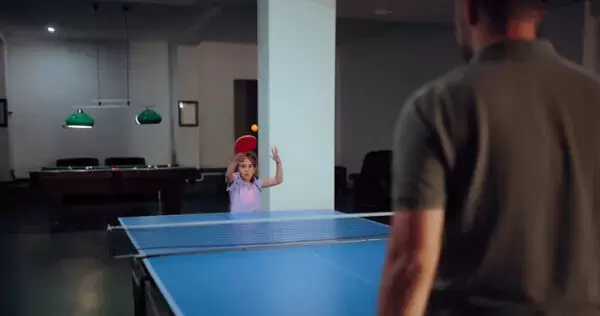
When I was six, family friends gave us their old ping pong table. On day one, my dad handed me a paddle. And even though I could barely see over the table, it was game on. We spent hours in the basement battling to 21 points. In the beginning he would spot me 19. That meant I had to score only 2 points before he could score 21.
Despite giving me that ridiculous lead, he won every game.
As I got bigger and better, he would spot me only 10 points. And still, he won every game. By the time I was eleven years old, there would be no more spotting of points and yet I never once beat him. These competitions, by any standard, were fierce as I would often take the lead. But time and again, I would get so excited or nervous when I was about to win that I would flub a serve or send a slam halfway across the basement, a million miles from his side of the table.
It wasn’t just ping pong. My dad taught me how to body surf before I was five years old. Once I could hold my own out there, the game was to catch the same wave just to see who could ride it farther. But even when my belly scraped along the sand after holding my breath for an impossibly long ride, I would look up, wipe the saltwater from my eyes and there he would be, sometimes yards, sometimes inches but always ahead, smiling back at me.
Even when we played cards, it was inevitably the same story. It didn’t matter if the game was Gin Rummy, Hearts or Casino, I would lose every-single-time.
From the outside and certainly with today’s “everybody wins” mentality, my father’s unsentimental thrashing of his youngest child in every arena might be scorned as harsh or even psychologically damaging. But that’s not how I see it. My dad was just having fun. And it was simply more fun to play ping pong against a 6-year-old when the stakes were that he could only lose 2 points. And wave riding was way more fun when he could look back at his competition and know for that one moment, on that one beach, for that one wave, he was the best in the world.
My dad loved to have fun and I loved that I was not just included in that fun, but my participation was a critical element of it.
True, he never let me win but my dad always taught me how to play better, think smarter and want to win. It never crossed his mind to exclude me. Why would he? He wanted to play and the better I played, the better the game (whatever game we were playing) was for him.
And the knock-on effects were tremendous: Even though he wasn’t conciously preparing me for my future, his simple act of including me, of not telling me that I couldn’t or shouldn’t participate, taught me to stand tall. Trying new things wasn’t scary and losing never felt like a failure, just an opportunity to get ’um the next time.
It might be counterintuitive, but I can draw a straight line from my dad’s merciless, if joyful beatings in every game to my confidence both on and off the playing field. Growing up in the 70s when most girls weren’t playing anything, I played everything, often the only girl on my team. I also never shied away from raising my hand in school or later from stating my opinion during work meetings. I think that’s because I grew up being included. This meant I grew up never questioning my right to not just be in a room but to let my presence be known when I was in it.
So, as this year’s Father’s Day approaches, I have a request for dads of girls everywhere: Please, include your daughters whenever and wherever possible. Sure, investing in things like violin lessons, extra math classes, or private sports coaches might help her get ahead in the world but to me, the best thing you can do for your daughter is simply hand her a glove, a paddle, or a deck of cards and say the following 4 words: “Come on. Let’s play.”
—
Previously Published on substack and is republished on Medium.
—
Photo credit: iStock

