


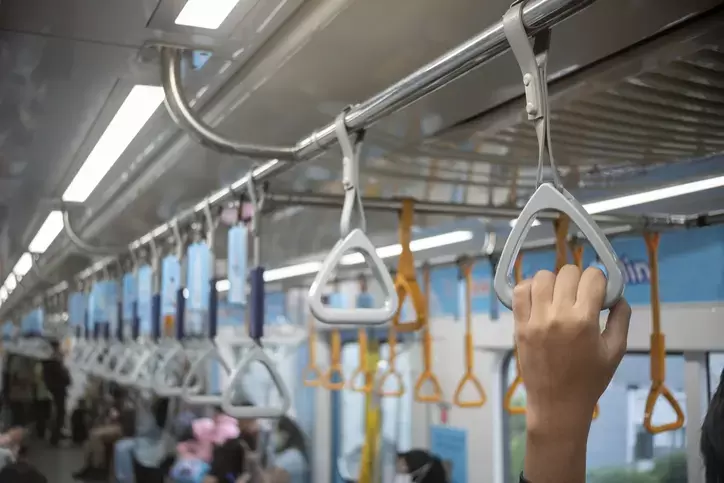
There are unspoken rules of being in public and taking public transportation. Make no eye contact. Don’t talk to anyone. Don’t have loud conversations on the phone on a crowded train car. Don’t be too trusting.
Above all, most of it can be boiled down to one rule: mind your own business.
In the past half year, my daily commute to and from work has changed from driving to work every day to taking the train for almost three hours and 20 minutes total every day. I try to get as much done as possible during this time period, but it is tough. It was a challenging commute at first, but I have gotten used to it, and the consolation is that I only go in three days a week.
There are multiple occasions where strangers have saved me from near catastrophe, as I rushed and got used to my new commute.
. . .
I went to the train station, like usual, on a Wednesday morning. The train was running late, so I was standing on the platform. A woman approached me and asked if I drove the type of SUV I drive. I said yes, and then she told me that she saw me leave my car and that I had left my car running without turning it off. She said that while I might miss the train I was on, I might be able to make the next one.
I thanked her, and then I walked briskly back to the car and saw that I had, in fact, not turned off the car. I turned off the engine and then went back to the train platform, and went about my day, catching that train. I have seen this woman on my usual train and still need to go about thanking her.
It was one of those situations that could have ended really badly in a million ways, but did not due to the intervention for a stranger. Between that and leaving my wallet on the train on one of the first days of my commute, followed by another train rider finding me on LinkedIn and coordinating to return it to me, I have been very lucky to be helped by quite a few strangers.
Of course, the goal is not to end up in these situations at all, but it has happened, especially when the commute was new and I was just getting used to it. But I endeavored to always be the kind stranger myself to pay it forward.
. . .
It took a while, but I was able to pay it forward on three occasions — usually when someone leaves an item on the train or when waiting for the train.
On one occasion, a woman left her earmuffs. I noticed this on one of those days, there was a lot of snow and ice and we were slowly let off the train to make sure no one slipped and fell. It was also around 20 degrees Fahrenheit. When I saw her earmuffs on the seat, I had some hesitation on whether to get involved. Someone might think I was stealing them, or it also might be more trouble than it was worth to try to get it back to her.
She was about five people in line in front of me, so, again, there was a chance the person I was trying to return the earmuffs to wasn’t her. It took a while to get off the train, and then I had to walk fast enough to catch up to this woman. I had no plan if the earmuffs were not actually hers, other than to give them to an employee on the train. I caught up to her eventually and gave her her earmuffs, and she was very thankful. I never learned her name or exchanged another word, but I knew it was the right thing to do.
Another time, I was sitting in the waiting room for my commuter train and I saw that someone had left his gloves in the seat. I saw the person sitting in front of me in the train waiting room leave his gloves on the seat. I got up and caught up to him, and told him he left his gloves on his seat. He turned around and thanked me for telling him. I still never learned his name or anything like that.
This week, I was on the Amtrak from Baltimore to New York for a work trip. An older lady not familiar with the area was trying to get off at Penn Station. There are quite a few Penn Stations in the northeast — Newark, New Jersey, Baltimore, Maryland, and Manhattan, New York. She heard the train conductor say we were arriving in Penn Station, Newark, and asked someone next to her “is this Penn Station?” The other person nodded.
I knew for sure this woman was not familiar with the area, because when most people on the Amtrak mention Penn Station, they are going to New York. I did not want to assume and I also, of course, wanted to mind my own business. But as she got her suitcase and got in line to get off at Newark, I interjected.
“Ma’am, are you trying to go to New York?”
“Yes,” she said.
“There’s a Penn Station in New York, too,” I said.
“Oh wow, thank you! Is that Moynihan Hall?”
“Yes,” the guy in front of her replied.
She put her suitcase back and got back in her seat, then got off at the right station. The worst that would have happened if she had gotten off at Newark is wasting an hour of her day for the next Amtrak, and likely having to pay for another train ticket. It would have been very inconvenient, but not catastrophic. Still, my desire to help her out was instinctual when I realized that hour could have been saved by just saying something.
. . .
I learned that in psychology, this is called prosocial reciprocity. When other people do nice things for us, we feel inclined to pay it forward. I have felt this prosocial reciprocity for quite some time, but situations like this with strangers do give me more hope. There were multiple times in the past, like when my car battery died and someone helped jump my car, that I have been lucky and saved by the kindness of others.
To pay it forward and continue the kindness and grace I have received means quite a bit. I don’t know if I think of it at that high of a level in the moment, but it does just feel like an instinctual response. It comforts me knowing that even in moments of hesitation, I’ll usually go out of my way to do the right thing, even if there is no self-interest involved. The unspoken rules of being in public mean it’s not likely the other person and I will be best friends or anything, or that we’ll even learn each other’s names. I think this can change if I see the same people on my commute every day, but I haven’t gotten around to that yet.
I think we’re all human and prone to these types of errors. Having ADHD, I am a bit more prone to these errors. My mistakes, like leaving my car turned on or losing a wallet, are likely a lot worse than forgetting gloves or earmuffs.
As a Christian, helping strangers means loving my neighbor as myself and not seeking recognition for good deeds. I go to train stations every day and see the same homeless people asking for money, with hundreds of commuters like myself walking past them and not making eye contact. I used to have stronger feelings about this, but now I realize I’m just like everyone else. Once in a while, someone will go out of their way to give them money. If I have cash, I will sometimes do the same.
I commute for an hour and 40 minutes both ways, so with that long of a commute, times like these are bound to happen from time to time. Helping out strangers in times of need like this only takes a minute or so on my end, but it could save someone else a huge headache.
I am happy I eventually did the right thing in each of these occasions rather than continuing to mind my own business. Next time, however, I endeavor not to hesitate to do so.
—
This post was previously published on Ryan Fan’s blog.
***
You may also like these posts on The Good Men Project:
 Escape the Act Like a Man Box Escape the Act Like a Man Box |
 |
 |
 |

If you believe in the work we are doing here at The Good Men Project, please join us as a Premium Member today.
All Premium Members get to view The Good Men Project with NO ADS.
Need more info? A complete list of benefits is here.
Photo credit: iStock

