


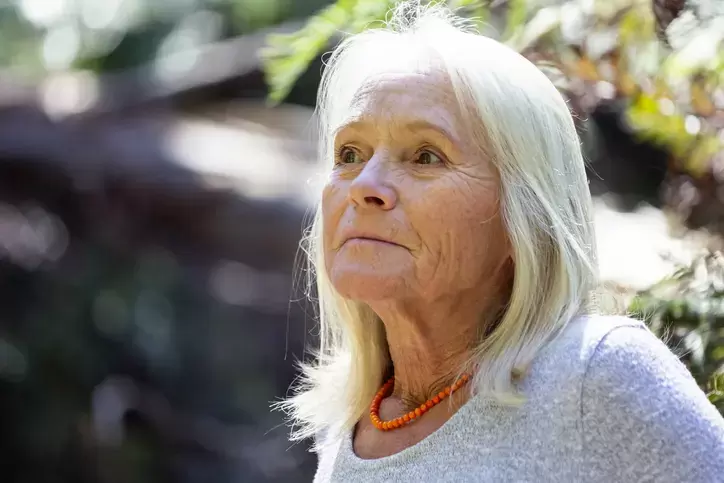
I am changing my attitude, or at least my response, to complaining and helpless older women. In the past, I struggled to interact with women, nearly always white, who exhibited learned helplessness or constant complaining behavior. My excuse is that I deplore the stereotypes and don’t like seeing them embodied. I’ve decided to do something different going forward when I encounter them.
The complainers
Recently, I stood in a line that wrapped around the Santa Fe Convention Center to hear Jason De Leon speak about his book on human smugglers of migrants, and his time as an anthropologist among them. Obviously, judging by the long line, he was popular, and his is a timely topic. The event was part of the annual Santa Fe International Literary Festival.
The older white woman in front of me in the line— full disclosure, I’m one as well — complained that the line was too long, the process of scanning tickets was inefficient, and that the procedure was different and more efficient last year. She first said this to me, and then proceeded to say it to every Literary Festival volunteer who came near, and to the one who scanned our tickets.
I didn’t want to be drawn into a conversation about it, although I did say I remembered the lines being nearly as long, and the process the same, when I attended three years ago. But I wasn’t there last year when she was, so I couldn’t, and wouldn’t have wanted to counter her facts.
Complainers don’t respond to facts.
A young volunteer assured her the procedure was the same last year, but she wasn’t having it. When an older white woman volunteer came by, she complained to her. I watched and wondered if she would interact differently with someone her age. She didn’t. She did drop it when that woman told her the same thing. Still, she assured me both volunteers were wrong.
Because I didn’t want my experience spoiled, I used what we therapists call supportive reflection. I simply expressed my empathy with her concerns about the long line. Still, the interaction bothered me, and I felt I was being too nice, as all we older women were trained to be.
Reflecting on the experience, and my tolerant behavior, but disdainful feelings, I’ve decided I have a calling, as a therapist and a mindfulness practitioner, to interrupt the thought patterns of people like her. Not by confrontation, because that won’t work, and would raise my blood pressure.
Rather, I could have said something entirely different and perhaps moment-changing if not life-changing. I could have said,
“Well, we’re stuck in this line now. Let’s make the most of it. We can get to know each other, or we can simply look around us and focus on the beauty of Santa Fe in the Spring.”
Would that have worked? I don’t know, but I would have felt better speaking my truth in a way that invited her to share in mindfulness with me. In Neuro-Linguistic Programming, we call that a pattern interrupt.
Learned helplessness
Learned helplessness is another stereotype of older, usually white, women that triggers me. I don’t want people thinking of us as helpless. Also, I’ve survived much of my life by deciding to learn to do things and navigate systems. The judgmental part of me believes they should do the same.
Of course, there are reasons some women don’t or haven’t. Our culture hasn’t encouraged or supported white women becoming fully competent. We have been coddled, been considered incapable and therefore taken care of, or we have been controlled by the people tasked with taking care of us. Husbands, children, and other older women.
Unlike women who have been married for fifty years and lost a spouse to death or late-in-life divorce, I’ve been single the majority of my life. When I was married, the men were more egalitarian than the previous generation, at least the ones I chose to marry. Apparently, many men of my generation were not as feminist as my ex-husbands.
The women I encounter who exhibit learned helplessness never learned to argue with contractors or other service people. They didn’t learn to fix things. They may or may not have been the ones to pay the bills, but somehow, they didn’t learn how to operate with confidence in the world of commerce.
I attended a single’s event a few months ago.
The bar was crowded, and there was one bartender, obviously overwhelmed. A woman stood behind me and futilely tried to get his attention. She didn’t want a drink. She wanted to get cash, using her credit card, so she could pay the $5 entry fee to the event. The leader of the event had suggested she go to the bar to get cash.
While waiting, she constantly questioned me and another woman.
“Do you think they’ll give me cash? What will I do if they won’t? Will I need to buy a drink to get cash back? Do you think Maggie will let me into the event since I don’t have cash? She sent me in here to get cash.”
I try not to get involved in these instances where not only learned helplessness is a factor, but obvious anxiety is being exhibited as well. I’m a therapist, and I don’t want to work when I’m out and about. However, as an older woman, I am trained to “help” even when I don’t want to.
I first gestured to the bartender, who nodded to acknowledge me, and also had to continue waiting on the people who were there before us. I then picked up the menu, looked at the bottom, and noted it said, “This is a cashless establishment”.
I showed her the menu and told her they won’t have cash.
The other older white woman next to us said in alarm, “What?? They only take cash?” which then triggered me more. In her defense, the bar was loud. I reassured her that the opposite was true.
The first woman then started worrying out loud about how to get into the main event. It was her first time, so I told her the $5 admission was actually a suggested donation. I was sure Maggie would let her in. She wasn’t reassured. I had already paid my $5, which was the only cash I had. The second woman looked and found cash and gave $5 to the first woman.
Am I different from helpless complainers, and if so, should I judge?
Maybe I am a problem solver as part of my personality. Maybe I operate differently because I was an early feminist, and these ladies weren’t. Maybe my careers, as a management supervisor and then a therapist, had better equipped me to solve problems, put out brush fires, and find workarounds. Also, to trust in myself.
I also attended many transformational workshops where I learned resilience, improved perception, and how to circumvent obstacles. And my mother, with only a high school diploma, pulled herself and us out of near poverty by becoming a stockbroker late in her life.
Therefore, I shouldn’t judge. Maybe these women are a mirror of who I would have been without all those influences. The question is, how do I respond differently from judging, stereotyping, being irritated, and then being reluctantly helpful?
I find these scenarios more difficult than the ones with complainers. In this particular scenario, I don’t know how I would have showed them how to be mindful. I could have modeled behavior for them, though.
I’ve decided to do something different going forward when I encounter them
I could have asked the lady next to us to save my seat, then taken the first woman back to Maggie, the organizer of the singles’ event, to explain that the bar didn’t have cash, and could she enter this time and pay next time. Not as a way to rescue the first woman, but as a way to show her how it’s done.
Instead, I tried to stay out of it, but also pumped up my own ego by getting the bartender’s attention and finding out they didn’t have cash. I used the learned helplessness of the other women to feel good about myself. I’m not proud of this part of my personality. And I want to change how I respond by changing how I feel. I want to use the skills I learned to help other older women learn them as well.
I’m resolved in the future to use my tools as a therapist, a Neuro-Linguistic Programming practitioner, and a mindfulness practitioner to soothe my own discomfort around complaining and helpless women. Then, to help them break free of a pattern that feeds their worry and demeans them at the same time.
It’s time for us all to break free of stereotypes, ego, and enforced gender roles together.
Carol Lennox is a psychotherapist and writer who leans far left. She began as a humorist, and then realized the current state of the world requires more. She’s still funny at times, but with a sharper edge. She has resolved to be more inspirational and less judgmental.
—
This post was previously published on MEDIUM.COM.
—

If you believe in the work we are doing here at The Good Men Project, please join us as a Premium Member today.
All Premium Members get to view The Good Men Project with NO ADS.
Need more info? A complete list of benefits is here.
—
Photo credit: iStock.com

