



 They found Jim Harrison on the floor next to his writing desk, a pen by his hand.
Is there a more fitting way for a poet to exit this world? On Harrison’s desk was an open notebook, containing the following words of an unfinished poem:
The earth used to be God’s body / but he took too many wounds and abandoned it…
Harrison was no stranger to wounds.
When he was seven years old, a neighbor girl stabbed him in the eye with a broken bottle during a dispute, permanently blinding that eye. Then, when Harrison was 21 years old, his father and sister were killed in an automobile accident.
Years later, Harrison fell off a cliff while bird hunting and was bedridden for months. Much later, after 55 years of marriage, his wife Linda passed away from a rare lung disease. He also suffered from back surgery and shingles.
Maybe that’s why Harrison was such a heavy drinker and smoker.
Sometimes vices, despite their deleterious effects, provide a kind of salve for the wounds of life. The scars remain, but their sting softens.
In a piece for Esquire, writer Benjamin Alva Polley noted:
Jim Harrison’s voice sounds like he’s spent half his life gargling gravel. It’s a whiskey-soaked, cigarette-tainted growl that he spent five decades earning one drink and one smoke at a time.
Harrison was 78 years old when his heart finally had enough.
He was a prolific American poet, novelist, and essayist, having published over three dozen books in several genres including fiction, nonfiction, children’s literature, and memoir. He often wrote about nature and felt most at home in the protective cocoon of a thicket in the woods.
But first and foremost, Harrison was a poet.
The best art is fearless
I have an old video with Jim Harrison and the American poet Gary Snyder titled, “The Practice of the Wild.”
The video was a companion to the book, “The Etiquette of Freedom: Gary Snyder, Jim Harrison, and the Practice of the Wild.”In the video the two men discuss their loves, lives, and what became of them over the years.
Both men are in the winter of their lives, and they share wise and wonderful observations about life and writing.
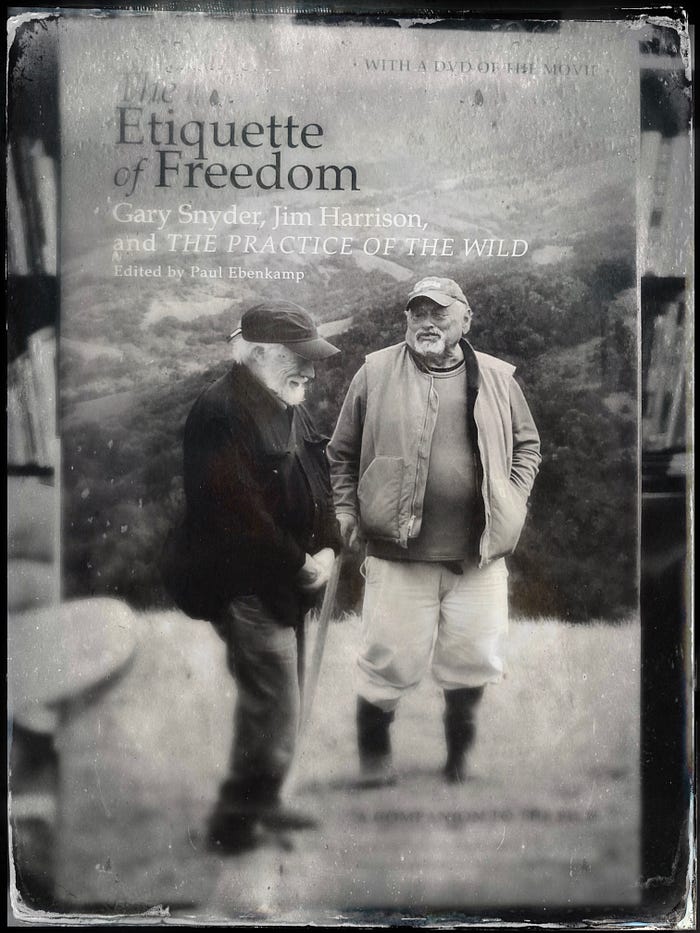
In one part of the video, Snyder talks about a series of poems he wrote with the title, “How Poetry Comes to Me.” Snyder describes the inspiration for his poems as a wild animal that cautiously approaches him just beyond the campfire.
He quotes a bit of his poem in the video:
It stays frightened outside the circle of our campfire. I go to meet it at the edge of the light.
Harrison replies, “You are in the ring of the firelight and you go to meet the arriving poem at the edge of darkness.”
Snyder says, “And so the suggestion is that the dark is very rich too.”
Harrison says, “True, fecund.”
Snyder explains that the idea came to him on an actual camping trip. The nights got very cold, and they’d start a fire. There was a huge boulder nearby reflecting heat onto them.
Snyder adds:
And as it got down below freezing, I could hear animals or something, maybe deer, moving out in the edge of the darkness there. And so I walked step-by-step quietly out farther and farther from the heat and the light and more and more into the cold and the dark and I knew there were presences. And I said, ‘Oh yeah, this is like art!’
I often marvel at the mystery of creative inspiration.
Ideas seem to alight in my consciousness, and I have no idea where they come from. But like a cautious deer approaching at edge of a firelight, the best creative epiphanies find me when I stretch myself. When I risk more, through bold experimentation or complete vulnerability.
The best art is fearless.
It doesn’t worry about the audience, commerce, popularity, clicks, or fame.It comes from a place deep within, just outside the firelight, where the mysteries of the forest and its mystical presences whisper their secrets if you’re brave enough to visit and listen.
Perhaps this is why I require so much solitude.
A desire for solace
After early retirement from my law enforcement career to become a writer, I became increasingly monastic in my lifestyle and routines.
Whether immersed in my home library, reading in the backyard, or taking long walks with my dog, this hermitic way of life benefits the work I produce.I make time for family and close friends, but if there are too many people around me, I fear they’ll chase away the cautious deer at the edge of the firelight.And without the mysterious creative epiphanies of the forest and its creatures, the best prose may never reveal itself.
Similarly, Jim Harrison preferred the woods to people.
Even after the financial success of “Legends of the Fall,” Harrison still preferred the outdoors to the tyranny of Hollywood parties and noisy crowds.
As noted in the aforementioned Esquire piece:
But success, at least in the traditional sense, has never been much of a concern for Harrison. Instead, he’s always sought safe haven in the woods of northern Michigan, a desire for solace that he shares with many of his protagonists. ‘You can be in a thicket and see out, but people can’t see you in there. We all know the woods are safer than people,’ he says.
I think we all long for solace.
The many indignities, hardships, losses, and vicissitudes of life wear us down. We look in the mirror and see a different person staring back at us. Someone with life’s journey etched across our features and a corresponding understanding that time is growing thin.
In the video, Jim Harrison tells Gary Snyder:
I used to tell students when they were being unpleasant, The difference between poetry and you is you look in the mirror and say, ‘I’m getting old,’ right, but Shakespeare looks at the mirror and says, ‘Devouring time, blunt thou thy lion’s paws.’
I’ve been thinking about those lion’s paws lately.
The fertility of the soul
Over the last few years, I experienced a lot of loss.
Loss of a mother. Close friends. Our beloved cat. And most recently, a dear mentor who succumbed to cancer.
A kind reader emailed me and wrote, “Mourn, but don’t dwell.”
Good advice.
Dwelling on things we have no control over is unhealthy. Loss comes to all of us, sooner or later. As well as aging, infirmity, loneliness, and the recognition that there is less time ahead than behind us.
This is why I find solace in Jim Harrison’s thicket in the woods.
A safe place where I can observe the world without being seen. It’s also why I like Gary Snyder’s description of how poetry comes to him. How we have to leave the warmth and safety of the campfire, and commune with the mystical deer and “presences” at the edge of the forest.
Gary Snyder once wrote:
I hold the most archaic values on earth…the fertility of the soul, the magic of the animals, the power-vision in solitude…the love and ecstasy of the dance, the common work of the tribe.
I like that line…“the fertility of the soul.”
We all want our lives to be enriched by the very best of things. Beloved family, good friends, comfortable homes, meaningful work, and creative passions. These things are what make life sweet, and illuminate our souls with warmth and goodness.
Sooner or later, the sharp claws of the lion’s paws will find us, and devouring time, eternity itself, will subsume us. But until then, we must steal a page from Jim Harrison.
Escape the madding crowds.
Find your thicket in the woods, where the peace and solitude of nature can restore your spirit. Then, remember the promise of Gary Snyder’s “presences” at the edge of the campfire light. Those mysterious creatures who dwell in the darkness of the forest, and who dare to meet you halfway, and serve as your artistic muse. Learn their secrets, and channel that knowledge into your creative work.
Do all this, and someday they may find you, like Jim Harrison, collapsed at your writing desk or easel.
They’ll talk about how you stayed true to your artistic and creative sensibilities. How you were authentic, fearless, real, and beautiful. You communed with the wild things at the edge of the forest, just beyond the campfire light, and shared their wisdom.
Do this, and you’ll transcend the lion’s paws. Time may devour you, but it won’t matter. Your work will live on.
And you’ll belong to the eternities.
Before you go
I’m John P. Weiss. I write elegant stories and essays about life. If you enjoyed this piece, check out my free weekend newsletter, The Saturday Letters.
—
This post was previously published on Medium.com.
—

If you believe in the work we are doing here at The Good Men Project, please join us as a Premium Member today.
All Premium Members get to view The Good Men Project with NO ADS.
Need more info? A complete list of benefits is here.
Photo credit: joel herzog

