



In times of global crisis, it’s easy to point our collective finger to the foreign. To what we don’t understand.
It’s easy to follow our current leader’s example: calling COVID-19 the “Chinese virus” and blaming other countries for the emergence of the disease. To cast blame on other, more exotic, cultural practices.
It’s easy to picture a Chinese man, sitting in a wet market, slurping down bat soup with chopsticks, blissfully unaware that this simple action would lead to a global pandemic. If only they didn’t eat bats — it’s easy to think — then we wouldn’t be in this mess.
This triumphant finger-wagging is not only xenophobic, but narrow-minded. If we believe that wet markets are the sole originators of disease, then we ignore the dangers beneath our own noses.
Don’t get me wrong. Wet markets are cruel and dangerous. They have barbaric animal welfare practices and their mere existence can easily cause preventable outbreaks. Dr. Fauci, the leader of the American Coronavirus Task Force, has called for the immediate prohibition of wet markets for their huge risk of the emergence of novel diseases. And bats, often found in wet markets, incubate more disease than most mammals.
But they’re not the only problem we have. There is a danger far closer to home than we can be comfortable with. A danger that we eat for breakfast, lunch, and dinner. A danger that’s grilled on the Fourth of July and roasted for Thanksgiving.
Meat.
Factory farming and industrialized animal agriculture have vast ecological effects. It wastes water, it destroys land, and it pollutes our air. And now, more clear than ever, it presents a huge risk of zoonotic diseases.
The next pandemic may emerge from bat soup in a far-flung wet market halfway across the world.
Or from a plate of eggs and bacon.
. . .
What is a Zoonosis?
Zoonoses are diseases that can be transferred from animal to human. Some, like Lyme disease, don’t pose a risk for human-to-human transmission. But others, like COVID-19, very much do.
Zoonoses are a huge danger to human health, as we are all very much aware; 75% of new human pathogens of the last 25 years are zoonotic. Every year, a billion humans are infected with a zoonosis. Most of these infections are endemic, meaning they are constrained to a be specific region, but they’re still deadly.
Consider a longer history of zoonotic infections. We’ve all likely heard of a disease in recent memory that has originated from animals: H5N1 (commonly known as Avian or bird flu), H1N1 (commonly known as swine flu), Ebola, West Nile Virus, Nipah virus and MERS, among others. Each of these was first incubated in animals (pigs, bats, ticks, mosquitos, camels, and more) before spreading to humans.
The emergence of such “zoonoses,” is facilitated by the human disruption of natural ecological conditions, which has allowed for increased human-animal contact. (Catherine Machalaba & co., 2015)
Most experts agree that COVID-19 likely emerged from a wet market in Wuhan, China. When many different animal species, some of which are brought together from disparate regions, it creates an unnatural form of biodiversity that allows viruses to jump from species to species.

Photo by Anastasiia Chepinska on Unsplash
Giant Petri Dishes
Factory farming is a completely unnatural phenomenon that mankind imposes on the animals, the environment, and the land. We breed animals for slaughter, crowd them together, ship them to non-native habitats, and ultimately slaughter them for distributions across an entire continent. It’s no wonder Mother Nature is rebelling.
Factory farms are petri dishes. But instead of amoeba crawling around in agar, farmed animals are miserably crowded in horrific, unsanitary conditions.
The methods of factory farming makes the animals far more susceptible to host a zoonotic disease than if they simply ran free. For one, the animal populations are bred, artificially imposing low genetic diversity in a species. In modern factory farming, each pig has almost an identical immunological response to the pig next to it. The virus can then easily jump between hosts and then mutate.
If the hosts are all quite similar, then the viruses are able to proliferate and replicate with greater success. Once the virus base is huge, it is able to mutate and might become more virulent to jump the species gap to infect other species too. — Anadish Pal, environmentalist
Second, they are overcrowded, meaning if a disease were to originate, it would spread infect hundreds of animals in a matter of days. Each animal is barely given enough room to stand; six feet of social distancing might as well be a joke.
Third, the animals are understandably under severe stress while kept alive, which may compromise their immune systems. This allows the virus to jump from animal to animal at a faster rate and increase the chance of mutation.
The problems continue after the animals are slaughtered. Slaughtering animals is a violent and messy process, that allows gut bacteria to infect slabs of meat, other animals, or the slaughterhouse workers. Animal body fluids, a known carrier of disease, are incredibly prevalent on slaughterhouse floors. During packaging, animal carcasses are often mixed and combined together; a single sausage may have parts from many different animals. It follows that a single infected pig may end up in grocery stores across the country.
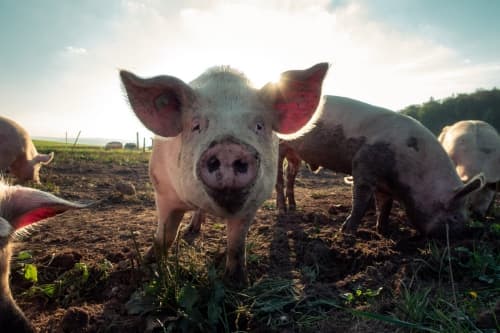
Photo by Pascal Debrunner on Unsplash
Just like prisons are basically a breeding ground for viral diseases, leading to many prisoners being temporarily released to prevent COVID-19 from spreading, factory farms are perfect incubators for an emerging disease.
Tens of thousands of animals with nearly identical immune systems crowded together nose to tail? Viruses might as well be licking their lips.
. . .
But this goes far beyond conjecture. It’s happened before.
Factory farming has already caused, in part, two zoonotic diseases in humans: the H5N1 bird flu outbreak of the early 2000s and Nipah virus from 1998. The bird flu outbreak was likely created due to the high mixing of flocks (allowing the disease to jump more naturally from hosts) and spread to humans due to a widespread distribution of the poultry (Machalaba, 2015). The Nipah virus was able to spread in Malaysia because fruit bats infected the highly intensified pig farming industry there.
Such a study, which included years of field data collection on fruit tree distribution, pig farm management. . . and mathematical modelling of virus infection dynamics, identified the intensification of the pig industry as the driver of the zoonotic emergence of Nipah virus in Malaysia (Cunningham, 2017).
Thankfully, the Nipah virus, despite its 60% fatality rate, was contained in Malaysia. Next time, we might not be as lucky.
If an animal like a rat passed on a disease to a farmed animal like a chicken, the consequences could be disastrous. The disease could spread through an entire factory farm within a day, perhaps less, due to insufficient space. With over 20,000 chickens per factory farm on average, the disease would have plenty of hosts with similar genetic material, creating a greater chance of jumping from one species to another.
It’s scary stuff. Even if the eventual disease doesn’t have human to human transmission, it could still infect 100,000 human beings, depending on how widely the factory farm distributes.
And, if the disease is capable of human to human transmission….well, let’s say that Zoom boredom would be a best-case scenario.
Climate Change
Like with the vast majority of human life, climate change has an adverse effect on pandemic prevention.
Climate change and deforestation are upending, in some capacity, the natural habitats of basically every animal on Earth. Rising temperatures are changing bird migration patterns, polar bears are going extinct, and animals are fleeing rainforest being cleared for animal agriculture farms. As biodiversity changes faster than normal, it raises the likelihood that species will intermingle in ways unheard of several years ago. Parasites in particular are susceptible to changing climates and habitats.
Natural biodiversity limits the exposure and impact of many pathogens, including those that are zoonotic, through a dilution or buffering effect. (Cunningham, Daszak, & Wood, 2017)
As natural landscapes are bulldozed and demolished, the animal survivors will have fewer habitats to call home. These animals, such as bats and rats, come in closer contact with humans and farmed animals, creating an increased risk of infection. A 2017 study found a correlation between the change in land-use at the emergence of zoonosis. In other words, the destruction of land can lead to new diseases.
Animal agriculture is one of the leading causes of rainforest destruction. 14,400 acres of rainforest are cleared every single day in order to create soy products for cattle feed. Animal agriculture contributes more to greenhouse gas emissions than all of the world’s transportation systems combined. Factory farming destroys natural biodiversity.
Sick Pigs and White Swans
Aside from perhaps Spot and Fido, animal agriculture is the largest animal/human interaction in modern America. Every single day, most Americans eat the flesh or byproducts of a variety of farmed animals: eggs for dinner, chicken breast for lunch, pork roast for dinner.
It’s absolutely true that certain animals — bats and certain rodents among them — are more at risk to create zoonotic disease. However, bats interact with humans at a far lesser rate than farmed animals. The foods we eat every day deserve just as much scrutiny as bats.
If a disease were to emerge among farmed animals, it could potentially cause an impact far more devastating. Meat from industrial factory farming reaches far more people than wet markets; in other words, meat can infect by the hundreds of thousands.
Zoonoses intuitively seem like black swans. Black swan events, as characterized by Nassim Nicholas Taleb, are rare and hard-to-predict events with massive consequences, like 9/11 or a lottery winning. However, while zoonotic diseases absolutely have some unpredictability in origin, scientific research can tell us where and when they may pop up. The COVID-19 pandemic, Taleb argues, is a white swan: predictable, preventable, perspicuous.
A disease that is spread from bat to human has a possibility of containment. A disease spread from pig to human could reach thousands of omnivorous Americans within a matter of days.
A disease spread from pigs to humans could be catastrophic.
Don’t be Gwyneth Paltrow
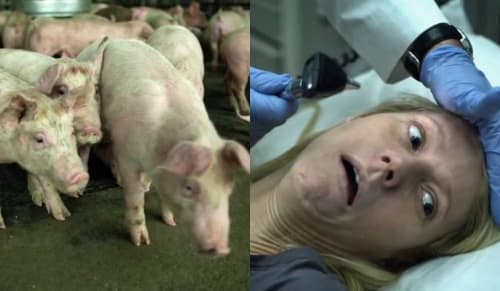
Think of the massive sleeper hit Contagion (2011).
In the movie, a bulldozer destroys banana trees while clearing a rainforest. A bat, fleeing the destruction of its habitat, resides briefly in a nearby pig factory farm. It drops a piece of banana. A piglet eats the banana, unknowingly ingesting infected bat saliva. When the pig is later slaughtered for a fancy meal, Beth (Gwneth Paltrow) becomes Patient Zero of novel virus MEV1.
The disease then goes on to kill millions of people worldwide.
Contagion | 2011
Now, while MEV1 may be fictional, its entire premise is completely plausible. It’s easy to see events like these taking place in the real world: animal agriculture destroying natural habitats, animals fleeing and then mixing together, and then this disease spreading amongst farmed animals until it passes to humans.
If we are to truly be proactive, to truly mitigate these odds, we have to turn our analytic eyes to the West’s own history of factory farming and animal agriculture. They are far more prevalent than smaller wet markets.
Humankind needs to take many steps forward in order to mitigate or prevent the next epidemic. We need to revamp our health policies to allow people to work without the risk of infecting others. We need to have plans to increase testing capabilities. We need to abolish wet markets. And, finally, we need to end the unnatural practice of mass factory farming.
Every day, there are more and more alternatives to eating farmed animals. Factory farms are an unsustainable practice that leads to deforestation, water waste, and now, more clearly than ever, the possibility of the next viral pandemic.
If eating a Beyond Burger instead of a chicken thigh was the key to stopping the next COVID-19, wouldn’t you give it a shot?
—
This post was previously published on Greener Together and is republished here with permission from the author.
—
***

If you believe in the work we are doing here at The Good Men Project and want to join our calls on a regular basis, please join us as a Premium Member, today.
All Premium Members get to view The Good Men Project with NO ADS.
Need more info? A complete list of benefits is here.
Talk to you soon.
—
Photo credit: https://www.cdc.gov/

