



Kelly Sample can’t believe his own brain injury story – or the photos of the car he was driving that night. Since then, he has lived every minute of his life to the fullest. His unparalleled resilience is why he was the first recipient of the Brain Injury Alliance of Arizona’s Man of Courage award, which was presented at the organization’s Brainiac Bash Soiree Supporting Brain Health.
On July 3, 2008, he had left his restaurant in Avondale to check out his Peoria eatery, which was just down the road from his house. He had the next three days off for the holiday weekend and was looking forward to returning to work refreshed.
He was within five minutes of his home when everything changed in an instant.
Kelly sums it up nicely: “I say A NOT so funny thing happened on the way home one night; actually, it took me 3 ½ months to get home.”
A car had just pulled out into the right lane, so Kelly switched lanes to avoid them. In so doing, his left front tire clipped the six-inch curb framing the landscaped median. His car immediately began to roll over, shearing off a 25-foot pine tree.
His airbags had deployed, but his car wasn’t finished rolling. Ricocheting off a second pine tree, he ended up on the other side of the street. Paramedics, fire, and police officers who have seen photos of the scene say it may be among the worst single car accidents they have seen where the driver was not killed instantly.
Still in a coma, Kelly was taken by ambulance to the nearest trauma center, John C. Lincoln North Mountain Hospital, because paramedics decided it was quicker than airlifting. The damage to his body was extensive – 2 internal organ surgeries, a surgical femur (thigh) rod implant to repair the snapped right leg from the gearshift, and 12 broken ribs that left him with extreme breathing difficulty due to the impact with steering wheel.
He also had loss of sight in his left eye from a brain bleed, a stroke affecting his right arm and leg, broken scapula, calcaneus, ankle, and neck requiring fusion of vertebrae C5 and C6 (C7 could have meant a lifetime in a wheelchair). What’s more, he had lacerations on his face, arms, and legs, as well as a deep gash across his left hip from the lap belt that likely saved his life by keeping him the car.
The night of the accident, doctors told in family members to prepare to say their final goodbyes to him. But here’s the thing about Kelly Sample: He never gives up.
After 2 ½ weeks in the hospital and still in a coma, he was transferred to St. Joe’s Select Specialty Hospital. “My family was told my situation was so bad, I had two options: Get into long-term acute care or possibly Hospice. My daughter went out visiting long-term acute care centers.”
That’s when his previous cervical neck fusion became infected, and they wheeled him across the bridge to Barrow Neurological. After that surgery, which was 4 weeks since the accident, he came out of his coma and started in-patient rehab.
Barrow was anything but easy. Comas were induced intermittently for nearly five weeks to assess the healing progress. However, when they would bring him out of the coma, his “fight or flight” impulses would set in.
Since he couldn’t speak, he had a tracheotomy tube protruding from his throat. With his left hand (the right side had been paralyzed from the stroke), he would pull out the tube. Attending staff had to tie his hand down, but that had negligible effect as he would subsequently yank it out with his right hand. “I was somewhat relieved when they told me later this was normal,” recalls Kelly. “But at least this helped me regain function of both my hands.”
Seeking to accelerate his rehab, his family learned of an intensive program at the Barrow Center for Transitional Neurorehabilitation (CTN). His family was told they seldom take patients directly after discharge from Barrow, due to their waiting list, but Kelly persevered and was accepted within one week.
Over the course of the next 16 months, he battled to regain as much of his former life as possible. In addition to the physical rehab, he was challenged with homework, projects, quizzes, and memory puzzles. In the evenings he caught up with what was happening at his restaurants.
As always, his sense of humor gave him perspective, “Before the accident, I was a Type A personality. Now I’m more like a triple-A.”
Kelly is also quick to point out that his family, close friends, and coworkers did the real work. “For almost a year and a half, they developed a transportation team, where one of the team would drop me off at CTN at 8, then pick me up at 4, five days a week. I will be forever grateful to them for that huge sacrifice, to and from Central Phoenix in rush hour traffic in both directions.”
As part of his journey back from brain injury, he focused on his restaurants, which were struggling to recover from The Great Recession. However, Kelly always looks for silver linings. “In retrospect, the accident may have saved my life. I was in a coma while the recession devastated my three restaurants. I’m sure if I knew what was going on financially, I would have had a heart attack,” he says, half-kiddingly.
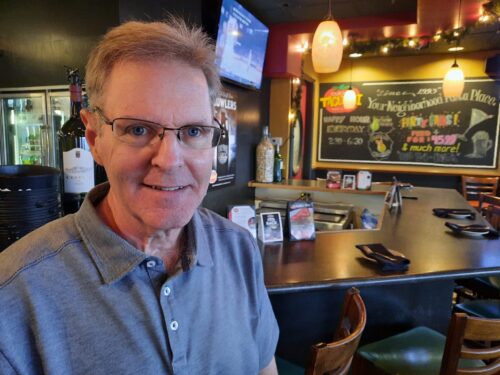 Seven months after the accident, he triumphantly got out of his wheelchair walked with a cane into his Avondale restaurant. “I had to start recovering by readjusting to society, remembering tastes, smells, relearning everything, how to walk, talk, eat, shower, shave.” He also started to gain an admiration for those helping him get there. “Before the accident I was never a sentimental kind of guy, it was all business. Over the course of my rehab, I’ve developed a new appreciation for doctors, neuro professionals, psychologists, physical and speech therapists, first responders, you name it.”
Kelly believes his recovery was enhanced by the Brain Injury Alliance of Arizona. “I started getting involved with them in 2010 when they were under a different name. I went through materials I had gotten from Barrow/CTN a year and a half prior, then realized I had to call them. I’m so blessed I did because they had resources and referrals I never knew about. More important, they connected me to the brain-injury community and support groups.”
That community is what has sustained Kelly and indeed become his motivation. He is passionately involved with the world around him. “I want to do is give back, so I do everything I can. I understand I’m playing in ‘extra innings’ so if selling spaghetti helps me be able to give back to others, maybe that is part of the reason I am still here.”
It started at the 2010 BIAAZ bowling event (at Bowlero, across the street from his Glendale restaurant Cucina Tagliani). During the 2011 fundraiser, he became visible in Phoenix media due to his associations with radio personalities Dave Pratt and Darrell Ankarlo – both 2012 Team Cucina Tagliani members. In fact, he originally met Pratt when they both attended a 2010 event for Luis Gonzalez’ retirement ceremony at Chase Field; they discovered they were both survivors, Pratt (cancer) and Kelly (TBI/stroke).
Carrie Collins-Fadell has nothing but admiration for Kelly’s commitment to helping others. “His battle to stay alive is one thing. However, his drive to help others recovering from brain injury is nothing short of remarkable. Kelly is extremely visible in the brain injury community informing others of the resources and programs available to them, regardless of their situation. Although he would never admit it, he displays the kind of courage that those with or without brain injury look up to.”
Today, the father of two and grandfather of two lives in north Peoria. He was honored with the Man of Courage award at the Brainiac Bash on January 14, 2022.
“I am humbled by this award,” he says with typical modesty. “I feel there are many more deserving of it. At CTN, everybody would tell their horrific Injury stories; sadly, there is no shortage of nominees for this honor next year. I’m fortunate I had family and friend support, great insurance, and DES/State of AZ support. Not everybody is so lucky with divine intervention.”
As his journey to recovery took shape, he turned to his sister Cindy, and declared he had been blessed and needed to go “on a church search.” Together they started attending a non-denominational.
“I came back from a near-death experience. I lost vision in my right eye. I had a stroke and brain injury. I have scars and I occasionally stutter. So, when back on what got me here…I’m proud to be where I am in my life.
“When I see someone I haven’t seen since the accident, they say, ‘It is great to see you!’ I reply, ‘It is great to be seen rather than viewed,’ Trust me, there is a difference.”
—
Previously Published on Brain Waves and is republished on Medium.
***

Support us on Patreon to help us build a better, more inclusive world for all.
***
Images courtesy of author

