


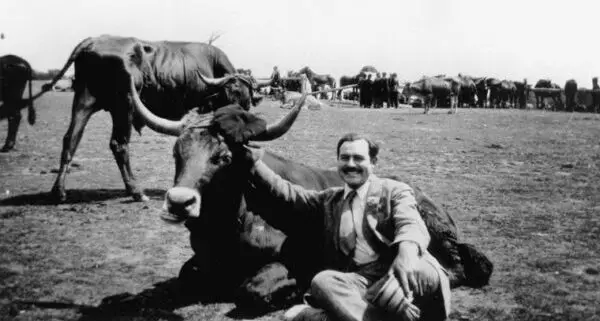
When I was nine years old my mother had me read The Old Man and the Sea, by Ernest Hemingway. I don’t know whether she wanted to expose me to great American literature, or perhaps knowing I loved boats and fishing, thought I would enjoy this particular book. Probably both.
Being literary buffs, my parents always spoke of Hemingway with admiration. I was led to believe he embodied the best of American male traits. Besides being the Greatest American Author, he was ruggedly handsome, a fearless war hero, as well as a real man’s man (as well lady’s man). He had a killer smile, was an adventurous outdoorsman, and was an international ambassador of American values. He had only been dead four years when I read that book.
Ken Burns has always been my favorite documentarian. Everything I’ve ever seen by him has left me with a deep understanding and an emotional connection with the subject. The West, Jazz, The Blues, Baseball, New York, are just a few of the multi-hour presentations I’ve observed over the past 30 years. He is truly an American Master.
Watching his latest six-hour presentation of “Hemingway,” I came away deeply saddened, if not sickened. I had held no illusions about Hemingway. I knew he was fond of bullfighting and big game hunting and fishing, things I had grown to abhor. And in the end, he committed suicide.
He was also a severe alcoholic (something he shared with my birth father). I learned he rejected his father’s prudent religious nature and possessed deeply rooted mother issues. A fan of bullfighting and killing animals for sport, his love of brutality extended to his desire to be in the thick of battle where he, although prohibited as a war correspondent, always took up arms in fighting his enemy of choice.
And while Americans were unduly proud of this man, he almost never lived here, choosing instead Paris, Spain, London, and his most favored, Cuba. The American town he preferred most was Key West, Florida, a tiny island in the Gulf of Mexico that least resembled our heartland. While he lived and worked in a palatial house donated by his wife’s uncle, he spent the majority of his day fishing or drinking in Sloppy Joe’s bar.
Perhaps due to his unresolved mother issues, he was deeply co-dependent and unable to stay faithful to any of his four wives, all of whom were strong women. Due to his abnormal appetite for taking risks in his life, he suffered numerous concussions, possibly contributing to the depression that ultimately took him. But most likely, it was a combination of his deeply rooted unhappiness, along with his immense intake of alcohol that ultimately resulted in him putting a shotgun to his head.
So, are these the American values that are so vaunted? Hemingway is the embodiment of a real man? Handsome and rugged on the surface, while self-medicating with never-ending addictions to alcohol, sex, and killing, ultimately resulting in depression and suicide? Yet this is how many of our parents and our parent’s parents secretly lived their lives. Believing in fierce independence, seeing receiving help as weakness, seeing the American way of life as exceptional, always putting up good appearances, and then drinking themselves to sleep at night.
What I recall most about The Old Man and the Sea was that it seemed to be about endless toil, loneliness, struggle and ultimately, failure. Maybe these were the messages my mother wanted me to imbibe, to prepare me for my life ahead. And as an impressionable nine-year-old, undoubtedly some of those beliefs imprinted themselves deeply upon my subconscious. It is only due to the good fortune of meeting my Spiritual teacher when I did, and through the help and guidance of the wonderful teachers and mentors I’ve had ever since, that I’ve managed to unlearn those old beliefs and adopt values centered around love, spirituality, reverence for life, gratitude, collaboration and community.
I owe each of them a debt I cannot repay, for, without them, my fate may very well have been the same as Ernest’s.
—
Previously published on Facebook
—

