


January 6th, 2006 was the first day of the second semester of my sophomore year of college. I’d transferred from Santa Clara University, where my father did his undergrad and grad school, to Azusa Pacific University, a Christian University in Southern California. I transferred there because they, unlike Santa Clara, had a film program, and I wanted to be in Hollywood and make movies. For Jesus, naturally.
Anthime Joseph Gionet, better known as “Baked Alaska,” was also at Azusa Pacific in 2006. Gionet was two years behind me — a freshman when I was a junior — so while I lived in University Park my junior year, he probably lived in Trinity, the big co-ed freshman dorm, or Smith, the freshman dorm that was exclusively male.
He, like me, studied film. To the best of my recollection, I don’t remember sharing a class with him or having a conversation with him. The film program, however, was small, so odds are we shared professors or at least passed each other on the way to and from our classes.
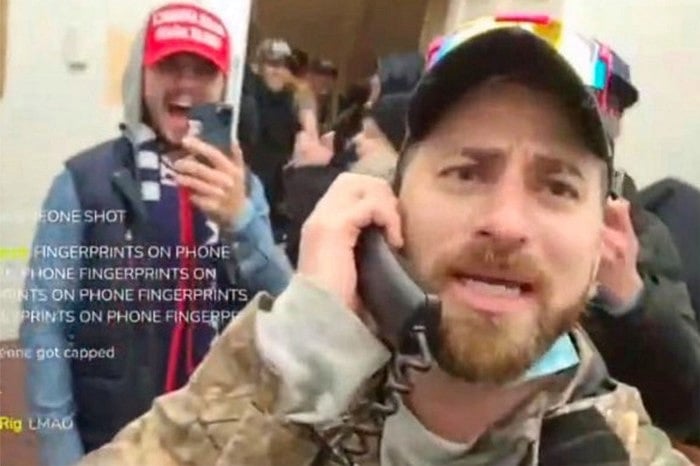
On January 6, 2021, fifteen years to the day after my first day at Azusa Pacific, Gionet made news for livestreaming the riot at the Capitol building. On that day, five people died as a result of the violent crowd that broke into the People’s House. Windows were smashed. Offices were vandalized. White domestic terrorists, hiding under the banner of “patriotism,” stole property, attacked Capitol police, and smeared the ground with shit and urine.
Gionet was arrested ten days later in Houston, Texas, due largely to the self-captured video evidence of his crimes.
I remained friends with several men I graduated with from APU, and two days after the riots, I learned via text about Gionet’s participation in the insurrection. In the immediate days that followed, my mind fought to reconcile how Gionet and I attended the same college yet wound up in such different life circumstances.
Well, I thought, he might’ve committed treason, but not me. I didn’t storm the Capitol.
But did that not sound like just another version of “I didn’t own slaves?” Were those words just one more attempt from someone — myself, in this case — who descended from majority White Male American Culture to slither away from any sort of personal reckoning or accountability?
When I looked at Gionet and those who stormed the Capitol with him — Jake Angeli (white guy in Viking hat), Kevin Seefried (white guy with Confederate flag), and Erik Munchel (white guy with zip ties) — I saw a bunch of white guys.
Like myself.
When I looked at videos of people erecting crosses mid-riot, praying, and carrying “Jesus Saves!” signs while also storming the center of the U.S. Government, I saw more white guys.
Like myself.
When I looked at the Charleston shooting in 2015, the Las Vegas shooting in 2017, the Pittsburgh shooting in 2018, and the El Paso shooting in 2019, I saw more white guys.
Like myself.
The two cultural systems that raised Gionet, Western Evangelical Christianity and White Supremacy, were the same ones that raised me. We both grew up in families that went to church. We both took part in missions trips as high schoolers — he traveled to Russia, while I traveled to Central and South America. We both attended private Christian schools and universities.
Growing up in the dual cultures of Western Evangelical Christianity and White Supremacy, my gender and skin color were valued above everyone else’s and afforded me immense privilege. Heroes in movies and television looked like me. Men — white, hetero men — were rich, super buff, good with a gun, got the bad guy, got the girl, got and did whatever they wanted without impunity or responsibility.
It wasn’t just restricted to movies and television, however. Pastors in pulpits looked like me. They were personal representatives of God. The glorious figures of the Bible — Moses, David, Joshua, Peter, Samson, Joseph — they all looked like long-haired, bearded versions of me, at least in their white-washed depictions.
In the stories I was taught, God as Father (and only Father, mind you) used these men to make His will manifest. He cared for them. Spoke through them. Loved them.
Even Jesus himself — the Savior of the world, the Messiah, the Lion and the Lamb — he looked like me, too.
None of this information regarding the systems of Western Evangelical Christianity or White Supremacy is new, and none of it justifies the actions of men like Gionet.
Or myself.
Without question, these words come at a convenient time, when antagonism against white supremacy is high and President Trump has left office. I could’ve written some version of this essay years before; back when President Trump, slathered in an oil slick of toxic masculinity, boasted of grabbing women; or back in the summer of 2020, when he had Black Lives Matter protestors tear-gassed so he could walk a few blocks, stand in front of a church and have his picture taken, all for his name’s — and a photo op’s — sake.
I could’ve written this earlier, but I didn’t. My silence, I told myself, didn’t negatively affect my life circumstances, so it was okay for the time being. I wasn’t banned from traveling, wasn’t evicted, wasn’t cut off from aid, wasn’t discriminated against or called names. I permitted myself to chug ignorance and pretend I wasn’t drinking bleach.
I knew, and I said nothing. I regret my inaction. The fact that I had an option to remain silent lays bare my privilege. My choice to remain silent and believe that my silence didn’t also harm me, on the other hand, reveals both my ignorance and cowardice.
In the wake of the attacks on the Capitol, multiple politicians from both the Democratic and Republican Party denounced the actions of the domestic terrorists and bleated, “this is not who we are.” That’s a useful balm of a narrative, but I don’t believe it’s true. Ibram X. Kendi, in his Atlantic article, “Denial is the Heartbeat of America,” argues that what gives the United States its identity is not its capacity to overcome catastrophe, but instead its profound, horrific ability to deny its own complicity in said catastrophes.
This is how a nation can steal land through massacre through “doctrine” and not account for its bloodshed. It’s how that same nation can acknowledge slavery but avoid reparations. It’s how we can call for unity after the Capitol attacks yet avoid accountability for four years of purporting lies and conspiracy theories.
It’s how in the White Evangelical Church, the system I considered home for most of my years, acknowledgement of and reckoning with the past had no point. After all, “once I was lost, but now I am found.” The sinful past was rendered void of any instructive capacity.
For too long, I’ve shunned reckoning with a cultural past that didn’t fit the story I told myself about myself: The good guy. The nice guy. The guy who was on the right side.
I, a white Christian male, a product of White Supremacy and White Evangelical Christianity, have long been able to construct a narrative of my own choosing, an image of my own making. Since birth, I’ve had permission to envision myself as some kind of savior, continually fed (and seeking out) the image of a hyper-masculine, warrior Messiah who resorts to violence to impose his will and maintain control.
I’ve been able to denounce years of violent acts and mass shootings in the United States, especially when committed by white men, as the works of lonely, troubled individuals. Their isolated actions do not, I’ve been allowed to say, reflect the attitudes of the whole. Yet at the very same time, I’ve been permitted to label other communities, BIPOC communities specifically, with blanket opinions, and have been able to do so without impunity.
If only they would just work harder.
If only they would just not be so angry.
If only they would just obey and do what the officer tells them.
The riots at the Capitol building weren’t an assertion of power, but rather a gross revelation of fear. But in my opinion, what makes these fears and fragilities dangerous — the fears of White Extremists, the fragilities of Christian Nationalists — is the long-standing cultural permission to weaponize the fear and bring harm to others, all under the idea of self-preservation, all under the assurance we as a white male culture won’t be held accountable for our actions, all while telling ourselves we’re doing the right thing for our country and our God.
I write not to claim any sort of arrival or complete transformation, but to instead acknowledge my brokenness and need for personal change. I lament the actions of those who attacked the Capitol, and I lament my own complicity in allowing such a culture to proliferate.
I’ll end with a bit of Scripture from the Gospel of Matthew: “After a little while, those standing there went up to Peter and said, ‘Surely you are one of them’…then he began to call down curses, and he swore to them, ‘I don’t know the man!’”
It would be more convenient for me to reject any and all associations with Gionet. It would be easier for me to say, “I don’t know the man.”
But I do. Quite well, in fact.
He’s the one staring back at me in the mirror.
—
This post was previously published on Equality Includes You.
***

If you believe in the work we are doing here at The Good Men Project and want a deeper connection with our community, please join us as a Premium Member, today.
All Premium Members get to view The Good Men Project with NO ADS. Need more info? A complete list of benefits is here.
—
Photo credit: Dominic Laing

