


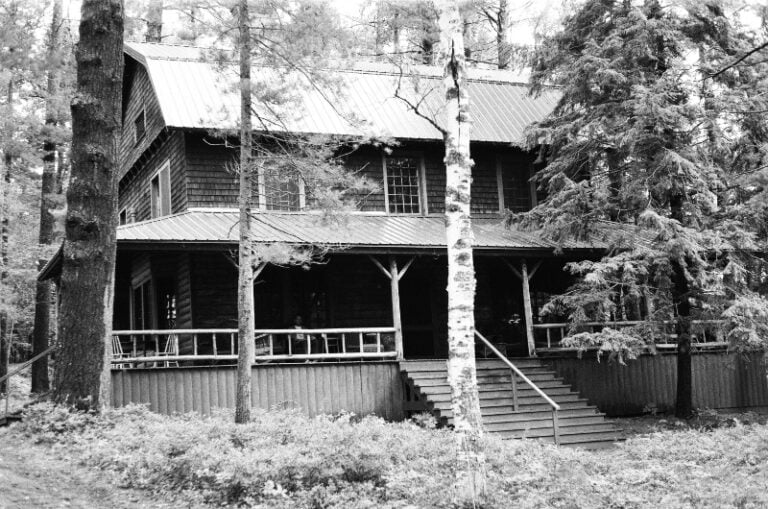
That is why I find it strange when tropical architecture is treated mainly as a matter of visual style. We often look at buildings from Europe, the United States, or places with very different climates and copy the image without carrying over the logic of adaptation. But architecture must always negotiate with sun, wind, rain, materials, and the habits of the people who use it.
In a hot, humid climate, thermal comfort should not be solved only by adding more air-conditioning capacity, which increases energy demand.
I am more interested in a simpler question: what did local architecture already understand long before modern mechanical cooling became common?
Rumoh Aceh offers one answer. In one of our published studies on the traditional Acehnese house, we examined how its architectural characteristics respond to the local environment.
The traditional Acehnese house is raised on stilts. Its floor sits above the ground. Timber is the main material. Small gaps between floorboards and wall boards allow some air exchange. The roof is high, and traditionally many houses used thatch made from sago palm leaves.
If we look at these features only as a style, they are easy to reduce to ornament. If we read them as climatic responses, their logic becomes more useful.
The raised floor allows air to move beneath the building. Openings and gaps can support ventilation. A high roof creates more air volume above the occupied zone and separates people from some of the heat that accumulates near the top.
Not every principle can be copied literally into a contemporary building. That is not the point. What matters is the way the house responds to climate before relying on machines.
A 2024 study on the thermal conditions of Rumoh Aceh, published in Heliyon, found that orientation and location were associated with differences in indoor temperature, humidity, and air speed. To me, that makes vernacular architecture more than cultural heritage. It also becomes evidence of climate knowledge developed through long experience.
The same way of thinking should continue outside the building.
Roads, yards, parking areas, and open spaces in our cities are increasingly covered with asphalt, concrete, or paving blocks. These surfaces absorb heat during the day and release it back into the environment. As vegetation decreases and impermeable surfaces expand, the microclimate changes with them.
So tropical design should not stop at the facade.
We need to ask how much ground really needs to be hardened, where shade can be created, where soil and vegetation can remain, and whether buildings or site elements are blocking useful wind paths.
For me, three old ideas remain especially relevant: create a real path for cross-ventilation, make the building envelope respond to the climate, and reduce hardscape that adds unnecessary heat around the building.
None of these ideas is technologically impressive. That may be exactly why they are easy to overlook.
The energy question makes them harder to ignore. The International Energy Agency has noted that buildings account for around 30 percent of global energy demand. Decisions about orientation, ventilation, shading, materials, and cooling therefore reach beyond one building. They accumulate.
Passive design is not nostalgia. It is part of an energy strategy.
I do not think we should return to building every house exactly like Rumoh Aceh. Technology, spatial needs, safety, materials, and lifestyles have changed. What we need to recover is not the form, but the intelligence behind it.
The point is to let a building work with the wind and shade available on its site before asking mechanical systems to do all the work.
Perhaps the challenge for tropical architecture in Indonesia is not to search for forms that look increasingly foreign. It may be to look again at what has already worked in front of us for a long time, then translate that knowledge through today’s technology and needs.
Ar. Azlan Shah, S.T., M.Ars., is a lecturer in Architecture at Universitas Islam Negeri Ar-Raniry Banda Aceh, Indonesia, and a practicing architect.
—
This post was previously published on medium.com.
Love relationships? We promise to have a good one with your inbox.
Subcribe to get 3x weekly dating and relationship advice.
Did you know? We have 8 publications on Medium. Join us there!
***
–
Photo credit: Quincy RoseS On Unsplash

