


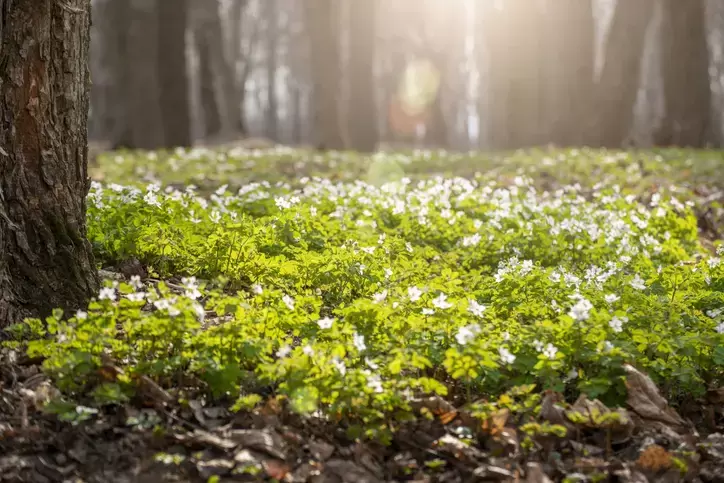
I stood on a hill this morning, just outside our small town in the Emilia-Romagna region of Italy, and I couldn’t help but wonder: When did we lose our connection to the logic of the land?
We live in an era of grand environmental promises. Here in Emilia-Romagna, the regional government had committed to a noble goal: planting one tree for every inhabitant. It’s the kind of headline that wins elections and garners “likes” on social media. And indeed, a slope near my home — a space of about two or three football fields — has recently been populated with rows of new bushes and saplings.
On the surface, it’s a win for biodiversity. But as I watched a municipal tractor methodically shaving the life out of the meadow between those saplings today, I realized that we aren’t practicing conservation. We are practicing “tidiness” under the guise of ecology.
The Cult of the Mowed Lawn
The meadow was beautiful this morning. It was a tapestry of daisies, buttercups, and several wild species that, if they aren’t protected by law, certainly should be. In the spring, this is not just “grass”; it is a vital buffet for pollinators. Bees, butterflies, and insects that form the very foundation of our food chain depend on these “untidy” spaces.
And yet, the municipal workers were out in force. They mowed the grass to a military buzz-cut between the rows of newly planted bushes, leaving only tiny tufts of green immediately surrounding the stems.
Why?
The meadow is not used for recreation. No one is playing football there. The wooden platforms scattered randomly across the slope — mysterious structures that look like sunbathing decks or abandoned stages — remain largely ignored. The grass isn’t being harvested for animal feed. So, why spend the fuel, the man-hours, and the ecological capital to destroy a flowering meadow in the height of spring?
Is it “occupational therapy” for council workers? Or is it something deeper — a lingering, archaic obsession with “order”? We seem to have a collective psychological allergy to anything that looks wild. A mowed lawn is a sign of “care,” while a flowering meadow is seen as “neglect.” In reality, the mown lawn is a biological desert.
If the goal was access to those strange platforms, a few winding paths mowed through the tall grass would have sufficed. Even better, why not hire a local shepherd to let a flock of sheep graze for a few days? It would fertilize the soil, maintain the vegetation naturally, and save the taxpayers money. Instead, we choose the loudest, most carbon-intensive, and most destructive method possible to maintain an aesthetic of “neatness” that serves absolutely no one.
The Pendulum of Panic: From Neglect to Destruction
This lack of common sense becomes even more dangerous when it meets public safety.
At the bottom of the slope runs a small stream — more of a drainage channel than a river. Two years ago, our region experienced a night of catastrophic rainfall. The volume of water coming off the fields was unprecedented, overflowing the ditches and sending a wall of mud and water into the town center. Garages were submerged; basements were filled with silt. Even the oldest residents had never seen anything like it.
The cause was clear: years of criminal neglect. The drainage channels had been allowed to choke with fallen trees and debris. When the crisis hit, the water had nowhere to go.
The criticism of the local government was loud and justified. But the reaction was a classic example of the “pendulum effect.” We went from total neglect to total destruction.
Instead of a surgical intervention — removing the fallen logs and clearing the specific blockages — the municipality sent in the heavy machinery. Within days, they didn’t just clear the stream; they obliterated the entire ecosystem surrounding it. Years of growth — elderberry, ivy, dense thickets of scrub — were hacked to the ground. This “jungle” was a sanctuary for birds, pheasants, and countless other creatures.
Now, it is a barren, brown scar in the landscape.
The authorities call this “flood protection.” I call it blind activism. By removing every scrap of vegetation from the banks, they have removed the very thing that holds the soil together. The stream is flanked by a steep, tilled field. Without the roots of the bushes and the dense ground cover to act as a buffer, the next heavy rain will wash half that field directly into the channel.
The soil will turn to mud, the mud will clog the pipes and culverts downstream, and we will have the exact same catastrophe we were trying to avoid — only this time, we will have no birdsong to accompany the cleanup.
The Myth of “Tabula Rasa”
This “clean slate” approach is the antithesis of true conservation. Nature is a system of nuances, but our management of it is increasingly binary: we either ignore it until it becomes a hazard, or we “maintain” it until it is dead.
We see this everywhere, not just in small Italian towns. We see it in massive reforestation projects where monocultures of the wrong trees are planted in the wrong soil, only to die or become fire hazards five years later. We see it in “green” urban developments that replace ancient trees with potted saplings that provide a fraction of the cooling and carbon sequestration.
We are obsessed with the act of planting, but we seem to have forgotten the art of nurturing.
In our town, the manpower used to destroy the stream-side habitat could have been used for genuine maintenance. They could have spent those hours removing the dead, hanging branches from the old-growth trees that actually pose a risk to passersby. They could have focused on expanding the forest canopy rather than manicuring the grass beneath it.
A Plea for Common Sense
What we are missing is a middle ground. The “as much as necessary, as little as possible” approach.
True conservation requires us to embrace a certain level of “messiness.” It requires us to understand that a bush isn’t just a fire hazard or a flood obstruction — it’s a windbreak, a soil stabilizer, and a home. It requires us to realize that “nature” isn’t something we just put in a box or a neat row; it’s a living, breathing process that often knows better than we do.
If we want to protect our environment, we need to stop treating it like a suburban front yard. We need to:
- Ditch the Aesthetic of the Short Grass: Let the meadows bloom. Stop mowing for the sake of mowing.
- Practice Surgical Maintenance: If a stream is blocked, clear the blockage. Don’t bulldoze the entire bank.
- Think in Systems, Not Headlines: Planting a million trees is great, but protecting the existing soil and the existing biodiversity is even better.
- Listen to the Land: Use the wisdom of the past — like grazing animals or traditional water management — instead of relying solely on heavy machinery and fossil fuels.
As I finished my walk this morning, I looked back at those neat rows of bushes on the shorn hillside. They looked like soldiers standing on a battlefield. We had “conquered” the weeds, we had “organized” the slope, and in doing so, we had silenced it.
It is time we realized that the best thing we can do for nature is often to just let it be. We don’t need more “action” if that action is disconnected from logic. We need a little less “management” and a lot more respect for the wild.
Otherwise, we are just planting the seeds of the next disaster and calling it “progress.”
—
This post was previously published on Notes from the Anthropocene.
***


If you believe in the work we are doing here at The Good Men Project, please join us as a Premium Member today.
All Premium Members get to view The Good Men Project with NO ADS.
Need more info? A complete list of benefits is here.
Photo credit: iStock

