



I recently wrote a story that surprised me when it blew up.
It wasn’t what I expected — it was a story I’d written in a mere few hours on the fly, in fact. A “filler” story to keep me posting regular articles. It was a simple but honest story about how life is different when you’re sober, and for some reason, it took off.
Whenever that happens, I’m a mixture of pleasantly surprised and mildly confused, and my imposter’s syndrome starts to kick in a bit, admittedly. Why doesn’t every story do this? Why does it happen when I least expect it? Why is it that a story I spent a week writing and perfecting gets minimal views while a random story that was conjured up on the spot soars comparatively?
When a story takes off like that, my knee-jerk reaction is to analyze what happened, to pour over my data, and to try to decipher what my readers are really looking for. I realize now, though, that I don’t need to do that at all.
While it’s helpful to know your audience, it’s also helpful to know what you like — what resonates with you—before you even put your thoughts on paper. It’s no secret that honest, from-the-heart stories touch people in a way that how-to pieces never could, so there’s no real mystery in this mystery.
So how do you keep this momentum going? That’s the easiest part to answer — you write. In the world of online writing, I am coming around to one very real truth: more is more.
A future dad
Here’s a little story to get the ball rolling. We all know (and many of us love) Tim Denning. He’s one of the most successful writers that I know of, and he writes compelling stories from the heart that touch us emotionally while also providing useful, actionable advice.
That’s a damned near perfect writer, if you ask me.
Tim spent years writing online before he recently became a dad. I suspect his writing frequency will change as time moves forward, and even more so when you consider the time he spends on his other writing projects, such as his books and courses. At the height of his Medium career, however, he was writing something like ten articles a week, if my memory serves me correctly.
That’s an absolutely bonkers amount of writing for someone like me, whose day job currently is to raise two entire humans; there’s not much time left to write ten articles a week. But there’s something about this effective approach that I really like.
The more you write and the more you put out into the world, the more likely you are to find success. It’s a simple but universal truth: if you don’t write, no one will read your work.
And we all know what that leads to: a whole lot of nothing.
Spaghetti on the wall
My recent approach to writing has been Tim Denning-inspired, and as a tribute to his new dadness, I’ve decided to throw the proverbial spaghetti onto the wall (there’s a lot of actual spaghetti on the kitchen walls in Tim’s future.)
When I started writing online a few years ago, I decided the best approach was slow, steady, and careful. I went to university for journalism, so in theory, I had a tiny bit of skill under my belt, and I wanted my writing to be perfect. I wanted my writing to be professional and quotable and viral.
I learned pretty quickly that you can’t force perfection, and you can’t be successful if you don’t write enough. The four people who read that lovingly crafted article might love it, but that’s not going to cut it in an excessively competitive online market.
My new approach is to throw spaghetti on the wall and see what sticks. That doesn’t mean that I’m replacing quality writing with poor-quality writing, but it does mean that I have a system. It means that now I use a template to guide me, one that enables me to write quickly and effectively so that I can get as close to Tim Denning’s ten-a-week status as I can.
I’m throwing as much as I can out there for you all to see, and sure, some of those stories are duds. What’s important, though, is that a lot of them aren’t duds, and the more I write, the more success comes my way.
This approach has led to my earnings increasing by over 200% in the last two months, and I’d really like that trend to continue.
You’re (probably) not a psychic
I’m going to go ahead and guess that, chances are, you aren’t able to predict the future.
While it would be wonderful to know exactly what your readers want you to write about, you can’t read their minds. You can’t predict what other writer will swoop in and snag their attention, or what other form of media will pull them away from reading your work. You can’t predict what they will crave or what they will find boring.
What you can use is data. That’s it. You can see what your readers are interested in according to the data, such as with the story that I referenced at the start of this article:
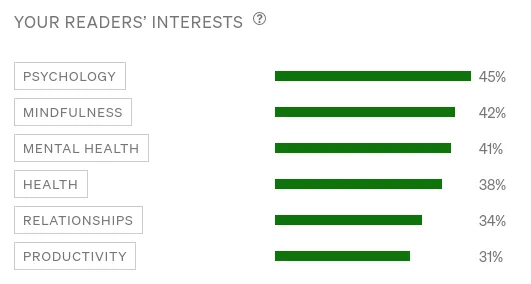
Image captured by author
In my case, my readers appear to care about psychology, mindfulness, and mental health for the most part. Cool, cool. That’s kind of overwhelming, right? Think about it: how many topics fall under psychology? Oodles. Mindfulness? Heaps.
So I don’t sweat this stuff too much. Yes, I use it, and of course I try to keep within those parameters when I’m writing a story under any of those umbrellas. But beyond using tags effectively and writing a compelling headline, there’s not much else I can do to attract the attention of every reader in those categories.
Instead, I just write a lot. Then I write some more.
More is definitely more
I’m not sure where the old saying “less is more” originated from, but I’m inclined to think it wasn’t inspired by anyone who writes online for a living.
When decorating a home or writing a speech, this saying has some merit. Too many contrasting colours in a home might make it garish; too long a speech might become tedious to listen to. But when it comes to writing, less is definitely just that — less.
Less views, less money, and less success. Doing less online usually means you’ve lost motivation or confidence, and that ultimately leads to quitting altogether. But doing more? That will never be the wrong choice.
In online writing, doing more of whatever it is you do is how you head towards success. By doing more, you make more mistakes that you can learn from. By doing more, you learn how to write better. By doing more, you learn what works and what flops.
For me, I noticed that when I started doing more and increased the volume of my output, I saw a genuine return on that investment. It wasn’t just one viral article that set me up for more success; it was the multiple articles I wrote alongside that article, too. The more articles you put out there, the better your chances of success.
It’s really just about playing the odds, and when it comes to writing, you have to go all in.
—
This post was previously published on Lauren Hall’s blog.
***
You may also like these posts on The Good Men Project:
 White Fragility: Talking to White People About Racism |
 Escape the “Act Like a Man” Box |
 The Lack of Gentle Platonic Touch in Men’s Lives is a Killer |
 |
Join The Good Men Project as a Premium Member today.
All Premium Members get to view The Good Men Project with NO ADS.
A $50 annual membership gives you an all access pass. You can be a part of every call, group, class and community.
A $25 annual membership gives you access to one class, one Social Interest group and our online communities.
A $12 annual membership gives you access to our Friday calls with the publisher, our online community.
Register New Account
Need more info? A complete list of benefits is here.
—
Photo credit: iStock


“While it’s helpful to know your audience, it’s also helpful to know what you like — what resonates with you—before you even put your thoughts on paper.” This is so true, Lauren! Throughout my writing career, I have consistently been writing content that appeals to readers, regardless of my personal interest in the subject matter. But, it wasn’t until I began sharing honest stories and personal experiences from my own life that I truly started to attract a dedicated following and receive positive feedback. People (readers) love it, as it often touches them.
Thanks, Lauren, for this wonderful article. I believe this article will blow up as well. You truly motivated me to decide to write more. You are right; you never know what will attract people’s attention at a specific moment, so writing as much as possible is the key to success.