


When I was a teenager growing up in Illinois, I drove a 1974 Comet. She was a 2-door tank with a rare creamsicle orange-on-white exterior. Its monochromatic, wall-to-wall orange interior covered the dashboard, steering wheel, door panels, and headliner. With a powerful 302 V8 under the hood, it was the ultimate “bold-on-a-budget” cruiser.
At some point, the heater core broke. I found out the hard way—green antifreeze hemorrhaging all over the passenger floorboard. After cleaning it up with a couple of rolls of cheap paper towels, I took the car to a mechanic. The cabin now featured a Little Tree-style signature scent of ‘Boiling Glycol’—a bold, chemical fragrance that was very much “the rage” that season. He gave me two options: replace the heater core for about $120 or bypass it for $40. For a cash-strapped teen, I wasn’t about to tie up $80 of fast-food money on a car part I couldn’t even see. I went with the cheaper option.
For the next three Illinois winters, I drove without heat. On bitter days, my breath fogged the windshield instantly. Passengers—including dates—faced the same problem, navigating my embarrassment. I explained that we had a choice: we could drive to the movies, or they could keep yapping and ice up the windshield. “We’re almost there!” I like to think I was just being practical.

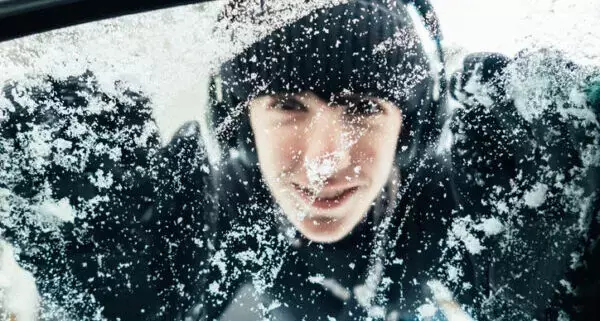
To mitigate icing on the interior, I developed a method of huddling inside my own coat that made me look like a frightened prairie dog. But snow and ice presented the real ordeal. This was early‑1980s Illinois, when winters were punishing even by Midwest standards. One storm alone—the January 1982 blizzard—dumped up to twenty inches of snow, piled drifts six feet high, and stranded thousands of motorists while the National Guard dug roads back out. Without defrosting capability, buildup formed on both the outside and inside of the windshield. I pulled over constantly to scrape with an ice scraper, often losing ground as fast as I cleared it. On more than one occasion, I drove with my head stuck out the window!
One icy evening after church, during an ice storm, I was frantically scraping when an older gentleman noticed my struggle. He fetched a can of De-Icer spray from his car, handed it over, and said, “If this ever happens again, just spray it on—it’ll melt everything away.” I thanked him, tucked the can into my glovebox, and went on my way.
For years afterward, through countless snowy drives, I never fixed the heater and never used the De-Icer. My reasoning? I was saving it for a real emergency. When I finally sold the car, there it sat in the glovebox—mint condition and untouched. I shook my head, reflecting on all the times I’d wrestled with the harsh Illinois winters instead of deploying that simple, effective tool. At the time, I thought this was just a story about being cheap. Turns out I accidentally documented large swaths of modern American behavior. Gold star for me!
Looking back, this wasn’t grit or discipline; it was a predictable mess of bad instincts dressed up as frugality. I was seduced by the siren song of the cheap, quick fix: bypassing the heater instead of repairing it properly. Eighty dollars felt like a fortune. Three winters of misery felt…educational. Behavioral economists coined a technical term for this specific brand of freezing martyrdom: “cheap-bite.”
There were a few times—usually when the scraping got frantic, when my fingers were numb, and traffic hissed past—that I actually remembered the can sitting inches away in the glovebox. I’d picture spraying it on, the ice collapsing, and the windshield clearing like a fitness center on February 1. And then I wouldn’t use it. I’d tell myself this wasn’t bad enough yet, that I could muscle through, that I should save it for when things were really dire. So, I kept scraping.
Then came the hoarding of the De-Icer—it became ceremonial. It wasn’t to be wasted on ordinary weather, like preserving folded guest towels or those flower-molded artisan soaps. Possibly to be handed down like a family Bible. After that, nothing seemed like a legitimate emergency, and so I passed it up again and again—until the downward spiral locked it away forever, unused.
Now, smart preparation for real uncertainty is wise and responsible. The problem arises when that instinct hardens into ritual hoarding, preventing us from using what we already have to face the ordinary hardships right in front of us. It’s the same instinct behind “saving the good China” for an occasion that never quite materializes: over-preparing for hypothetical tomorrows while depriving ourselves of today.
These quirks are not uncommon. Sure, rationing made sense for The Donner Party, but not for mere inconvenience or a broken car heater. The can in the glovebox serves as a metaphor for every unused tool, unopened emergency kit, or unspent resource left sitting idle while we scrape by…unnecessarily.
Once you notice this pattern, you start seeing glovebox De‑Icer everywhere. On a personal level, how many of us own exercise equipment gathering dust, books we’ll “read someday,” or fancy clothes with the tags still on, receipts long gone? All of them preserved for the ideal version of ourselves that never quite shows up.
Emergency funds sit untouched for routine needs because of worry that “what if something bigger comes along?” Health symptoms get ignored until they erupt into full-blown crises. We put off maintenance on our homes, cars, and bodies, opting for quick fixes instead of addressing the root causes—just like I did with that heater core.
Think about America’s infrastructure crisis. As a nation, we’ve repeatedly opted for the $40 bypass—again and again—while insisting the real fix will happen next year. We hit potholes hard enough to knock the alignment out of our cars, re-elect the same officials, then act shocked when a bridge finally shuts down.
Governments often opt for quick fixes amid budget fights rather than addressing issues properly. Every report says the same thing: we don’t fix problems until they become embarrassing. We’re always one panel, one study, or one election away from finally spraying the windshield.
Culturally, this pattern permeates even broader issues. In an age of remarkable technological abundance, we espouse many theoretical solutions—everything from climate change and public health to educational gaps and social problems. However, the implementation of simple, practical tools we already have stalls because we wait for the “perfect” or “true emergency” moment. Instead of routine upkeep that could prevent bigger headaches—patching roads before they crater, maintaining schools so classrooms stay functional, or addressing neighborhood wear before it turns into blight—we often hold back, treating everyday fixes as too ordinary or risky to deploy. Ordinary discomforts—such as visible disorder on streets, ongoing struggles in schools, deferred upkeep in neighborhoods—persist while we keep effective tools in reserve, waiting for conditions that seem more urgent or less complicated.
We retreat to policies that kick the can down the road. The prepping culture and emergency stockpiles grow, while everyday quality-of-life improvements go unaddressed. Resources are more abundant than ever, yet the scarcity mindset keeps us scraping windshields in the snow. We endure unnecessary hardship—economic, environmental, emotional—because using the De-Icer feels like we’re wasting it.
The deeper tragedy is that this mindset perpetuates itself. Every time we choose to endure rather than act, the spiral of specialness tightens. The boiling frog gets a little warmer. But awareness offers an antidote. My children have heard the story so many times they now tease me about “using the De-Icer” whenever I hesitate on small pleasures or practical fixes. The lesson is simple but profound: tell the difference between smart preparation and reckless delay. Fix the root cause when you can.
Teenage me thought he was being responsible. Adult me knows he was just scared of the unknown—and very, very cold.
Preparation itself is not the enemy — fear-driven paralysis is. We should use the tools we already have when today is an emergency—when our families or we are actively suffering or losing ground. The trap, however, is treating every ordinary discomfort as something that must be endured, so the tool remains unused for a hypothetical worst day that may never come. Maybe we should shift from rigid scarcity thinking to wiser abundance thinking by asking not only “What if I need it later?” but also “What good is it doing me now, unused in the glovebox?”
In the end, that untouched can of De-Icer taught me more than any mechanic’s bill ever could. It wasn’t just about a broken heater; it was about how easily we trade present comfort for imaginary future security—and how our entire culture risks doing the same on a large scale. The ice is forming on the windshield right now. Maybe it’s time to spray.
iStock featured image

