



In the exquisitely sad film Living, actor Bill Nighy plays a joyless civil servant named Rodney Williams who works in the bureaucratic morass of the public works department. Set in 1953 London, Williams is one of those stiff, old-school city gents wearing an impeccable pin-stripe suit and Bowler hat.
The seemingly pointless tedium of Williams’s job is darkened more because he is a widower, estranged from his son and daughter-in-law, and he recently received a terminal diagnosis of stomach cancer.
Williams is given one year to live. He considers suicide, decides against it, and then meets an insomniac writer in a restaurant.
Williams confides in the young writer that he wants to live a little, then mournfully adds “…but I realized I don’t know how.”
Thus, the two of them spend a wild night on the town, visiting pubs, drinking, singing, and even visiting a striptease/burlesque show. A review of the movie in The Guardian tells you what happens next:
After a mad and undignified attempt at boozy debauchery in the company of a louche writer (Tom Burke), Mr Williams realises there is one thing he might still achieve: forcing the city authorities to build the modest little children’s playground for which local mothers have been desperately petitioning and which he and his colleagues have been smugly preventing with their bureaucratic inertia.
Through sheer force of will, and astonishing his co-workers with his deeply unbecoming new urgency and baffling desire to help people, Mr Williams is determined to get the playground built before death closes in.
In an interview about the film, Bill Nighy said that the movie explores death and procrastination, the latter of which he described as:
…the corrosive element in our lives.
When I think of the many people I’ve encountered over the years in seemingly soul-crushing, bureaucratic jobs, or who feel indecisive about their future, the more Bill Nighy’s comments resonate.
We all tend to play it safe.
We put off career changes, avoid risks, and delay our dreams. We procrastinate. So perhaps Bill Nighy is right about procrastination.
Maybe it is “the corrosive element in our lives.”
How do you not waste your life?
Whenever I watch beautifully filmed movies with poignant storylines, I often research who the author or screenwriter was.
In the case of the movie Living, I was pleased to discover the screenwriter was Kazuo Ishiguro, the Nobel prize-winning author of The Remains of the Day.” Ishiguro crafted Living as an adaptation of the 1952 Japanese film Ikiru, which was directed by Akira Kurosawa, which was partly inspired by the 1886 Russian novella The Death of Ivan Ilyich by Leo Tolstoy.
Ishiguro and his family moved to Britain when he was five and he didn’t revisit Japan for almost thirty years. His first two novels, A Pale View of Hills and An Artist of the Floating World, both explore the notion of people looking back on their lives with regret and bewilderment.
But Ishiguro’s brilliant novel, The Remains of the Day, surpasses his first two novels in plumbing the depths of regret and missed chances. An article in The Guardian describes The Remains of the Day thusly:
Set this time wholly in Britain in the 1950s, Stevens the butler, a believer in the elusive concept of ‘dignity,’ recalls his life of service to a man who was, we come to realize, a Nazi sympathizer. Stevens’s misplaced dedication has cost him his own chance of love and fulfilment, a realisation he comes to all too late.
The Remains of the Day is wonderfully funny and sad at the same time, ‘both beautiful and cruel’, as Salman Rushdie said. It won the Booker prize and was turned into a successful film, starring Anthony Hopkins and Emma Thompson, winning eight Oscar nominations.
Ishiguro admitted that he had in effect written the same novel three times, getting closer and closer to what he wanted to say. The result is a book that is perfection in its own terms.
In an online interview, Ishiguro says that, as a writer, he’s always been interested in the following question:
How do you not waste your life?
Anthony Hopkins and Emma Thompson give brilliant performances in the film version of The Remains of the Day. Hopkins plays the emotionally reserved butler, Mr. Stevens, and Thompson plays the head housekeeper, Miss Kenton. They are in love with one another, but Mr. Stevens is too remote to allow Miss Kenton inside his heart.
In one scene, Miss Kenton tries to find out what Mr. Stevens is reading. It is a love scene devoid of kisses, and it achingly captures Mr. Stevens’s repressed longing. But it also reveals a concealed sort of tragic romanticism.
Miss Kenton eventually leaves her position and marries another.
Years later, Mr. Stevens visits her in an attempt to lure her back into service, but she declines. Despite a troubled marriage, she still loves her husband, and there’s a grandchild on the way.
At the end of the movie, a stray pigeon gets into Darlington Hall (the estate where Mr. Stevens works).
Mr. Stevens and the new owner of the estate eventually catch the pigeon and release it out a large window. We watch the pigeon fly off as Mr. Stevens closes the window, thus sealing himself inside, in a kind of self-imposed prison of service, self-denial, and unrequited love.
It’s a powerful scene, perhaps because there’s a bit of the butler in all of us.
Make the best of what remains of my day
We all have times in our lives when we feel stuck, uncertain, unfulfilled, regretful, or simply adrift.
And that’s when “the corrosive element in our lives,” otherwise known as procrastination, rears its ugly head. We sense that change beckons. We intuit that a different path calls, yet we stand down. We stay put, afraid to spread our wings and escape, like the pigeon fleeing Darlington Hall.
Kazuo Ishiguro said in an interview that some of the inspiration for The Remains of the Day comes from a ballad by Tom Waits called “Ruby’s Arms.” It’s about a soldier who leaves his girlfriend in the morning. She’s sleeping and he slips away, perhaps to war or a different life.
The soldier in the song has a gravelly voice. A voice and a person not accustomed to expressing his emotions, much like the butler Mr. Stevens.
The song moved Ishiguro, and he realized that his novel needed Mr. Stevens to admit to himself that his heart was broken, which Mr. Stevens does in a scene near the end of the novel.
Perhaps, then, there is something to his advice that I should cease looking back so much, that I should adopt a more positive outlook and try to make the best of what remains of my day. After all, what can we ever gain in forever looking back and blaming ourselves if our lives have not turned out quite as we had wished? —Kazuo Ishiguro, The Remains of the Day
How do we not waste our life?
Admitting our broken hearts and past mistakes is only the first step. Whatever stage of life we find ourselves in, we must then decide the path ahead.
It’s never too late to change course.
I intentionally retired early from my law enforcement career to become a writer. I gave up a bit of extra pension. But every time I stroll into my backyard to read, write, and enjoy the fresh air and mountain views, I thank God for the peace and creative spirit that’s alive in me.
It’s never too late to atone for past mistakes, reinvent ourselves, and set off like Tom Waits’s soldier to a new future.
The key is to avoid the butler’s fate. To avoid being forever trapped in a wasted life of denial, unrequited love, and regret.
Look back to remember and learn.
Then, adopt a positive outlook. Say your apologies. Forgive yourself, if necessary. Set a better course. Make the best of what remains of your day.
Because your life is too precious to waste.
Before you go
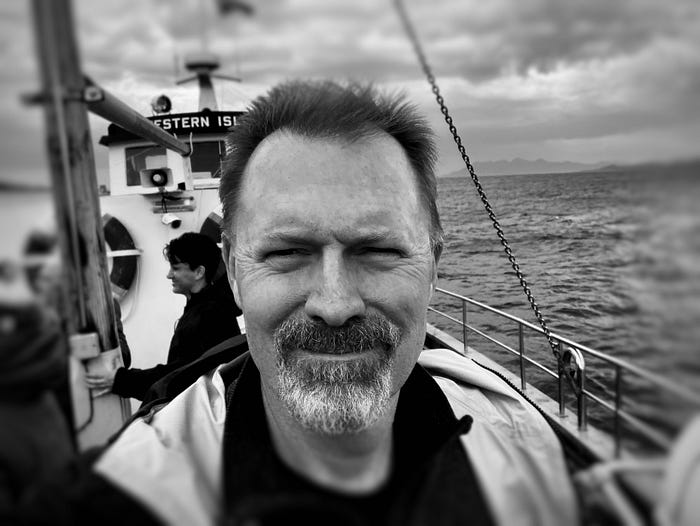
I’m John P. Weiss. I write elegant stories and essays about life. If you enjoyed this piece, check out my free weekend newsletter, The Saturday Letters.
—
This post was previously published on Medium.com.
—

If you believe in the work we are doing here at The Good Men Project, please join us as a Premium Member today.
All Premium Members get to view The Good Men Project with NO ADS.
Need more info? A complete list of benefits is here.
Photo credit: “My backyard.” Photo by John P. Weiss

