


My father was a station mechanic. When anything broke down at the factory where he worked, he would fix it. He once joked that on any given day, he might fix anything from a soda vending machine to the latest and most advanced type of production equipment.
He had gone this route primarily because he had suffered from dyslexia before anyone knew what dyslexia was. He was a smart guy who got labeled as a lazy student in his history and English classes, but he came alive once he got to Lane Technical High School, as it offered a place for bright, hands-on kids who weren’t headed for college.
He then honed his skills by becoming a sergeant in the US Army Quartermaster Corps, fixing advanced military equipment in Asia as a teenager. Coming back from the military, he got married and bought a house, in the city of Chicago, where he had been born. He had three children, of which I was the youngest.
He woke up every morning at 5am, Monday through Friday, to be out the door by 6am and was home by 6pm for the dinner my mother would have ready. I always smelled the lingering scent of his aftershave in the bathroom before school each day. He worked for the same factory for almost 40 years.
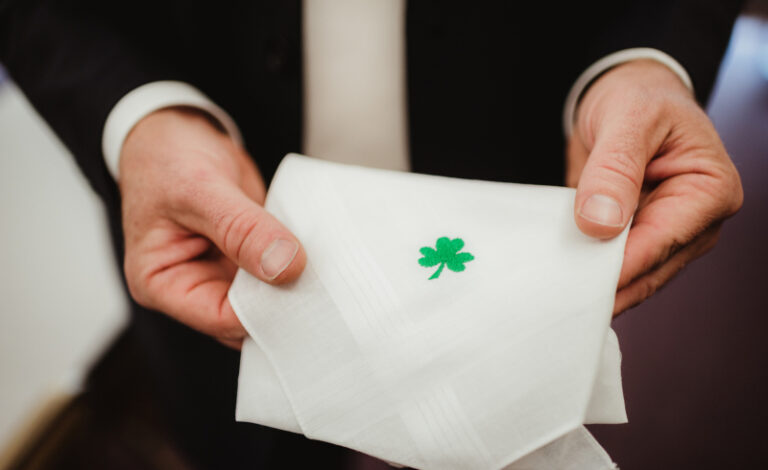
There were two things that my father always seemed to need: a nice car and a 100% cotton, pressed, immaculate, white handkerchief. Folks in Chicago waited for the massive auto show every January, and my father, older brother and I would trek over to it and pick out his new car for the year.
One year, my father bought a Mercedes, which made him the virtual potentate of our working-class neighborhood of Bucktown. Yes, a station mechanic made and probably still makes that kind of money. The white handkerchief? I don’t know where that started. But he always carried around a high quality, 100% cotton handkerchief with him. He kept it in one of his pants’ pockets.
Once, when I was four or five, we were in an auto parts store when a guy spilled some oil on the counter. My father instantly pulled out his handkerchief and tossed it to the man, who used it to soak up just enough oil to prevent a real mess. When the man turned to my father, apologetic, holding the now-ruined handkerchief, my father hesitated for just a second, then nodded and told him that he could toss it in the trash.
That tiny moment struck me hard as a child. There was a real pathos for me in watching that, probably because I was just a kid with emotional responses based on being a kid. To me, at that time, anything you owned and liked a lot that was broken or ruined and tossed out was sad.
I knew how much my father valued those handkerchiefs and watching one of them get soaked with oil and then casually thrown away felt like a kind of injustice, something small that mirrored something larger about his life that I intuited, even as a little one, as my father’s life was marked by early hardship; a cruel father, limited educational opportunities, ridicule at school and decades of steady labor that began at dawn and ended with steak, potatoes, a little TV in the living room and sleep.
In the summer of 2003, I got a call in New York telling me that my father was dying of brain cancer. Things were moving swiftly downhill, and there was really not much hope. My siblings had their own families to care for, and my mother couldn’t manage the situation alone, so the plan was to move him into a nursing home. Instead, I got out of my contract for the next academic year and came home to help care for him, with my mother, as well as I could, while he died a little each day.
When I arrived, he no longer recognized me. He thought I was my Uncle Ed. I took that as a compliment, as my Uncle Ed was tall, handsome, broad-shouldered; an ex-vet who became college educated through the GI Bill. He had been a type of ideal for me. He was a cool, smart, gentle guy who reminded me of every cool, smart, gentle guy – like Gregory Peck in The Big Country. That being said, I looked nothing like my uncle.
Each day I drove with my father to the hospital for radiation treatments meant to slow the growth of the tumor in his brain. That didn’t work out well, but at least, during that process, his memory of me returned. We converted our family dining room into a de facto hospital room, visiting nurses and helpers came and went, and I took some comfort in knowing that I had helped make sure he died, quietly, in the same house where he had raised his family. When he died, I saw for the last time what beautiful blue eyes he had.
So what motivated me to start writing about all this?
I was in Indonesia a while ago. Before that, I was in Vietnam, before that China. After Indonesia, I was in Hong Kong again and now in China again where I worked for several years and have many friends. I am not an international jet-setter, I am a guy with no family commitments and no permanent home but a relatively powerful passport and a robust savings account. But I’m now in a bit of a pickle, to put it mildly, and I’m not sure I’ll emerge from it well.
After teaching, I ran a small educational consulting business for a while in a Chinese city. A corrupt educational recruiter approached me through Chinese social media with what sounded like an interesting short-term university assignment for an improbably high salary. I repeatedly asked whether it was legal, and they assured me it was. They said that I had a master’s degree from Columbia, so I was qualified to do lectures at the vocational university in question.
I already had plans to leave China briefly, and they told me that while I was abroad I should obtain an F visa for an academic exchange, the university would supply an invitation letter. They insisted this was the correct procedure. But after the visa was issued, they slowly but surely revealed the real plan: there was no academic exchange, they intended to use that visa for me to do full-time teaching work and even expected me to lie about my background and falsely claim I was a current professor for a New York college. Like true con artists, they were very sweet and reassuring about all this.
The scheme gets really bizarre at this point, because to apparently make their scheme look real, the university found websites to publicize what is clearly a fake inter-college relationship between a New York college and the Chinese university participating in the scheme.
So this was quite an elaborate scam I had walked into. I have revealed this to the American college in question (which seemed shocked to see the Chinese websites involving a person falsely claiming to be an administrator from the college) and their legal staff has assured me they are working to address this matter despite a number of international and diplomatic obstacles. I also contacted the Chinese visa authorities and informed them of everything that happened and they thanked me for my cooperation.
To explain, the Chinese F visa is much easier and cheaper to obtain than a valid work visa, and the recruiter has been, from what I can tell, illegally funneling foreign teachers to some Chinese universities using this system. Indeed, for an educational scam like this, the F visa is perfect in that it does not require a criminal background check or even an academic credential check. It gives an established foreign professor 60 days in China to do academic exchange activities, for a small stipend, assuming that the person is coming from a legitimate foreign college with an established and real inter-college relationship.
With this scheme a recruiter can bring anyone they want into China and tell them to lie about their backgrounds and academic credentials. In my case, I was a real educator, but, frankly, if they run out of real educators they can conceivably bring anyone who speaks English in to teach the Chinese college kids while telling the English speakers to pretend to be professors from the American college in question.
Because I had given up my previous long-term visa, and reported the F visa to the Chinese authorities, I had to wait for the F visa to expire before applying for a new entry visa. Since Chinese authorities don’t seem to process complaints from abroad (they don’t seem to respond to email for these matters), I felt my reports on this visa fraud had to be filed in person with a passport and physical evidence.
So returning was the only way to hold the perpetrators accountable and stop them from criminalizing foreign teachers for some kind of profit. The recruiter and/or university seemed to suspect this and began harassing and threatening me through my social media.
From China I went to Vietnam, then I went to Bali and then Java (where I visited the temple of Borobudur and asked Shiva for help at the temple complex of Prambanan), then to Hong Kong to get a new entry visa, drifting on my passport and tourist visas with a single suitcase that weighs 19.1 kilograms (it has to be under 20).
As both my parents are gone, and I am single, I have no real place to return to in the USA, no job prospects at the moment, and I’m trying to assess what I might do with the last stage of my life. Yes, I have discovered that anxiety is the dizziness of freedom.
In Bali, I unpacked my freshly laundered clothes one night and found something unexpected: a large, white, high-quality 100% cotton handkerchief. I’ve gotten someone else’s laundry mixed in before, but this time, I took it as a sign I desperately needed.
It’s my father’s handkerchief. It’s the handkerchief he lost by being a good man and tossing it to a guy in need. Now it got tossed back to me, freshly laundered.
I’m back in China now, visiting some of my friends, working my way up to Shandong province where I want to file my first report and stop the criminal organization before they sucker other foreigners into their scheme, putting them at risk in a foreign country. I’m not going to let the recruiter and university do this if it is within my power.
Some folks are telling me this must be a hard-core criminal organization which must know people in local government, but I have faith in the Chinese, and the Chinese police are well-educated and seem to serve with a sense of integrity. Still, part of me worries.
If everything goes well, and I think it will, I’ll keep trying to live with integrity, regardless of consequences (this isn’t the first time I’ve gone through something rough for doing the right thing), and I will continue to write essays and stories and articles that have an edge and that matter, wherever my suitcase and I land.
After I reorient myself and before I run out of money, I’ll try to find work that is meaningful to get the stability I think we all need. I’ll find ways to be a good presence among whomever I interact with and will keep striving for greater humanity in myself and the world.
I’ll also carry this handkerchief in my pocket now; a symbol of the dignity, service and quiet endurance of my father. His concern for my welfare, and his confidence that I will live honestly and bravely, has transcended his death.
—
This Post is republished on Medium.
—
Photo credit: iStock

