


Some Americans hate America. They think it’s a horrible, sexist, racist, homophobic place. I’m not one of those. But I’m also not an American of the rah-rah variety, who thinks the United States is perfect. It’s not.
However, one thing America IS — a nation where most of the people now living here are either immigrants or the descendents of immigrants. Obviously this is not the case for African Americans who were transported here on slave ships, or for Native Americans, who were subject to genocide.
Along with the internment camps during WWII, Jim Crow, etc., these are deep stains on the fabric of our nation.
However, there is also a reason that the United States has a border crisis — because people want to come here.
Other countries, like the former East Germany and the modern day North Korea have walls to keep people trapped within their borders. The United States, however, is one of those places that have walls for a different reason.
Which is not to say that we haven’t been a welcoming place. In fact, with 50.6 million immigrants, America has the highest number in the world. They make up more than 15% of our population of 331.4 million. Only Germany comes close, with 15.8 million immigrants.
The first people to arrive here were the Native Americans, who came over from Asia many thousands of years ago. Unfortunately for them, when the Europeans came, their numbers were decimated by unfamiliar disease.
One reason that immigrants coming through Ellis Island and other checkpoints were examined carefully — to keep pandemics from spreading.
After the initial settlements by the English, the French, and the Spanish, people from other parts of Europe started to arrive. This resulted in waves of openness to the new arrivals where they were made to feel welcome that alternated with periods in which there was a lot of anti-immigrant sentiment.
The hostility was particularly bad against the Irish who arrived in waves after the Irish potato famine.
Prior to that, most Irish who came to this country were well off. A fictional example of this is Scarlet O’Hara’s family — they are wealthy and socially prominent. However, there were also poor Scotch-Irish immigrants who were never well liked by “respectable” society.
This article gives historical context on the waves of immigration along with the various anti-immigrant movements that periodically emerged.
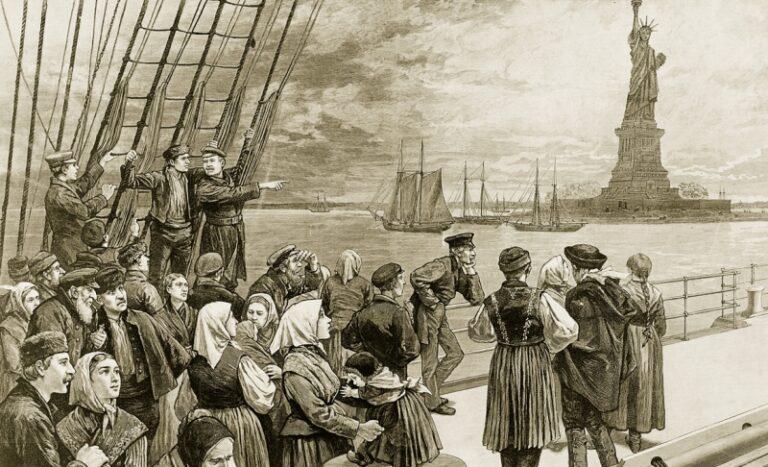
One of the massive waves of immigration occurred in the early 20th century, and one of the main points of entry at this time was Ellis Island.
I visited when I lived in New York, along with the Statue of Liberty.
While the Statue tells the world to send their huddled masses yearning to breathe free, in reality, there were boxes that immigrants needed to check before they were allowed into the country.
For example, a new arrival must have a place to go. A relative or other sponsor was needed, because New York did not want hordes of the homeless. However, people who already had an employer in America would not be allowed because this was associated with situations like the import of Chinese labor to help build the railroads.
This was objectional for two reasons — it exploited the workers and it took jobs away from Americans.
All immigrants, whatever their social class, were given physical examinations. Those who arrived on expensive liners had the medical staff come on board to conduct the exam, but if they were considered a health risk, they would be quarantined on Ellis Island along with the poor.
Ellis Island was opened in January, 1892. Annie Moore, a teen girl from County Cork, was the first person processed. More than 12 million immigrants would follow her through this access point between 1892 and 1954.
In 1907, when U.S. immigration peaked, there were 1.3 million people coming through Ellis Island alone.
One thing I didn’t realize — it was not just those being quarantined that were held at Ellis Island.
Sometimes people were held here because they didn’t have anyone who could vouch for them, and they might need to try to contact a relative, friend, or charity to help them find a place to stay so they could disembark. Other times, their names might not match the ship’s manifest, and that would have to be clarified, or there could be some other misunderstanding.
When this happened, people had to stay on Ellis Island.
Fortunately, they did not starve.
While early in the time period, the meals were often abysmal, this changed after President Teddy Roosevelt visited. He was so appalled by the meals served that he insisted on providing better meals.
The ones responsible for paying for the food? The shipping companies. They were supposed to ensure that people coming into New York Harbor were healthy and did not have any other reasons for not being allowed entry. Since they were considered at fault, they had to cover the costs, which included meals.
After Roosevelt got done with them, the corporations were providing three meals a day.
Given how many of the poor arrivals were in various phases of malnutrition and even starvation, they were stunned by the generosity of America when they received three nutritious and satisfying meals a day.
While you or I might find the food bland, for the immigrants, it was a harbinger of future prosperity.
In many parts of Europe, peasants had been starving periodically for centuries. It’s what sparked the French and Russian revolutions.
Meanwhile, in America at the time — no matter how poor you were, you were unlikely to starve. Some groups, such as African Americans and tenement dwellers of all races, were more likely to be undernourished, but for most of the new immigrants — America was a magical place, according to their diaries, letters home, etc.
I was particulary intrigued to read about how new immigrants reacted to bananas (which many had never heard of before, let alone tried), coffee (which they refused to drink, asking for milk instead), and ice-cream (which some immigrants thought was a type of butter and so spread it on bread.)
What stunned them was that all their meals were free.
Things have changed since then, obviously. When my family came to America, we came through an airport at the beginning of another wave of immigration. Now battle lines are being drawn again regardine immigration.
One thing to remember — this has happened before and will happen again. Regardless, in the long run, new arrivals learn to fit in. Having endured various hardships to come here, they are motivated to do so. And others will realize America is not the place for them and leave. Human beings have migrated as long as they’ve been around and I can’t see that changing, even if the next big destination for immigrants is extraplanetary.
I am fighting stage IV cancer. If you can help with medical bills, I would really appreciate it. Or if you enjoy my writing and would like to buy me a cup of coffee, that’s great too. Maybe someday I can return the favor.
—
This post was previously published on Shefali O’Hara’s blog.
***
You may also like these posts on The Good Men Project:
 Escape the Act Like a Man Box Escape the Act Like a Man Box |
 |
 |
 |
Join The Good Men Project as a Premium Member today.
All Premium Members get to view The Good Men Project with NO ADS.
A $50 annual membership gives you an all access pass. You can be a part of every call, group, class and community.
A $25 annual membership gives you access to one class, one Social Interest group and our online communities.
A $12 annual membership gives you access to our Friday calls with the publisher, our online community.
Register New Account
Need more info? A complete list of benefits is here.
—
Photo credit: iStock

