


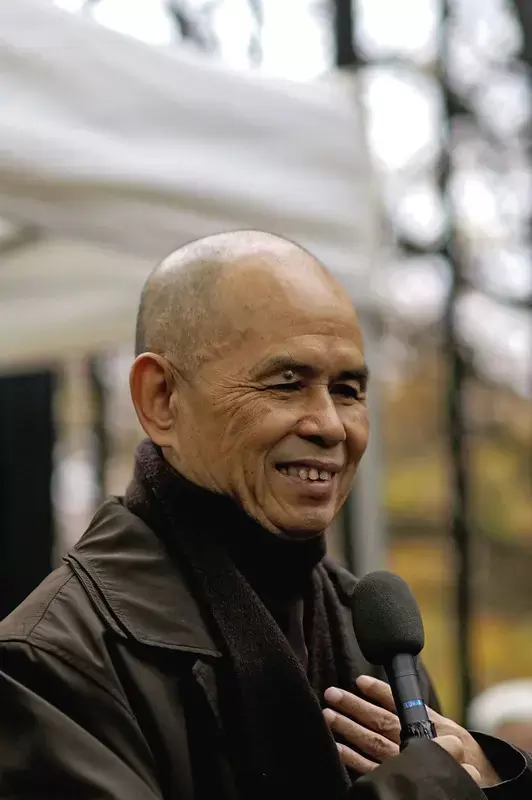
In 1967, the Rev. Dr. Martin Luther King, Jr. nominated Thich Nhat Hahn for the Nobel Peace Prize. Dr. King had met Hahn previously and they had become friends and comrades in the call to end to the American war in Vietnam.
In nominating Hahn, Dr. King wrote the following tribute to the committee on his friend:
I do not personally know of anyone more worthy of the Nobel Peace Prize than this gentle Buddhist monk from Vietnam.
This would be a notably auspicious year for you to bestow your Prize on the Venerable Nhat Hanh. Here is an apostle of peace and non-violence, cruelly separated from his own people while they are oppressed by a vicious war which has grown to threaten the sanity and security of the entire world.
Because no honor is more respected than the Nobel Peace Prize, conferring the Prize on Nhat Hanh would itself be a most generous act of peace. It would remind all nations that men of good will stand ready to lead warring elements out of an abyss of hatred and destruction. It would re-awaken men to the teaching of beauty and love found in peace. It would help to revive hopes for a new order of justice and harmony.
I know Thich Nhat Hanh, and am privileged to call him my friend. Let me share with you some things I know about him. You will find in this single human being an awesome range of abilities and interests.
Dr. King also described Hahn as a “holy man” who was “humble and devout.” He is not saying so because Hahn was a professed Christian. He wasn’t. He was a Buddhist professor, in exile from his homeland of Vietnam for his demands for peace through civil disobedience.
Hahn’s writings have been important to me for years now. I read him regularly. I listen to his meditation sessions. For the last decade, I have sought to understand his teachings and how he lived his life.
I have especially found Hahn’s teachings and meditations useful to my struggles with anxiety and stress over the years. When his death was announced today, the thought of how much he has helped me personally came immediately to mind but also his relationship with Dr. King.
They met in 1966 and Hahn told Dr. King in 1967 that Dr. King was a “bodhisattva, an enlightened being trying to awaken other living beings and help them move toward more compassion and understanding.”
Thich Nhat Hahn lived a righteous life and lived that life for others, and for all of the human family. He left behind a record for how to live.
Like his friend, the Rev. Dr. Martin Luther King Jr., whose life we just acknowledged last week, Hahn’s voice missing on the planet creates a void. We are lucky to have his writings. We would be wise to go read some of them:
“All violence is injustice. Responding to violence with violence is injustice, not only to the other person but also to oneself. Responding to violence with violence resolves nothing; it only escalates violence, anger and hatred, and increases the number of our enemies. It is only with compassion that we can embrace and disintegrate violence. This is true in relationships between individuals as well as in relationships between nations.” — Thich Nhat Hahn (2002)
—
This post was previously published on MEDIUM.COM and is republished with permission.
—
under CC 2.0 license

