



Around the corner, I visited my maternal grandparents’ resting place and my Aunt Catherine’s as well. They have all been gone for years now, so tears did not well up in me. Just fond memories of the past.
Making my way back to the car, I passed the same woman again, although now her eyes were dry. “I’m sorry for your loss,” I offered. She smiled and said, “Thank you.”
Her face looked familiar to me, in a haunting way.
We all look for ways to make the pain go away
The cemetery where my family members are buried is located in the hills of Northern California.
There are oak trees, squirrels, fountains, and beautifully maintained lawns surrounded by rolling hills in the distance. It’s peaceful and soothing.
I decided to sit on a park bench, near the spirit of my loved ones, and enjoy the sunshine and soft breeze. I tried to figure out why the sad woman I encountered was familiar to me.
And then the name Elaine surfaced and came into focus from the blur of my memories. The woman in the cemetery bore a striking resemblance to Elaine.
It’s odd how strangers can remind us of people we’ve known. Or maybe that’s the purpose of some strangers.
They help us remember.
Elaine was a beautiful young professional woman whose house I responded to many years ago when I was a young police officer. She had a sweet disposition and success as a computer engineer, but she had a tragic problem.
She was addicted to cocaine.
Her boyfriend called 911 when Elaine had a bad reaction to the cocaine they’d been snorting all evening.
There are all kinds of addicts, I guess. We all have pain. And we all look for ways to make the pain go away. —Sherman Alexie, The Absolutely True Diary of a Part-Time Indian
Upon arrival, my sergeant and I surveyed the living room where they’d been partying. There was a Cabernet bottle on a glass table beside two wine glasses, an empty cocaine vial, a razor blade, and other assorted paraphernalia.
“I don’t know, she started to shake a little and breathe funny,” the boyfriend said, adding, “I got scared and called you guys.”
We summoned an ambulance, and my sergeant spoke with Elaine. She admitted that she had a cocaine problem and that she bought the drug earlier that day. We issued her a citation and said her case would be forwarded to the District Attorney, who would likely recommend treatment if this was her first offense.
She seemed to be open to getting treatment, but sometimes the pain in people is bigger than the cure.
Learn how to swim to the surface
Nearly a month later my sergeant and I got another 911 call. A medical emergency.
The address was Elaine’s house.
While responding with lights and sirens, we radioed dispatch to send an ambulance. We both had a bad feeling. When we arrived, the front door was open and we heard Elaine’s boyfriend screaming for help.
Inside, we found Elaine lying on the floor in convulsions.
There was cocaine paraphernalia all over the glass table in the living room. We placed a pillow under Elaine’s head, and I noticed that her eyes were rolled back as if she were looking at the bangs of hair on her forehead. Her fingers were curled, shaking with each convulsion.
But pain’s like water. It finds a way to push through any seal. There’s no way to stop it. Sometimes you have to let yourself sink inside of it before you can learn how to swim to the surface. —Katie Kacvinsky
The medical professionals arrived and did what they could, but Elaine died later at the hospital.
Elaine was in her early thirties, a professional businesswoman with so much life ahead of her. But then, tragedy and pain have little to do with youthful promise and fairy tale endings.
Elaine’s death, and the countless others I witnessed in my law enforcement career, taught me that life can be hard, and sooner or later many of us will feel like we’re drowning in our lives.
Drowning in pain, loss, regret, sadness, despair, or desperation.
Turn on the nightly news and witness this reality firsthand. School shootings. Vehicle accidents. Crime. War in Eastern Europe and the Middle East.
Not to mention the pain of losing loved ones and the indignities of aging.
How are we to stay above water? How do we turn our backs on the chilly winds of despair?
How do we live when we feel like we’re drowning?
The survivability of the soul
The other day I was feeling a bit down.
I leashed my dogs and set out on a walk through the neighborhood. My thoughts were of several friends. One lost his life to Alzheimer’s, and another is losing his brave battle with cancer. One is in the early throes of dementia. Another succumbed to a brain tumor a few months after his recent retirement.
Even worse, all of the people who loved me and raised me are gone now.
The philosophic stoicism that used to serve me well seems a bit wobbly these days. But I have a secret weapon when the skies darken and my soul feels the weight of loss and despair.
My secret weapon consists of four things.
Four things that keep me from drowning. Four lifesavers that keep me above water. That help me swim for shore.
Perhaps these four things can keep you above the waters of despair.
Memories
I’ve read Eckhart Tolle’s bestseller “The Power of Now: A Guide to Spiritual Enlightenment,” but I disagree with the author’s notion that the present moment is all you ever have.
Because we also have memories, those mysterious recollections of the past, where loved ones come alive again and traverse the celestial landscape to encourage us in our time of need.
Often, during moments of pain or hardship, I call up those memories. Times gone by with the ones I love. I hear their voices again. Their laughter. I feel their embrace.
And I know they want me to keep going.
Books
There’s a line at the end of the splendid movie Shadowlands, about C. S. Lewis and his marriage to Joy Gresham, when C. S. Lewis says, “We read to know we are not alone.”
Increasingly, I turn to books and novels to educate, entertain, and remind myself that many have wrestled with life’s broken dreams, losses, and persistent despair. Good people before me have grappled with life’s hardships and struggles.
And so I know that I am not alone.
Loved ones
Loved ones are the best inoculation against despair.
Whenever the sorrows of life fray my emotional well-being, it’s always the ones I love who restore my equilibrium. My wife, son, sister, extended family, friends, and animal companions all fill my heart with love, companionship, and gratitude.
And thus I am restored, and able to soldier on.
Mystery
In one of my father’s journals I found the following, written with a Parker 51 fountain pen in perfect, copperplate cursive:
I do not lack confidence that there is a supreme being who is watching over us as a loving, totally forgiving, and accepting Father. I question whether man can flourish were his entire world to consist of only objects that he can see, hear, touch, taste, or smell. Instinctively, a human being tends to feel that life on this Earth must be subject to some higher purpose. Most need, if they are to lead an emotionally satisfying life, a belief in the survivability of the soul.
Even the late author Christopher Hitchens, famous for his atheism and book, “God Is Not Great: How Religion Poisons Everything,” spoke of “the sense that there’s something beyond the material,” otherwise described as “the numinous and transcendent.”
The Catholic faithful talk about “the mystery of faith.” Whatever your spiritual persuasion or even lack thereof, we’ve all experienced magical and mysterious moments.
One happened to me last week.

I was walking my dogs, thinking of friends lost and others struggling in the twilight of their lives. I was feeling melancholy.
And then I randomly thought of my father, and how his advice often guided my decisions and life path. Dad was like a wise old owl, full of wisdom. He had a way of always making me feel better.
I could hear Dad’s voice, encouraging me.
The dogs and I strolled around the block and arrived at a group of trees. For some reason I looked up and there, staring back at me, was a magnificent great horned owl. He looked down on me and the dogs with those wise, knowing eyes.
It’s rare to see great horned owls, as they’re nocturnal and well camouflaged.
And yet, for the next several days, with each daytime dog walk, I’d look up and see my beautiful owl perched in the same spot. Finally, one day I told my wife. I was excited to show her my winged friend.
We walked up to the trees and looked up, but the owl was gone.
“I can’t believe he’s not here,” I told my wife. “He’s been here the last several days.”
“I wasn’t supposed to see him. He’s your totem. You must have needed him,” my wife said. She always says wise and percipient things.
Perhaps the owl was my father’s spirit?
All I know is that a bit of mystery is good for us.We need to hold onto the spiritual, transcendent, and numinous. Together with memories, books, and loved ones, we can avoid drowning in despair.
They’re the best ways to stay above the water. To swim for shore.
To know that we’ll be okay.
Before you go
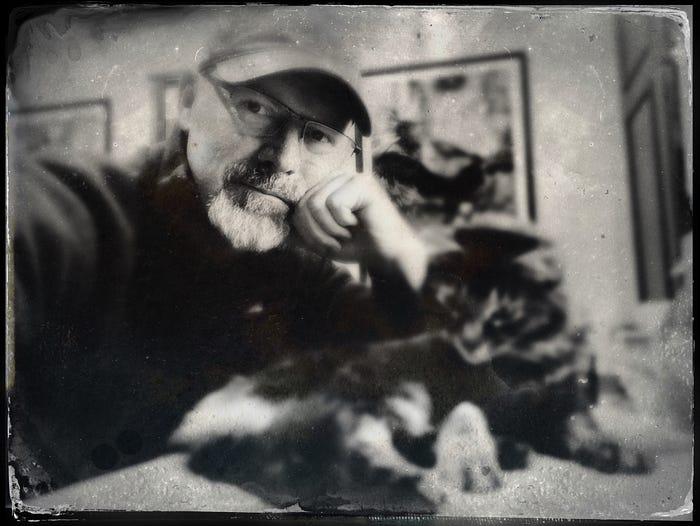
I’m John P. Weiss. I write elegant stories and essays about life. If you enjoyed this piece, check out my free weekend newsletter, The Saturday Letters.
—
This post was previously published on Medium.com.
—

If you believe in the work we are doing here at The Good Men Project, please join us as a Premium Member today.
All Premium Members get to view The Good Men Project with NO ADS.
Need more info? A complete list of benefits is here.
Photo credit: Ksenia Makagonova

