



Tom Gualtieri of The Weeklings believes men should advocate for choice when it comes to their bodies.
—
Originally published at The Weeklings
—
“My body, my choice.”
I like this phrase, even with its reductionist simplicity. All argument seems pointless in contrast.
In America we may do anything we want with our bodies, barring suicide (a topic for a separate essay) and using illegal substances. There are piercings, tattoos, collagen, sex changes & hormones, breast augmentation… The list goes on and on, and that’s not counting the non-invasive procedures like diets, beauty regimens, waxing, sugaring, hair styling, the classic cut & color, and even (heavens!) exercise. We may paint ourselves blue, wear nose rings, ear gauges, dress in rubber clothing or use mountains of silicon in an effort to satisfy our need to feel beautiful, unique or to fit in. We fight for the right.
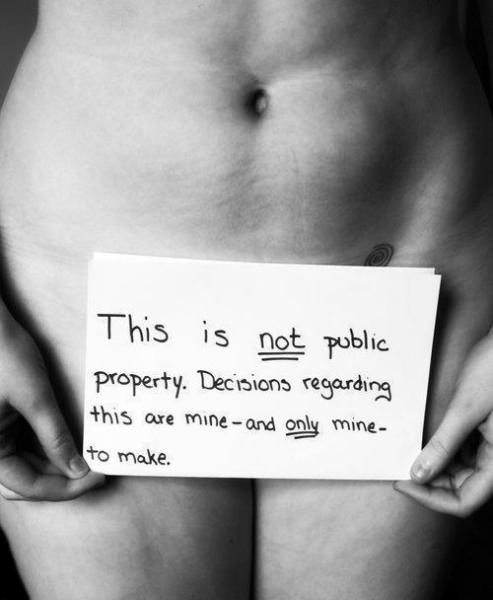
Todd Akin’s recent remarks about abortion (and his bizarre ignorance about rape) only highlight the ongoing debate over the phrase: “My body, my choice.” The subject of reproductive rights and battles to overturn two pro-choice decisions by the U.S. Supreme Court in the 20th Century come around again every election cycle. And even though the 2010 mid-terms were supposed to be a referendum on jobs and economic growth, they resulted in attacks on Planned Parenthood and women’s reproductive choices.
In the pro-choice movement, the most important argument has been a woman’s right to choose. That right to choose involves the whole body and sexual rights are inevitably tied to it. The inability of half our nation to recognize a woman’s right to her own body abuts another issue tied up with that powerful phrase:
“My body, my choice.”
♦◊♦
A decade ago I was walking a Manhattan street with my ex when I spotted a fellow (I assumed this person was a man, though I couldn’t tell for certain!) with neon-blue hair, a studded wardrobe and ear gauges – something I had never seen before. I turned to my ex and snidely remarked that he should remind me to pierce my eyelids when we next visited the mall. He shook his head and said, “I think people can do whatever they want with their bodies.”
With that plain declaration, he unwittingly asked me to look at myself. Why was I so threatened by this person’s self-expression? Why need I be? His choices had no effect on me except to irritate something I preferred to keep hidden: my insecurity. Ever since then, I have been a firm believer in privacy. What you do with your own body and how you do it, so long as it does not interfere with my rights, is perfectly acceptable. Sure, someone may cause a disturbance if he walks down the street with a skull tattooed on his face, but if it disturbs me that’s my problem, not his.
“Suggestive clothing” or “flirtatious behavior” are often used against rape victims — as if either justifies a perpetrator’s violence. If I don’t have the self-control to keep from raping a woman because her short skirt makes me feel a need to dominate her, there’s something wrong with me, not her. She is free to dress and behave as she chooses. Just like a man.
Self-sovereignty is the touchstone of American culture but is often opposed by those who feel threatened. To the small-minded, independence and the assertion of self somehow diminishes their rights. To feel superior, they must fight back. Rape and Female Genital Mutilation (FGM) are just two in the panoply of attacks which either aggressively or suggestively attempt to crush a woman’s right to self-hood.
In the fight for male dominion over his sexual self, the foreskin has gotten short shrift.
♦◊♦
Now that’s you’ve stopped laughing long enough to pay attention (because let’s face it, circumcision is almost always treated as a joke, as is any form of violence against male genitals), think for a moment about your instant reaction:
“Eww, foreskin is gross.”
or
“That’s the parent’s choice.”
or
“It’s healthier without it.”
or
“What about religious reasons?”
or
“There is no comparison to Female Genital Mutilation.
or
“What difference does it make?”
For me, it all comes down to one point:
“My body, my choice.”
The foreskin is the only body part we routinely amputate in the absence of an immediate health threat. There are perhaps a dozen reasons cited as to why circumcision is a “benefit,” but none is an immediate threat and all can all be traced back to one of these:
- Appearance
- Religion
- Possibility of medical problems.
Let’s address #3 first, since the American Academy of Pediatrics issued a statement this month reversing its previously neutral stance on circumcision. The AAP’s endorsement of circumcision cites several medical issues which are, debatably, more prevalent by a few percentage points (sometimes fractions thereof) in the intact male: urinary tract infections, increased chances of STDs including HPV, HIV and others, as well as reduction in penile cancer. None are a direct threat and all are contingent on possibility, not probability. In addition, counter-studies have suggested otherwise.
Dr. Douglas Diekema, a member of the AAP’s circumcision task force, states in a recent Huffington Post article on the subject, “What remains unchanged is that the AAP still holds that the health benefits are not great enough to recommend routine circumcision for all newborn males.” Nevertheless, the AAP’s statement leans sharply toward cutting. This new stance, coupled with the World Health Organization’s embrace of experiments involving the circumcision of African men in order to reduce HIV transmission risk, has caused more than a bit of controversy.
“Intactivists,” believe that routine infant circumcision is violence — mutilation. The stress on the phrase “routine infant” is notable because while infant circumcision is decried, Intactivists remain dedicated to the grown man’s right to choose.
The sleeve-like structure that is the male foreskin (which, unsheathed, amounts to approximately 12 square inches in the adult male) serves a sexual function. Among those cultures that practice circumcision, medical reasons are heaped onto existing societal and religious custom, even though religious and medical practices have no relationship. American women rarely give a thought to the foreskin unless they are expecting a baby boy OR encounter an intact man during sex. For American men it is the same; there’s no occasion to speak of it unless they are dealing with an infant, have same-sex partners, or joke about it in the locker room. It is largely addressed as a nuisance by the American medical community even though the last 15 years has seen a reduction in the US practice.
The message is, “Cut it off. It’s easier.”
Maligned in the U.S., the foreskin is accepted for what it is by the majority of the world population: a functional part of male sexual anatomy.
When we think about infants, we do not like to think about the sexual beings they will become. We think only of their safety and their protection. But our infant boys do grow up to be men. All adults, men and women alike, deserve their full spectrums of sexual function and pleasure. They are also entitled to make choices for themselves.
Can a man experience sexual pleasure without his foreskin? Well, duh! Millions have, but it is the quality of the sexual experience that serves both psychological and biological functions. (Prolonged periods of heightened sexual pleasure produce stronger orgasms in both men and women, making it more likely conceive. Not only that – it feels better! Duh!) Since the male anatomy can function (and has for centuries) without the foreskin, little thought is given by the general population to the long-term effects of its removal. If the plumbing works from infancy through the teen years, what problems could possibly exist? But it is often later in life that cut men start to experience problems.
According to Ronald Goldman, Ph.D., executive director of the Circumcision Resource Center in Boston, “Medical studies have shown that the foreskin protects the penile head, enhances sexual pleasure, and facilitates intercourse.” Additionally, a study released in the April 2007 British Journal of Urology (BJU) International concluded that the “five locations on the uncircumcised penis that are routinely removed at circumcision had lower pressure thresholds.” Let me translate: The parts that are removed in circumcision are more sensitive than the parts that are left.
The study also notes that “The glans [head] of the uncircumcised men had significantly lower mean pressure thresholds than that of the circumcised men,” which amounts to the same thing. The head of the uncircumcised penis is more sensitive than the head of a cut male.
The study also found that in the circumcised male the circumcision scar is typically the most sensitive spot on the penis.
That’s completely fucked up.
A flicker of logic will draw the same conclusion that led to the above experiment: if the penis is engineered around the biological need to orgasm, and if the orgasm is produced by nervous stimulation, wouldn’t amputation of a part of this complex web of nerves and vascular tissue have some effect? This is no numb, useless flap of skin, though the population of content but naive circumcised men (and repulsed women) may argue otherwise. Whose right is it to tell me that it should be removed at birth? Infants in our care are meant to be protected from harm. But what of the adults they grow up to be?
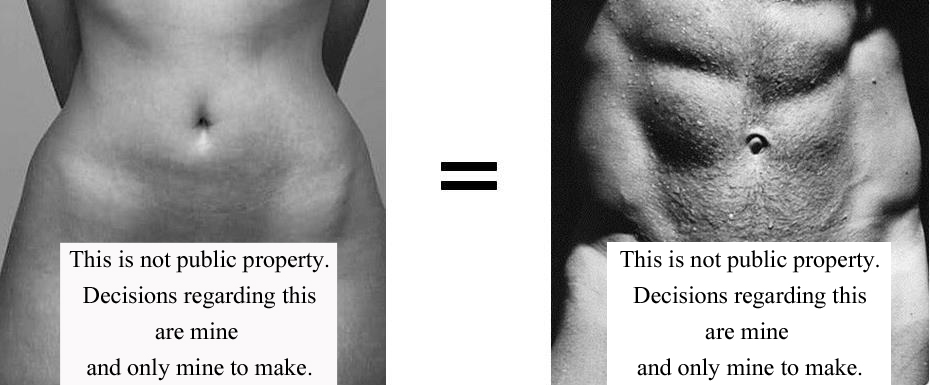
Parallels to Female Genital Mutilation (FGM), seem offensive when a parallel is mistaken for comparison. But let me be clear: I do not compare the two. I draw a parallel related to genital integrity.
Women’s sexual needs have been vilified for centuries. The violence done on women through FGM is done to subjugate women to male desire. By removing pleasure, the male who has been taught to possess, dominate and rule is placated. Her sexual power over him is diminished if he feels that he is dominant. Her pleasure must be secondary – or entirely eliminated.
Genital mutilation, like rape, is an act of violence. Unlike rape, however, FGM represents a bizarre marriage of patriarchal domination and female complicity in the cycle of abuse. Perpetrated and perpetuated by women on women at the behest of men, FGM stifles a woman’s sexual health and pleasure to keep her part of the tribe. No one must step outside the circle – power must be equal among the subjugated. If I suffer, so should you. If a woman does escape this ritual, her pleasure reminds the tribe of the millennia of horror men have forced upon women, and that women have allowed to be done to their daughters: what does it say about women who have, for centuries, perpetuated male dominion by taking on the role of circumciser? There can be no rebellion in these societies. And where there is no rebellion, there is no fear and no self-examination.
If you re-read the above paragraphs with a few substitutions, it is equally ghastly:
Circumcision represents a bizarre marriage of patriarchal domination and female complicity in the cycle of abuse. Perpetrated and perpetuated by men upon men, with the complicity of women, circumcision mutes a man’s sexual health to keep him part of the tribe. No one must step outside the circle – power must be equal among the subjugated. If I suffer, so should you. If a man does escape this ritual, his experience of greater pleasure than his father calls to mind the millennia of horror men have done upon men, and women have allowed to be done to their sons.
Circumcision rituals are performed on males in cultures that include Judaism, Islam and various African tribes like the Kikuyu and Maasai at ages ranging from infancy to adolescence. Unlike modern American circumcision, which is done under medical supervision in private, tribal and religious customs involve public settings in which the child or teenager is on display during this ritual.
Sexual subjugation is about power.
What power, then, do we wield over our boys when the first thing we do to them after birth is to take a knife to the most delicate and sensitive part of their anatomies? What happens to the mother/child bond when she gives him into the arms of a stranger to experience the most excruciating pain of his newborn life, before being returned to her?
♦◊♦
In her August 12 op-ed in the LA Times (“Circumcision: It Was Good Enough For Jesus”) Charlotte Allen says, “Cmon on, guys, man up!”
Did she actually write “Come on guys, man up?!!?!”
My response is: How fucking dare you, madam?
I wonder, does she know anything of the men who are afraid to be called victim or less-than-men because they are not allowed to complain that their circumcisions have left them mutilated, partially damaged, impotent or having to live through a life-time of genital reconstructive surgeries? Men who have suffered from choices made for them in infancy suffer well into adulthood, often remaining silent on the issue, or silenced by other men and women, like Ms. Allen, who think they are “whiners.”
I was permanently damaged by my circumcision. A surgery, badly performed, left me with severe scarring and extreme sensitivity which actually causes unbearable irritation during certain sexual activities. This sensitivity has grown worse as I get older. Basically, too much flesh was removed from one side. I learned as an adult that I came home from the hospital with stitches in my penis. Upon examination, it is clear that a major vein was severed and the cut was too deep.
Compared to the grotesque damage which can be seen in images in various forums and activist groups about circumcision(these images of adult men with severely deformed penises as a result of circumcision are almost unbearable to look at it), mine may be an ungrateful complaint; my sex life has been basically normal. The damage, because Americans are so accustomed to the circumcised penis, wouldn’t register unless you looked closely. I’ve even been asked to pose nude and appear naked onstage. I don’t know anything other than the sex life I’ve had, yet I can’t help but wonder what my sex life could be like had I been allowed to keep the body nature designed.
Ms. Allen, not having a penis herself, should shut up. She has no right to have an opinion on the matter of my genitals. Though there may be argument from the women’s health camp because studies have shown that circumcision reduces the threat of cervical cancer in women by reducing the possibility of HPV transmission. (Although counter studies say otherwise.)
So – just to clarify – you want to cut off a part of your infant son’s sex organ because there is a possibility that he might, as an adult, come in contact with HPV and, subsequently, might have sex with a woman who hasn’t had the HPV vaccine?
Sorry. No. I can’t get on board with a lifetime’s alteration of a man’s body any more than I can a woman being forced to undergo a 20-minute vaginal probe before an abortion.
The case of David Reimer, an example of a worst-case scenario taken to extremes (hyperbole intentional), remained largely unknown until an expose in Rolling Stone Magazine in December of 1997. Reimer and his twin brother were sent to be circumcised several weeks after birth due to phimosis (a tightening of the foreskin). When Reimer’s surgery went horribly wrong, his brother’s surgery was aborted. The brother’s phimosis, a condition often treated through surgery, cleared up on its own without surgical intervention. But Reimer’s penis turned black and fell off.
Reimer’s penis turned black and fell off.
The darkest irony, to me, is that the condition for which they were both being treated cleared up on its own in Reimer’s brother.
The loss of Mr. Reimer’s penis resulted in a series of tragic decisions. First, his parents were convinced by a Johns Hopkins scientist to choose sexual reassignment for David. What followed was an orchiectomy (the complete removal of Reimer’s testicles) and an attempt to raise him as a girl via hormones and dozens of genital surgeries throughout his life. In his teen years, Reimer’s father disclosed what had happened and Reimer attempted to live his life as a man until his suicide in 2004.
Reimer’s story went unreported for three decades. Other stories like it are available to those who will listen, told by horrified nurses, doctors and O.R. staff. One nurse, who spoke on the condition of anonymity, told me:
“I had a baby who, shortly after his circ, his penis turned black and necrotic. He was transferred to our hospital for evaluation and died within two weeks.
“Then several months ago, we had a partial amputation with urethral involvement. That baby had to be transferred to a tertiary care hospital for repair and will have lifetime urologic complications. The father was inconsolable.”
And those are just two of her stories. And those stories are just the observations of one nurse. This week alone I have read three articles on botched circumcisions. One story reports the loss of the penises of twin infants after botched circumcisions. Another, the partial amputation of the glans penis (the head) during a bris. There are hundreds of stories like this. What will it be like for those boys to grow into adults?
There are countless men who say, “Hey, my dick is fine,” but there are just as many who can verify a loss of sensitivity. The removal of healthy erogenous tissue, whether or not its loss is recognized, is more to the point than, “My dick works.” Can you miss something you never had? I do.
♦◊♦
Christopher Guest, M.D, co-founder of the Children’s Health & Human Rights Partnership (CHHRP) calls the AAP’s statement “seriously flawed.” In a press release picked up by Reuters and other online publications, Guest states:
“‘Circumcision alters the structure of the penis, which inevitably alters function. Long term harm to men from infant circumcision has never been studied.’ He referred to a growing body of anecdotal evidence collected by the Canadian-based Global Survey of Circumcision Harm. Guest said that in the past 12 months over 900 men have answered the online survey to document their harm.”
The type of circumcision performed on Reimer was an unusual method and though there are various methods available today, they each bear a different set of risks. Stories of damage are not urban myths.
I came across a extraordinarily moving video on YouTube in which a devout Jewish mother expresses her personal feelings about the ritual bris:
“…the trauma that I felt as a mother having witnessed this rite on my babies… I didn’t know how to even formulate the questions because they were in total contradiction with everything that I believed and trusted. And it wasn’t until… many years later that I finally took a step to start learning about circumcision and I was devastated. And my heart has never been whole since.” – Miriam Pollack on Circumcision.
There is no empirical data to justify her feelings so her emotional response can be easily dismissed. But Intactivist boards are filled with stories like this by women who listened to their child’s screams or who watched their boys go into shock and whose protective instincts caught fire in that instant of “too late.” What regret must a parent live with to know that she has subject her child to even the most momentary pain or, worse, to a lifetime of anger predicated by a decision in which her son had no part?
Whether or not you believe that the foreskin has any function; whether or not you have researched its function; whether or not you believe an infant is traumatized by this bizarre custom, the fact remains: the man your son will grow to be is left without a choice when you choose for him.
Hugh Young, the founder of www.circumstitions.com, speaking at a debate on religious circumcision, said,
“No matter how ancient, no matter how beautiful the ceremony … no matter how much it is perceived as binding people to their ancestors, no matter how divinely commanded – what is happening at the centre of this is that a baby is held down and part of his or her genitals are cut off, and they stay cut off for the rest of that person’s life…”
♦◊♦
The revised statement by the American Association of Pediatrics fails to address both the sexual function of our children’s genitals and statements by the medical organizations of other civilized nations which oppose routine infant circumcision on the basis of its barbarity and uselessness. The problem we step into with all matters sexual is the embarrassment caused by having to think about sexual pleasure and, more specifically, the quality of that pleasure. It tears at our puritanical scabs to consider that our infant sons will grow up to be sexual beings, yet the foreskin must serve a man in adulthood, for the most refined sexual pleasure possible. Not just for sexual pleasure that is “good enough.” So how can we avoid talking about it? It may be easier to “cut it off” — but easier for whom?
Even if circumcision were not violence, and even if the foreskin were not a functional part of the male sexual anatomy, why would it be anyone else’s right to decide to remove it? When we make a permanent choice that affects the adult sexuality of our infant boys, how do we justify the phrase “My body, my choice?”


This article, it has apparently been prepared for a male readership, May inadvertently distance women who may otherwise be sympathetic to the point. The no penis no opinion assertion some posters are making makes no sense in the world we live in. No battle can be thought alone.
The idea of deliberately hurting my son, particularly in this manner – the person who I’m here to protect and love – Absolutely disgusting.
Fantastic article.
Thanks Tom, back home in South Africa there are so many cases of young men who have gone through traditionals rituals and have lost their lives. It’s a shame and sad. Also I’m a 38 year old male intact and am very proud to be that way. I laugh at the ignorance of Americans who jest about foreskin.
Thank you for the article. I wish for other images at the beginning. There doesn’t have to be a sixpack. There could just be a regular male body, one a man gets when reading books and doing occasional house and gardenwork instead of going to the gym. I’m a woman and really put off by this whole gym culture, the bodies are not natural and the thought of someone man or woman, investing so much valuable time in their look is worrysome.
The bottom line is this: To routinely remove the foreskin of an infant means that it is believed that God/nature made a mistake in putting a foreskin on the penis, a mistake that we humans must correct ASAP. Really??
Excellent article. More men need to speak out on this and stand up for their newborns. I believe this is what it will take for routine infant circumcision to finally be socially unacceptable in the US., and consequently will create long lasting positive effects on our society.
Let’s pretend that there isn’t shit tons of scientific evidence out there that tells us the foreskin is a necessary and beneficial organ, that circumcision is painful, risky, and leaves lasting trauma on the newborn, and that the “benefits” are trivial at best and all could be achieved by other non surgical methods. The US is the only country where people still think circumcision is a normal, routine practice. No medical organization in the world actually recommends it. And you’re performing an irreversible largely cosmetic procedure on a newborn, putting that on higher priority than breastfeeding and bonding. That’s fucked… Read more »
I am a woman, without a penis, who feels very strongly against RIC. It is a good thing I felt entitled to an opinion because it ensured my son remained intact. I think it really comes down to whose penis it is, not the sex of the person with an opinion. The chart would make more sense to me and other female intactivists if that part were removed. Don’t alienate us, we need to work together to protect the babies. I liked the article otherwise.
When my son was born 16 years ago, I did not want him to be cut; However my ex said yes because he wasn’t and he suffered a lot with his foreskin. I do not have a penis, so I just shut up and went along with it – even though I though this was a stupid procedure and that if the boy wanted that he should say so when he gets older. I was looked like I was crazy by his dad. I couldn’t advocate because I have no penis. Most people who are in favor of circumcisions are… Read more »
I’m confused as to why people are getting up in arms about comparing male circumcision to female circumcision- they are two sides of the same coin! The same way that those girls are having part of their healthy genitals forceibly removed (yes there are different kinds and different amounts removed: it’s still removal)- so are those male babies who are being circumcised. What’s so hard to grasp? Good article, it’s all true. Do your research. The foreskin is meant to be there- all mammals (male and female) have one. Look at the physical visible damage done *linked*~ there is an… Read more »
The “good men project” gets millions of dollars in federal funding to operate……so why don’t we let men share their concerns about being sexually mutilated as young boys…instead of having women shame them into silence????
Wow. This article really made me shiver. As a young adult living in Israel, having grown up in a modern Orthodox Jewish community, I have given the matter of circumcision a great deal of thought (despite your helpful chart above.) I envision myself becoming a mother and I am so torn between the immense pressure of the religious tradition and my own personal abhorring of the ritual. I recently polled my group of friends in favor or against circumcision, and those who are religious could so easily say they would obviously do it to their sons, while those who are… Read more »
Have you read Maimonides’ Guide for the perplexed? It contains some reasoning for circumsision, like “It is hard for a woman with whom an uncircumcised man has had sexual intercourse to separate from him” or claims that it is done to weaken sexual stimulation and cause pain.
The religious texts actually show that circumcision is done for the very same reasons as FGM, with the same justification. Please stay strong and don’t do it to your son(s) 🙂
Sorry but no one has a choice to discriminate themselves or their community from the human species:
https://www.academia.edu/3444281/Between_barbarity_and_exclusion_circumcision_the_worst_of_racisms_and_the_greatest_crime_against_humanity_catalyzer_of_fanaticism_terrorism_genocide_and_feminicide_sexual_mutilation_an_unconscious_ultra-racism_masked_behind_religion_tradition_culture_and_folklore_updated_01.26.14
I think the “Horror” of circumcision is being greatly over played here. I’m aware there are cases where being circumcised has led to health problems and a loss of feeling/pleasure for some. But speaking as someone who was circumcised later in life (10 years old) due to my foreskin being too tight and getting stuck. I wouldn’t say the experience was traumatic, it wasn’t pleasant but no operation is. I have a healthy and robust sex life which I enjoy immensely. I agree it should be your choice when it comes to your body. Nobody should make that decision for… Read more »
Then what are human rights worth? One side argues that you shouldn’t have been cut unnecessarily. The other says you should have been cut whether there was a problem or not. And chances are your cutting wasn’t necessary either. A 10-year-old often isn’t retractable at all. Yes, let’s vilify a procedure (done by people who have no right, for the sake of profit and to alter human behavior) for the sake of human rights. You have a good sex life. What does that have to do with other people? Since you’re happy nobody else can complain? Lots of cut women… Read more »
Well said Steve and Wellokaythen. Argue the severity ask you want. Any mutilation of any unwilling person is barbaric. It’s ok to do to a boy because girls have it worse its rediculous. Anyone can have an opinion, but, no one should be allowed to mutilate anyone without their express written consent, as an adult.
The central question is why are we doing this to BABIES? People who can’t consent who are completely at the mercy of other people. Forget about the penises of grown men for a moment or how you feel about this as an adult. Forget for the moment that this is even about genitals at all. This is cutting something that (virtually) every boy is born with. We’re not talking about fixing a clept palate or a club foot. This is basically cutting a baby because you want to. Dress it up in tradition or religion or culture or aesthetics, but… Read more »
People without penises are not allowed to have an opinion about male circumcision?
If they’re against it, I bet you’d be okay with them having an opinion….
If a female doctor was in the position being asked to perform one, I would like her to have an opinion, preferably deep scepticism about the medical benefits of doing so. If there are women on a hospital governing board examining the evidence about medical benefits, I want them to have an opinion based on good evidence. If there are women in the forefront of putting a stop to this barbarity, then good.
It’s like FGM. It’s not like FGM. What difference does that really make to the larger point? Whatever the similarities and differences, the basic argument sounds pretty valid and pretty gender-neutral: Don’t mutilate a baby’s genitals because it’s traditional or because it’s just what you do in your culture, country, hospital, whatever. You better have a damn good medical reason, and so far a lot of the so-called medical reasons are dubious. I cut my baby boy’s foreskin because the voices in my head told me to — lock me away. I cut my baby boy’s foreskin because someone 3000… Read more »
Why FGM and MGM are not the same thing?
Most FGM is of the nick, pinprick, hood or labia removal variety, which are either not worse or similar to mgm.
Wherever rusty blades are being used on women they are also being used on men.
The same rationales are used for both.
We have been deceived into believe they are not the same thing, by comparing the worst forms of FGM with the best forms of MGM.
Wow. Some of you ladies are so over the top its pretty nuts. Reasonable women are recoiling in horror all over this article. The article states quite clearly that circumcision and FGM are not the same thing. I agree. But as a circumcised male, I can tell you I am REALLY NOT HAPPY that 90% of the nerve tissue in my penis was removed for no good reason. Thats all it says. In the future, when a woman tells me I have no right to an opinion on reproductive law (I am Pro-Choice) because I don’t have a vagina and… Read more »
It’s not quite as simple. Apparently you have a right to an opinion on abortion as long as that opinion is pro-choice. Likewise a woman is allowed to be pro-choice on this matter (being against infant genital cutting is nothing than being pro-choice — after all a man is entitled to have it done on his own volition anytime later). And that makes a lot of sense. You cannot have an opinion that forces an irreversible decision on others, but an opinion that grants the other person autonomy over themselves is always alright.
Wow. Some of you ladies are so over the top its pretty nuts. Reasonable women are recoiling in horror all over this article. The article states quite clearly that circumcision and FGM are not the same thing.
Which is exactly why I said this above:
While there are those that try the direct comparison at the same time there are more than a few folks that take nearly any instance of cutting both boys and girls in the same article as a comparison by default and then launch into “girls have it worse” mode.
Please don’t say “if you don’t have one, you have no say”. While I was still pregnant, I made the decision not to circumcise should my child be born a boy. I believe it is an outdated and barbaric practice. This despite family religious pressure to conform. I did indeed have a son & expect to discuss this with him when he’s older. My mother said my son wouldn’t be accepted into our religion. A close male friend (of the same religion, who is also against routine circumcision) assured me that nobody has ever requested to see his lack of… Read more »
Thank you for that!
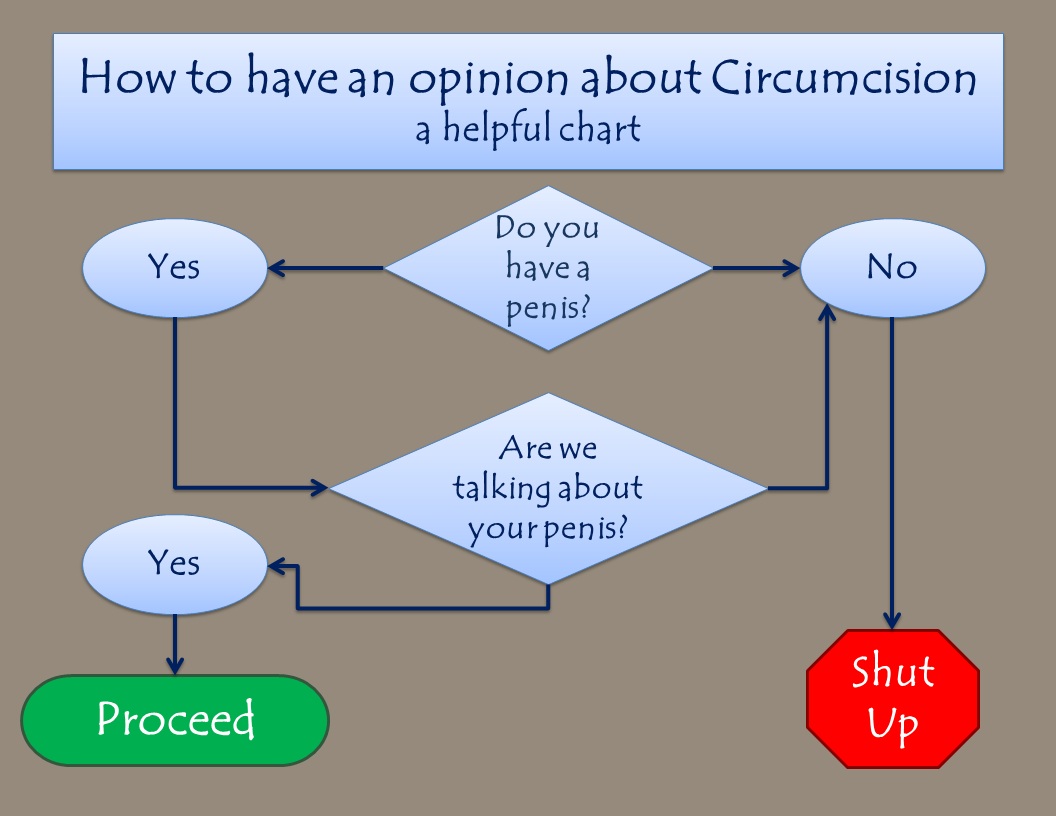
According to the author’s flowchart HE himself has no right or interest expressing his opinion.
According to his flowchart the only person entitled to such opinion is a fresh-born infant.
Oddly the word in-fant means “can’t speak.”
I am so thankful whenever I think of it that my parents decided to have me circumcised. I couldn’t imagine having to go through life without being cut. I don’t think woman should have any say in the discussion whatsoever. This is something that affects men and should be decided by men,
Let’s see how “thankful” you are after you are older, and begin to suffer from erectile dysfunction due to having been circumcised. Let’s see how “thankful” you are after your lady (assuming you are hetero) goes through menopause, and the pounding that you have to do because of your lack of penile sensitivity causes her pain.
Your “thankfulness” does not justify the continued routine genital mutilation of baby boys.
Except that your mother certainly had a lot of say in the discussion. But now that an empathic supporter of genital cutting is here, I want to ask you a question, because there’s something I want to understand: I understand how anybody can have a deep emotional investment in staying intact and wanting others to stay intact. What I do not understant is how anybody can have an emotional investment in being cut as a child. I mean, it’s not like a on-the-balance-of-reasoning decision for you, the idea of being intact is actually abhorrent to you. Barring religious reasons, why… Read more »
wow, give it a rest will ya, some people just like one thing over another, you don’t have to analyze the shit outta everything. a deep emotional investment, wow, it’s just appearance, most people won’t have any problems at all, you’re putting way to much thought into other peoples dicks. get a life.
The argument for circumcision really only comes down to two things, religion or hygiene. Religion: If you are a religious person I simply ask that you consider that if your god put it there, there was a reason for doing so. Otherwise your god made an error and I want you to consider the implications of that. How many people have had tonsils or appendixes removed because they were believed unnecessary? Hygiene: We don’t cut off peoples hands because some people don’t wash then effectively, we teach them to wash. The fact is, a penis has decidedly less nooks, crannies… Read more »
Hygiene: We don’t cut off peoples hands because some people don’t wash then effectively, we teach them to wash. The fact is, a penis has decidedly less nooks, crannies and folds to care for than a vagina. Is anyone suggesting that vaginas needs to be altered to make them easier to clean? I certainly hope not. Pretty much. Its amazing that people bring up the hygiene argument. And even the heavily contested “It decreases the risk of catching STDs/Is. Has it come to that now? Instead of teaching boys/men proper hygience and safe sex practices its better to just remove… Read more »
I fought my husband, even conceded my sons’ first name, to keep him intact! Mothers DO have a lot of influence on circumcision, so instead of. ‘Shut up’ encourage them to keep their babies intact. My son will one day have his own sex life who can then decide if he’d like to alter his body. The mothers of these babies could be your greatest ally!!!