



I started 2026 wanting to do something I had never done before: run 41 miles. I actually planned to do this on December 31, 2025, with a slower period at work, but I had to coordinate support and a ride back to my car, so I had to reschedule.
I was very happy about being able to do it, and I had some support to be able to do so in 5 hours, 15 minutes, and 48 seconds, the second fastest ever to run this 41 mile segment on a running social media app, Strava.
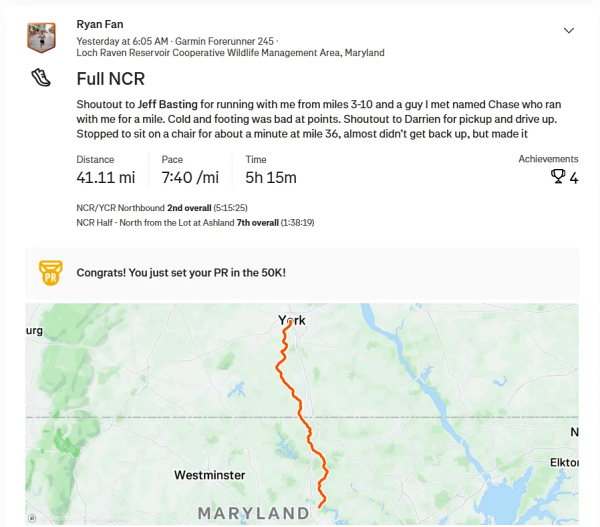
Screenshot from the author on Strava
Prior to running 41 miles, the longest I had run was 30 miles. I told several people last week I was planning on running 40+ miles, and some raised their eyes, said “that’s crazy,” and asked me why.
The reason is that I was being a follower — I knew three other runners in my area I highly respect who had done it. They are all faster than me, and I knew I could get the second-best time to ever do the segment on Strava (other people may have run this faster, but they weren’t on Strava).
The second reason is that the local trail I ran on, the Northern Central Rail (NCR) trail, has given a lot to me. I have done many long runs there. It is known as a faster trail in our area, so I wanted to do it as a bucket list item. It is a flatter trail that can get pretty crowded, where professional runners in our area regularly do faster long runs. As someone who is semi-competitive, it is where quite a few people in our area try to do long runs at a faster pace without going on a track or treadmill.
However, there is a Maryland side to the NCR and a Pennsylvania side to the NCR. Both ways go around 20 miles, from the border between the two states to York, Pennsylvania and Towson, Maryland, respectively. I have only run the Maryland side and never crossed state lines to go to the other half of the trail.
Thus, running the entire trail from Towson to York was an opportunity to explore and push past my previously conceived limits.
The 41 mile run
I started my run at 6 a.m., and early on, I had to worry mostly about logistics. As a 41 mile run, I had to worry much more about fueling than I do for any normal easy runs. A general rule in long runs and marathon training is to take one gel every 40–45 minutes, so I did that. This meant I needed to carry six gels. This was a number I could not carry in my hand, so I put the gels in the pocket of a light exercise jacket. I mention this jacket because it would come back to bite a bit later.
Another really simple but important thing was worrying about how I would get back. Since it was a one-way run, I needed a ride. Fortunately, my friend who is from the area agreed to sacrifice a good portion of his early afternoon to give me a ride back to my car, and I would not have been able to accomplish this run without that really essential element.
When I started, it was 6 a.m. and 25 degrees Fahrenheit. It wasn’t windy, so it was cold, but manageable. I needed my phone with me to be able to call someone in case of an emergency and hold my car key in another hand. I know other runners leave their key in a hidden location near the car, but I try not to do this, so both my hands were occupied. I tried but fumbled to just put the key in the pocket, so I ended up carrying it the whole time. I could have probably benefited from a pouch to carry all these items, but I came in a bit unprepared.
One thing I didn’t do was bring any water. Yes, I ran 41 miles without drinking a sip of water. I should have probably brought a hydration backpack since my hands were pretty full with gels or my phone, but I didn’t. Because it was cold and not humid or hot at all, I got away with it, but I most certainly would not recommend it to anyone else. I figured, “oh, there are water fountains on the trail.” This was true, but I did not stop at them because I wanted to finish the run faster. But if I were to do this in the future or in the summer, I would invest in some sort of hydration backpack.
When I started, it was pitch dark and I could not see any part of the trail. As someone who does not run ultramarathons, I also do not have a headlamp. I thus had to use my iPhone flashlight to see where I was going. There was snow on some parts of the ground, but it was a thin, less than one inch layer of snow that affected the footing some, but not much.
I kept the flashlight ahead of me to be wary of ice and to generally be able to see where I was going. I started with my first mile at 7:40 mile pace. If I ran faster than six minute pace, however, I think I would have run into issues with slips and falls on the snow.
At mile 3, another runner in my run club joined me. It was fun to chat with him for seven miles about our careers and lives, and the next miles went by very fast before he turned around and went back to his car.
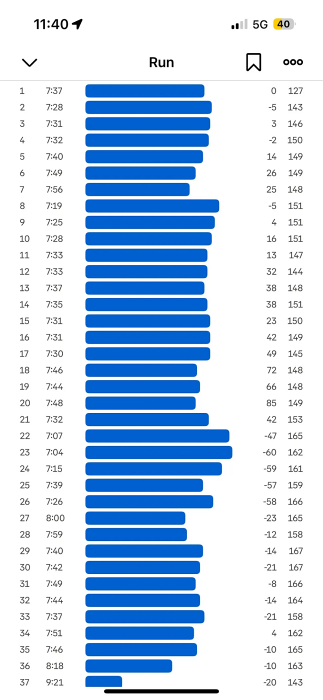
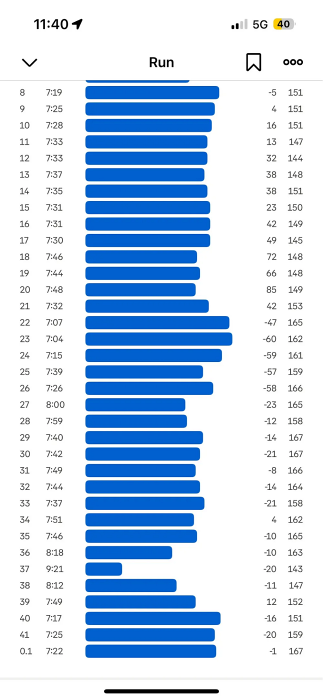
I then solo’d until mile 25 or so. During these miles, I averaged around 7:30 mile pace and even had some miles in the low 7 minutes. I instinctively knew this might be too fast for my first 40+ mile run and made efforts to try to dial it back a bit, but even on slower miles, I would still run 7:40s.
I was a bit conflicted — I knew the smarter and more prudent action was to slow down and play it safe, but I also wanted to be efficient, so I could go a bit fast but not too fast. This was my longest run ever, not only in terms of distance, but time, and I wanted to get back at a certain time. Believe me, I did not want to be out there on my feet for more than six hours, so I just committed to being around 7:40 or faster most of the way.
At mile 20, I passed state lines from Maryland to Pennsylvania. Miles 16–20 were a bit more difficult than miles 1–10, but I knew I was ascending in elevation based on some prior runs going the other direction. All of a sudden, at mile 21, I went from running 7:40s to close to 7 minute miles, and it felt very easy. I was using Siri to text friends about my progress on the run and informed some other runners that I came through 20 miles at 2:31:40. I ran through signs of Pennsylvania towns I had never heard of before, taking sights of beautiful scenery and farms: New Freedom, Hanover, Glen Ridge.
The train track that was the “rail” part of the trail was to my side the whole time. The occasional Trump flags indicated this part of Pennsylvania was a bit more conservative than what I was used to in Maryland, but everyone I passed on the trail was very nice and one person cautioned me on a part of the trail where I had to watch my footing or risk slipping.
At mile 25, I ran into another runner. He ran with me for about a mile before he peeled off to where his car was. We chatted about our mutual running goals, lives, and what we did for the holidays, and I do wish there was a way we could have connected, but he did not use Strava.
At this point, some of the snow on the trail started to clear up. Any part of the trail that had asphalt had no snow on the ground, whereas dirt parts of the trail were still pretty packed with snow. I never worried about slipping and falling except for when I crossed concrete bridges, where the surface was a bit more slippery.
At mile 31, I had run more than I had before. I was just focused on making it to certain time checkpoints, like 3 hours and 30 minutes, 3 hours and 50 minutes, 4 hours and 10 minutes. I needed to think about anything other than the fact that I was running longer than I ever had before.
This mental sleight of hand worked for a while, at mile 36, the jacket finally backfired. It was no longer 25 degrees, but around 33 degrees. This is still cold, but I had been running for 36 miles, and I was finally feeling my body sweating. It wasn’t a crazy amount of sweat, but it heated up my body to the point of being very uncomfortable. I kept going for around a mile, but the heat started to become tough to deal with.
I was slowing down from my 7:40–7:50 mile pace to around 8:30 mile pace, and then I saw a bench and stopped. I took about a minute to take off the jacket, which took much longer than it should have. Then I just sat and thought for a bit. I did not feel good anymore, and it was the longest I had run for six miles. My friend was on his way to pick me up at the 41-mile marker, so I would have had to just call him and drop a pin on the map. I felt bad, but not to the point where I couldn’t continue. The easiest way to get back was to finish, so I carried my negative thoughts, got back up with the most doubt I had on that run, and kept going. It didn’t hurt to just slow down to recover for a bit.
If I needed to run 10 minute miles, or God forbid, walk, it wouldn’t have really mattered that much. I had already done most of the run and was still feeling better than I probably could anticipate for that part of the run. And so I did just that — I ran 10 minute mile pace. It was slow but difficult, but I needed one mile to just chill and let my body catch up from being ahead of pace and the stress of running longer than I ever had at that point. I ran for about a half mile at 10 minute pace and continued to contemplate whether I needed to walk, putting one foot in front of another.
Gradually, over that half mile, I started to feel better. I started running 9 minute pace, then 8 minute mile pace again, pretty close to where I was before. It’s not like I felt as good or amazing as I did at mile 23 or even mile 33. In fact, I still felt pretty not good and I knew the run was difficult because I felt I could no longer hold a conversation. However, I was at mile 38 at this point, and all I needed to do was finish the run, and the adrenaline of the finish started to kick in to get me closer to 7:20 miles close to the end.
At the end, the trail ended in the city of York, Pennsylvania. I went from rural sights of farms and rivers to a smaller city I spent some time in, with a nice running path and a university to wrap up the run. My friend was there to film the finish and give me a ride back.
After I finished, I was mentally ecstatic, but physically in shambles. I would love to say I finished feeling strong, great, and like I could run another 10 miles easily, but I didn’t. I was cooked not from going super fast, but super far, and about five minutes after stopping, the cold caught up to me and my body heat went away. No longer was my body too hot, but it was freezing, and reasonably pretty fragile from just running 11 miles more than I ever had before.
My friend turned up the heat in the car, and we stopped at a restaurant to have lunch and for me to gulp down about a gallon of water. Despite the physical discomfort and fatigue, I felt very fulfilled knowing I pushed past my limits and barriers to do something I had never done before, and I spent the rest of the day trying to do some work but functioning (reasonably) slower than usual.
I just finished reading “Beyond Fast” from Sean Brosnan, the former coach of Newbury Park High School, which, in recent years, became the best high school of all time in American distance running. Newbury Park produced some of the best high school runners in American history, like Nico Young and Colin Sahlman, breaking both individual and team 5k records at the national championships.
Although I am not nearly as fast as Nico Young or Colin Sahlman, who are now some of the best professional and collegiate runners in the country, he documents a mantra he often told his male athletes: “4:20 isn’t fast.”
By 4:20, he is referring to teaching his athletes that a 4:20 mile is not fast. As someone who ran a 4:36 mile in high school and did not come that close to breaking 4:20, I can see why some people got upset by the quote, but he was misunderstood and taken out of context:
However, it’s not about whether 4:20 is actually fast or not. Brosnan writes about how 4:20 could be any time or arbitrary goal. It was about setting artificial limits on themselves, and Brosnan said, “if you have the mindset that 4:20 is fast, then you’re never going to run any faster.”
A lot of people might not jive with this mindset, but the message of not setting limits on yourself, to not build up an arbitrary goal to be bigger than it really is was what I needed to hear. I got scared as I got close to them, panicked, and often self-sabotaged by going out too fast in a race or getting so nervous I struggled to sleep or had an upset stomach. “4:20 isn’t fast” is a mindset to minimize the goal mentally and treat it as not a big deal rather than disparage it. There were plenty of time goals I built up to be much bigger than they were, and because I thought those times were daunting and fast, I struggled to hit them.
In my freshman year of high school, this was the five minute mile. I ran a 5:03 mile probably five consecutive times before I finally ran 4:59, but I built this five minute mile to be a huge thing in my head, and that held me back.
In my junior year of high school, this was a 10 minute two mile. I ran 10:20s, 10:10s, then a 10:06. I spent years not breaking 10 minutes in the two mile. Then, in a random indoor track race that did not matter my senior year, I ran 9:59 to barely slip under the 10 minute barrier. In that race, I faded to the back of the pack at 3000 meters, and then had a blistering finish to pass 3–4 people in the last 200. The difference between this indoor track race and others may have been a year of training, but it was also the race I cared about the least.
In college, there were various goals of times I did not hit. The 15:30 5k. The 33 minute 10k. The 27 minute 8k. I knew I was a better runner than all of these times. But if I went into races thinking “I must run this time that I’ve been trying to run for a while,” I usually would not hit it.
After college, it was the 2:40 marathon. I ran a 2:40 marathon in my first marathon, then did not break it until three years later after I ran four marathons slower than 2:40. It would take three more years when I ran a 2:35. The same concept applied: I overemphasized the 2:40 marathon, and as a result, it became harder to break and I started to freak out mid-race if I fell off 2:40 marathon pace. There were plenty of times I could have run a 2:45, but just went for it and had the “sub 2:40 or nothing” mindset.
Right now, I am trying to break the 2:30 marathon. Adopting Brosnan’s mantra of “4:20 isn’t fast” would mean telling myself “2:30 isn’t fast.” I believe I am capable of better than 2:30, and I don’t want to set the limit there. I want to run 2:25, 2:20, and eventually even 2:15.
I don’t think the mindset is meant to devolve into an unhealthy feeling of never being good enough, but when I break 2:30, I will celebrate the success and be very, very happy, just like I did when I broke 2:40. The day after, however, I am aware that I could go faster, that there is more to be accomplished.
. . .
For now, 41 miles feels like my peak. I do not want to run ultramarathons. It is too time-consuming, and I don’t like the feeling of it completely wiping out my ability to be productive the rest of the day. At least with the marathon, it could take a little less than three hours, and I could go home and attend to other business.
But 41 miles is not a lot — I could run a 50 or 100 miler one day (with much better fueling and hydration), even if that is not in my bucket list of desires right now.
I am not someone who walks around carrying around a lot of arrogance or outward confidence. But I am trying to move around with more quiet confidence. I ran 41 miles after my longest run being 30 miles. It was difficult, but with more training, I could go faster and longer. I later discovered there was a recently developed 6.5 mile extension of this trail where I stopped that I didn’t know about at the time, so next time (if there is a next time), I will try to go the full 47.5 miles.
But I ran 41 miles at 7:40 pace. That means any running goal is attainable. I should not put limits on myself — 2:30, 2:25, 2:20 in the marathon are all attainable and aren’t a big deal. I am happy with all I have accomplished, but I know I can accomplish more.
—
This post was previously published on Ryan Fan’s blog.
***
You may also like these posts on The Good Men Project:
 White Fragility: Talking to White People About Racism White Fragility: Talking to White People About Racism |
 Escape the “Act Like a Man” Box Escape the “Act Like a Man” Box |
 The Lack of Gentle Platonic Touch in Men’s Lives is a Killer The Lack of Gentle Platonic Touch in Men’s Lives is a Killer |
 |

If you believe in the work we are doing here at The Good Men Project, please join us as a Premium Member today.
All Premium Members get to view The Good Men Project with NO ADS.
Need more info? A complete list of benefits is here.
Photo credit: iStock

