


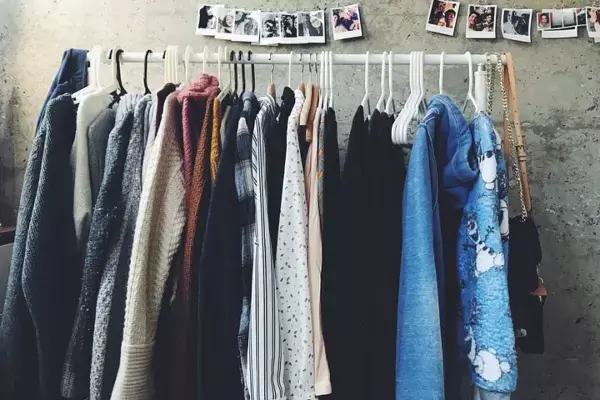
Instead of trying to convince consumers to buy less and focus on investing in better objects, maybe encouraging sustainable behavior by nudging them into wanting to do so and to share and repair their things would be a better and more effectual and durable approach.
Because, despite the evidence of pollution and global warming and the link between these devastating scenarios and overconsumption, consumers don’t really seem to act or change their behavior; or at least, not enough do, and not on a large enough scale. There is still a large demand for cheaply produced goods, and the manufacturing industry still seeks to meet that demand by producing more stuff quicker and cheaper.
The fast fashion industry emits more carbon than international flights and maritime shipping combined, more than 15 tons of textile waste is generated each year in the United States alone, and the number has doubled over the last 20 years, only confirming that increased pollution and global warming doesn’t scare consumers away from shopping for cheap clothes.
Polyester clothing takes nearly 200 years to decompose and nylon is not much better, while they continue to release microplastic into the environment.
It takes approximately 2,700 liters of water to make a cotton t-shirt which becomes an even scarier scenario when understanding that globally, more than one in three people does not have access to safe drinking water
In other words, the environmental impact of mass-produced clothes is huge — almost immeasurable. The production of low-priced toys, kitchenware, interior accessories, etc., is equally pollutant to add to that.
So, if alarming facts about pollution caused by fast fashion are not encouraging enough to alter consumption habits, perhaps the sustainable product designer’s main task is to seek new approaches to encourage sustainable behavior.
But, how do you make people want to change their ways, rather than inform or scare them into doing so?
In general, consumption needs to be reduced massively. Investing in long-lasting things, or perhaps sharing or swapping things rather than using and throwing them away, should ideally be the norm. However, what does the prospect of being a long-term investment require from design-objects? And can any object be a shared object?
The short answer to the latter question is: No, I don’t think so. Not all objects can be swapped or shared and repaired.
Simply put, the main motive for overconsumption is the sensation that what one already owns is somehow obsolete. Maybe it is no longer functioning, and repair seems impossible — perhaps due to the design or to lack of access to the tools and/or skills needed — maybe it is weathered and worn out, or perhaps it still works fine, but it somehow feels wrong and is perceived as obsolete. A majority of the belongings of a 21st-century person are discarded due to perceived obsolescence, not because the products don’t work anymore or are worn out.
So, if perceived obsolescence is one of the big sinners when it comes to the landfills filled with unwanted stuff, what does it take to eliminate this mechanism? What are the characteristics of objects: clothes, furniture, interior accessories, etc., that can continuously satisfy our need for newness?
A newness that opens the door to the idea of sharable or swappable goods. Or are we looking at this wrong? Should the question rather be: How can the constant need for newness be eliminated?
…
Let’s connect! https://www.instagram.com/the_immaterialist/
—
This post was previously published on medium.com.
***

All Premium Members get to view The Good Men Project with NO ADS. Need more info? A complete list of benefits is here.
 |
 |
 |
 |
—–
Photo credit: Shanna Camilleri on Unsplash

