


—
There comes a moment on almost every property, residential or commercial, when storage becomes a real problem. Tools pile up, equipment needs a home, and the yard starts looking more like a dumping ground than a functional space.
At that point, most people start weighing their options, and the plastic shed from the hardware store often looks like the path of least resistance.
It’s affordable, it ships flat, and it claims to solve the problem fast. But a few seasons in, that shed tells a very different story. If you’re serious about long-term, reliable storage, a shipping container is not just a better option. It’s in a completely different league.
The Plastic Shed Trap
Walk into any big-box home improvement store and you’ll find rows of plastic sheds marketed with words like “durable” and “weatherproof.” Those claims aren’t outright lies, but they’re doing a lot of heavy lifting. Plastic resin panels might resist a light drizzle, but they’re no match for extended UV exposure, freezing temperatures, or a serious wind event.
The panels warp and become brittle over time. The floor buckles under heavy loads. The roof panels flex under snow accumulation until they crack or cave entirely. What seemed like a cost-effective solution ends up costing more money and frustration than the original purchase price ever suggested.
There’s also the security problem. A plastic shed offers almost no resistance to forced entry. A determined thief with basic tools can be inside in under a minute. For anyone storing valuable equipment, that’s simply not acceptable.
Steel That Was Built to Survive the Ocean
Shipping containers were engineered to handle some of the most brutal conditions on earth. They spend weeks at sea stacked six high on cargo ships, enduring salt spray, high winds, and enormous structural stress. By the time one of those units arrives on your property, it has already proven itself in ways that no plastic shed ever could.
The corten steel walls, roof, and floor are built to last decades. They don’t warp, crack, or degrade the way resin panels do. Even in regions that experience extreme seasonal temperature swings, the structural integrity of a container remains completely intact.
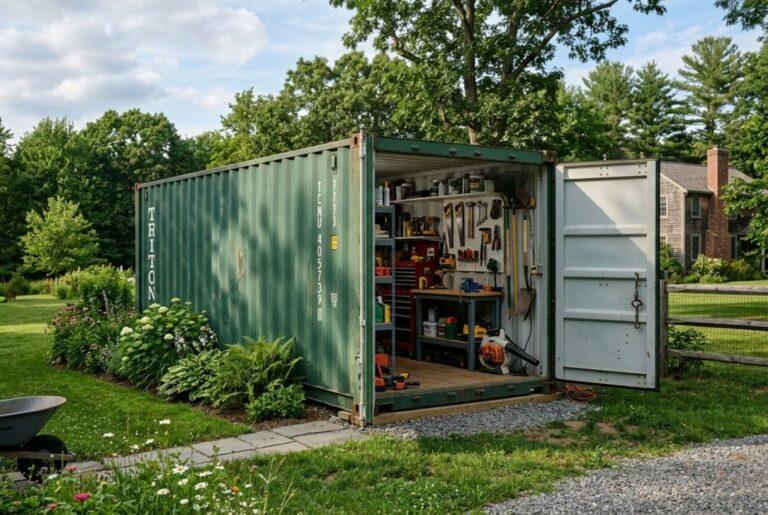
Using a shipping container shed as a storage solution means you’re working with a structure that was designed to protect cargo worth hundreds of thousands of dollars. Your tools, equipment, and supplies get the same level of protection.
Security That Actually Means Something
A shipping container comes with heavy-duty steel locking bars and a door mechanism that’s designed for serious use. You can add a lockbox to protect the padlock from bolt cutters, and the result is a storage structure that is genuinely difficult to breach without major equipment and significant time.
Contrast that with a plastic shed, which often comes with a simple hasp lock mounted to flimsy plastic. Even without tools, those locks are vulnerable. When you’re storing anything valuable, including power tools, landscaping equipment, generators, or business inventory, the security difference between the two options matters enormously.
Containers are also harder to move without heavy machinery. Theft of the entire unit, which can happen with portable storage alternatives, is simply not a realistic concern. Your storage stays exactly where you put it.
The Flexibility Factor
One of the most underrated advantages of shipping containers is the range of sizes and configurations available. Standard units come in 10ft, 20ft, and 40ft lengths, with height options that include standard and high-cube variants. That means your storage solution can scale with your actual needs rather than forcing you to make do.
For large-scale projects or operations that need maximum capacity, 40ft shipping containers offer over 2,300 cubic feet of usable interior space. That’s enough room to store an entire workshop’s worth of equipment, pallets of materials, or a fleet of smaller machinery, all under one roof and behind one set of secure doors.
You can also have containers modified with shelving, electrical hookups, ventilation, and additional doors. A plastic shed doesn’t offer that kind of customization potential, and the structural limitations of resin construction mean it never will.
A Smarter Investment Over Time
The upfront price of a shipping container is higher than a plastic shed, and that’s the comparison most people stop at. But that comparison ignores the full picture. A quality container, properly maintained, can last 25 years or more. A plastic shed typically starts showing serious wear within three to five years, and most don’t last a full decade before requiring replacement.
When you factor in replacement costs, repair expenses, and the value of the items that may be damaged or stolen due to poor protection, the container wins on economics as well as durability. It also holds residual value. A used container can be sold or repurposed long after a plastic shed has become landfill.
For businesses or property owners who aren’t ready to commit to a purchase, many suppliers offer cargo containers for rent. This makes it easy to get premium-grade storage on a short-term basis without a large capital outlay, giving you all the structural and security benefits without locking up your budget.
Weather Is Not Your Container’s Problem
Rain, snow, hail, high winds, and scorching summer heat. None of these are a meaningful challenge for a steel container. The weatherproof seals on the doors keep moisture out, and the steel construction doesn’t absorb water the way wood framing does under a plastic shell. What’s inside stays dry, even when conditions outside are brutal.
Plastic sheds, by contrast, are vulnerable to UV degradation that weakens the panels over time. They flex in high winds, and those flex points become crack points. The gaps that develop around warped panels invite moisture, insects, and rodents into your storage space.
A shipping container creates a sealed, controlled environment that protects its contents far more effectively. For anyone storing items that are sensitive to moisture, temperature changes, or pests, that level of protection isn’t a luxury. It’s a necessity.
The Decision Is Simpler Than It Looks
When you look honestly at the comparison between a plastic shed and a shipping container, one option offers decades of solid performance, real security, and genuine versatility. The other offers convenience at checkout and a slow decline from the moment it’s assembled.
The plastic shed appeals to the short-term mindset. The shipping container rewards the long-term one. For homeowners, farmers, contractors, and business operators who take their storage needs seriously, the container is the clear choice every single time.
Storage that holds up under pressure, keeps your property secure, and delivers real value over the years isn’t just a practical upgrade. It’s the kind of decision that pays for itself quietly, season after season, without asking anything from you in return.
—

