



One unfamiliar with history might think the current administration’s focus on removing people of color from this country without due process, to any country, whether theirs or not, is something new. America, at least white American leaders, have always considered what to do with red, brown, yellow, and Black people, and the answer usually came down to assimilation, deportation, destruction, exclusion, or some combination of the four.
After the injuries we have done them, they cannot love us, which leaves us no alternative but that of fear to keep them from attacking us. — Thomas Jefferson
Thomas Jefferson’s statement might have applied to many groups, but in this case, he was specifically describing Native Americans. In his first address to Congress in 1801, he outlined a plan to assimilate the Indians, aiming to civilize them and transform them from hunters to farmers.
But two years later, Jefferson revealed his true goal was to bankrupt the Native Americans and take their land.
When assimilation was offered to people of color, it was always the carrot that would be followed by the stick if needed. It was not sincere and required the eradication of culture.
As the white population grew in the United States and people settled further west, towards the Mississippi, in the late 1800s, there was increasing pressure on the recently relocated groups to relinquish some of their newly acquired land. Since there was no more Western territory to push them towards, the U.S. decided to remove Native Americans by assimilating them. The U.S. government established Native American Boarding Schools (also known as Indian Boarding Schools) in the late 19th century as an effort to assimilate Indigenous youth into mainstream American culture through education. This era was part of the United States’ overall attempt to kill, annihilate, or assimilate Indigenous peoples and eradicate Indigenous culture.
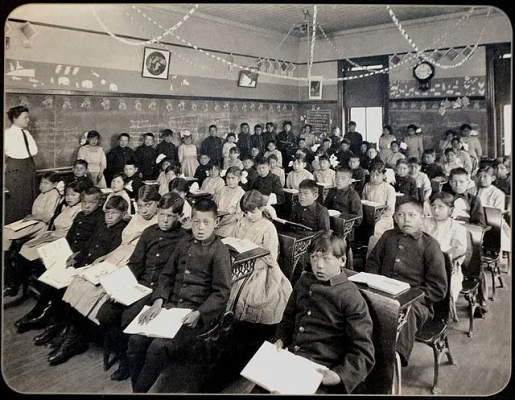
Genoa, Nebraska — Genoa Indian Industrial School, Public domain, via Wikimedia Commons
Deportation was once seriously considered as a way to deal with the end of enslavement of Black people in America. The prospect of the end of slavery had been at the forefront of the minds of white leaders for decades. Thomas Jefferson worried white Americans had a wolf by the ear.
“We have the wolf by the ear, and we can neither hold him nor safely let him go.” — Thomas Jefferson
While Jefferson’s concerns were theoretical, as he preserved the continuation of slavery for nearly fifty years by eliminating foreign competition when he eliminated the International Slave Trade in 1807, that protectionist measure strengthened the institution of slavery in America until the Civil War ended it in 1865.
Abraham Lincoln had the real problem of how to absorb 4 million formerly enslaved people into America. I will repeat Jefferson’s admonition about the Native American; would it be any less true of the enslaved people?
Lincoln’s solution was to deport the freed slaves. He unsuccessfully tried to convince Frederick Douglass and other Black leaders that the solution was to ship Black people to Liberia, Central America, or elsewhere. Rejected by Douglass, Lincoln conducted his own experiment by sending slaves he’d freed in Washington, D.C., in 1862 to Cow Island off the coast of Haiti. Lincoln’s experiment failed miserably, and he had to give up his deportation plans.
Liberia began in the early 19th century as a project of the American Colonization Society (ACS), which believed that Black people would face better chances for freedom and prosperity in Africa than in the United States. Between 1822 and the outbreak of the American Civil War in 1861, more than 15,000 freed and free-born African Americans, along with 3,198 Afro-Caribbeans, relocated to Liberia. In the 1920s, Firestone established a plantation in Liberia for the production of rubber.
While Lincoln’s views on Black people and slavery evolved during his lifetime, his views on the deportation of Black people did not. Four days before his assassination, he said the following:
The first Asian immigrants to America were Filipinos known as “Luzonians” or Luzon Indians. They came with the Spanish, arriving in areas of California and Louisiana as early as 1587. They also migrated North from Mexico. Wherever the Spanish went in America, the Luzon also went.
The first major wave of Asians arrived in Hawaii beginning in the 1830s, although Hawaii was not yet a state. As American capitalists established sugar cane plantations in Hawaii in the 19th century, they turned, through organizations such as the Royal Hawaiian Agricultural Society, to the Chinese as a source of cheap labor as early as the 1830s, with the first formal contract laborers arriving in 1852.
The first significant wave of Asian immigration to the continental United States occurred primarily on the West Coast, starting during the California Gold Rush in the 1850s. Whereas, Chinese immigrants numbered less than 400 in 1848 and 25,000 by 1852 Most Chinese immigrants in California, which they called Gam Saan (“Gold Mountain”), were also from the Guangdong province; they sought sanctuary from conflicts such as the Opium Wars and ensuing economic instability, and hoped to earn wealth to send back to their families. As in Hawaii, many capitalists in California and elsewhere (including as far as North Adams, Massachusetts) sought Asian immigrants to fill an increasing demand for labor in gold mines, factories, and on the Transcontinental Railroad.
Some plantation owners in the South sought Chinese labor as a cheap means to replace the free labor of slavery. Chinese laborers generally arrived in California with the assistance of brokers in Hong Kong and other ports under the credit-ticket system, where they would repay the money loaned by brokers with their wages upon arrival. In addition to laborers, merchants also migrated from China, opening businesses and stores, including those that would form the beginnings of Chinatowns.
As the Asian presence increased in America, so did the fear, often described as the “Yellow Peril.” America wasn’t alone in spreading the yellow peril, which began when Chinese workers legally immigrated to Australia, Canada, the U.S., and New Zealand. Chinese workers provoked a backlash against Chinese communities for agreeing to work for lower wages than did the local white populations. Horace Greeley published an editorial in the New York Times expressing a commonly expressed view:
What began in California with 325 workers in 1849 had grown to 20,026 within three years. The dream of mining gold spurred Chinese migration, but economic and social conditions, along with foreign intervention in China, helped to maintain a steady flow of immigrants to the United States. Only a small number of those seeking gold found enough to support themselves and their families in China, so most found other work across the western states or opened small businesses. In 1865, the Central Pacific Railroad recruited over 12,000 Chinese workers to build the western stretch of the transcontinental railroad, comprising 90 percent of the workforce.
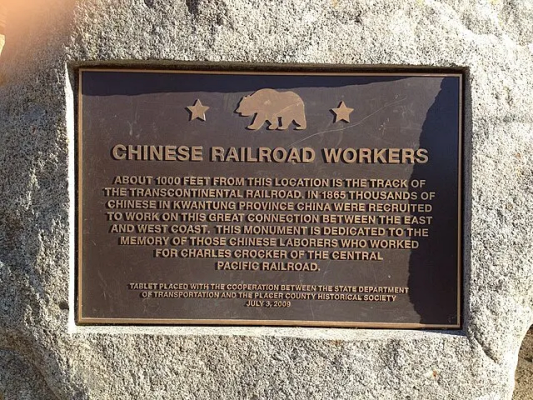
Gillfoto, CC BY-SA 4.0, via Wikimedia Commons
With the completion of the railroad, Chinese workers found employment in other industries across the country; they established Chinatowns in several urban centers, which provided cultural support and survival while also limiting economic opportunities for Chinese immigrants. Most of the mid-nineteenth-century Chinese immigrants were men who intended to return home after working abroad. A relatively small number of women immigrated.
As early as 1852, California imposed a tax on foreign miners, primarily targeting Chinese miners. Then, in 1879, California denied Chinese immigrants the right to vote and barred them from public employment. With the rise in unemployment during the 1873–1878 depression, a growing anti-Chinese movement emerged among Western labor leaders and politicians, who blamed Chinese workers for being paid depressed wages and for rising unemployment. Although Chinese immigrants represented only 4.3 percent of all immigrants arriving in the 1870s, they were singled out as being incompatible with the American way of life. Labor unions and the press portrayed this small immigrant group as posing an outsize economic threat to white workers. Racist and stereotyped images portraying Chinese people as immoral, disease-ridden, opium-addicted, and detrimental to white workers became common in newspapers and magazines.
The answer to the growing number of yellow people in America was generally exclusion. The Chinese Exclusion Act of 1882 was signed into law by President Chester A. Arthur on May 6, 1882, prohibiting the immigration of Chinese laborers for 10 years. The law made exceptions for travelers and diplomats. The Act also denied Chinese residents already in the US the ability to become citizens, and Chinese people traveling in or out of the country were required to carry a certificate identifying their status or risk deportation. It was the first major US law implemented to prevent all members of a specific national group from immigrating to the United States, thereby helping shape twentieth-century immigration policy.
That law was repealed in 1943 when the Magnuson Act allowed 105 immigrants from China each year. It wasn’t until 1965 that American immigration policies relaxed, which had prevented large numbers of immigrants from Asia, Africa, and various ethnic groups. There were still limitations on Chinese immigrants due to the emigration policy in mainland China, although many came from Hong Kong and Taiwan. Those were relaxed in 1979 when President Jimmy Carter normalized relations with China.
The fate of brown people is very much in the news as Supreme Court rulings impact their deportation and lack of due process come out almost weekly. What we’re told is that the focus is on criminals and murderers, but what we’re seeing is the deportation of many people who are following the immigration steps, sometimes dragged away from hearings and appointments. One grandmother, who had broken no laws, was pulled from her garden.
There are multiple subsets of brown people, including Puerto Ricans, Cubans, Venezuelans, El Salvadorans, Panamanians, Mexicans, and more. Some have been misled into thinking they were candidates for assimilation, but recent immigration policy implementation reveals there are no favorites. Cuban Americans are feeling betrayed as their once favored status has proven worthless. According to Census self-reporting, many Hispanic people consider themselves white or white and some other group. Don’t be fooled into thinking that this is how you are viewed.
Senator John C. Calhoun was clear on his views. At a time when America was expanding, Calhoun was vehemently against taking control of all of Mexico, because it contained “too many Mexicans.”
What never took hold in America was the concept of liberty and justice for all. There are still segregated schools despite what the law now says. The government forces that once cared have been disbanded. Voter suppression still exists, and more states are adopting laws to make voting harder, especially for minorities. Immigration policy is back to excluding shithole countries and favoring Europeans. The Yellow Peril is back in full effect, as China is our declared primary enemy. One thing is clear: the tactics remain unchanged. Assimilation is promised, but always at the cost of losing a culture. Deportation is undertaken, often for little or no reason, certainly without taking the time and effort to justify exile. You’d think destruction of a people would no longer be an option, but look at Palestine and the end to foreign aid programs. Exclusion is being selectively attempted, and birthright citizenship is seemingly in doubt. The players have changed, but America is still the same.
—
This post was previously published on The Polis.
***
You may also like these posts on The Good Men Project:
 Escape the Act Like a Man Box Escape the Act Like a Man Box |
 |
 |
 |

If you believe in the work we are doing here at The Good Men Project, please join us as a Premium Member today.
All Premium Members get to view The Good Men Project with NO ADS.
Need more info? A complete list of benefits is here.
Photo credit: iStock

