


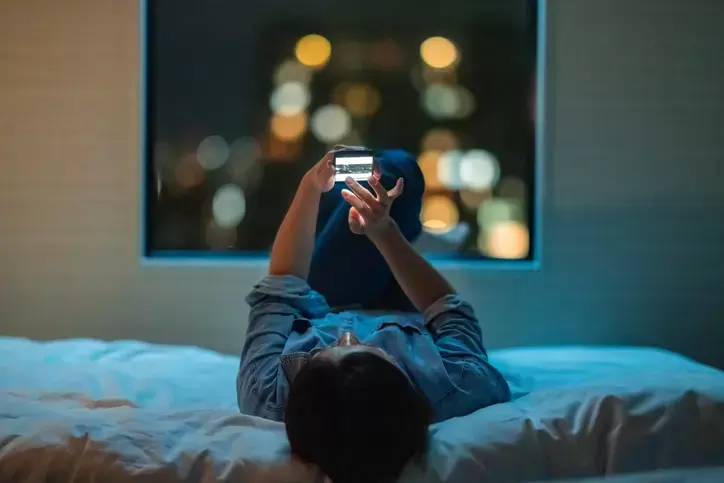
We’ve reduced love and relationship down to swiping on a hard glass screen encased by plastic and bits of computer chips.
Just like pornography or gambling — vices that often include a screen of some kind, swiping on an app rewards you with a quick rush of dopamine.
The endless options in front of you give you a false promise of sex, love, or connection, but you’re left feeling like an empty husk.
And none of this is by accident.
That’s how dating apps were made to be. Hedging your bets and relying solely on dating apps as a way to find love is…rather foolish.
And don’t get me wrong. I’ve used them and gotten laid, had memorable experiences, and found a long-term partner, but the evidence suggests that for most people, the best you can hope for is to find someone by “luck.”
Luck plays a larger role in dating apps than strategy
I sometimes think back to how I met my ex. I was more concerned with keeping things casual — maybe just sex or companionship. Relationships weren’t at the forefront.
I was using Bumble and Tinder back in 2018, and I was chatting with a different girl. She was too busy to go on a date one weekend, and when I matched with my ex, I got her out on a date quickly.
To be frank, my ex was a “second choice.” But that one small decision changed the trajectory of my life.
For years, she was everything to me. I loved her, but it eventually ended. That relationship started out mostly by luck. And when I went back to using them years later, I realized — through more experience — that dating apps need you to stick around.
And if you’re really lucky, you might find someone worth your time, but I’m stubborn and it took me over a year of trying and failing to see the truth.
I knew something had to change, but, like a porn addiction, I was still drawn to dating apps as a convenient option. I was kind of stuck in a cycle of swiping.
If it’s easy to get, it’s easily lost
Or not obtainable at all
When you think about it, it’s not hard to find out why.
You download an app in 30 seconds. Make an account. Log in. Upload some crappy selfies. Write a boring introduction. And now you’re set. Start swiping. (This is how most people use dating apps)
If it’s too good to be true, it probably is.
On the other side of this low-effort approach is the hope for sex, companionship, and love. And that’s hard to ignore.
Just like gambling, all you have to do is pull a lever or put down a few chips, and you think you’ll come out a millionaire.
“But the house always wins.”
In this case, it’s the companies that design and market their apps.
When I was using dating apps I faced an internal struggle. I knew it was too good to be true. You shouldn’t rely on them to find a real, meaningful connection, but the promise or hope of love and sex was too tough to ignore by swiping on static profile pictures of beautiful women.
I thought,
One more swipe.
Maybe it’ll be different this time.
She won’t be able to resist this message.
And the longer I stayed in this mindset, the harder it was to get out of it.
App developers aren’t oblivious to this fact
Dating apps, gambling, and porn are meant to tap into the reward system of our brains. While companies might not outright or explicitly state that they promise love or sex, the brain doesn’t necessarily know how to tell the difference.
And developers and marketers know this. They know its users have this idea of “the next swipe could be the one!” It’s emotional manipulation, and they’re well aware of the addictive nature.
They know the chase for the “one” keeps people coming back for more.
This is why they created subscription plans with extra features to get the “most” out of your experience.
…
Price breakdown of the popular apps
Tinder: Everyone thinks this is the “hook-up” app, but these days I like to think of it as the “avoidant’s safe haven.” No one seems to actually be interested in anything even related to dating anymore on this app.
- Free version with basic features and limited daily “swipes.”
- Tinder Plus and Tinder Gold provide additional benefits of $9.99 to $29.99 per month.
Bumble: A “woman-first approach,” — which differentiates it from other heterosexual dating apps. If the woman doesn’t message first within 24 hours of a match, it expires.
- Free basic version with limited daily “swipes.”
- Bumble Boost and Bumble Premium are $12.99 to $24.99 per month with more features.
Hinge: They intend it as a “Designed to be Deleted” app. This app has only ever caused me to delete it out of frustration (multiple times!)
- Free version with around 10 likes per day
- $19.99 per month for enhanced profile visibility; if I recall, some of the more advanced subscriptions exceed $60 per month.
…
While dating apps are used by men and women, I’d argue that app developers designed them to cater to men. Men typically have higher sex drives — I don’t think there’s much one could argue against this, and as a result, men will go through a lot of trouble to get laid.
But they will also pick the easiest option if they can.
It makes sense right?
Why go through the trouble of screening women in person when you can easily just get on an app, quickly make a profile, and have access to hundreds, or thousands of potential women?
It’s an over-simplification, but the problem is — most users of dating apps are men.
And again, the developers know this. I’ll get into the details of the ratios and statistics in a future article, but the odds are significantly stacked against dudes.
The average male user will find that he’s struggling to get matches and go on dates, and going on dates doesn’t automatically mean sex is guaranteed.
Obviously, the frequency or number of matches is based on (primarily) your main dating profile picture. If you have shitty pictures, don’t expect much — especially if you are a guy.
And from personal experience, I was meeting new partners at a slow, “steady” pace — by only using apps. Usually, it would take me (at most) 3 dates with the same girl before we had sex. I’d say I have that figured out, and that’s 1.5 to 2 weeks per woman.
My “dry” periods (when single) could average around 2 months or so. Not good.
I never spent money except for the occasional .99 cent boost, but the subscriptions were tempting.
So it’s no wonder men may feel pressured to pay for premium features. If they’ve been celibate or lonely for months, that $12.99 for the potential of easy sex is incredibly tempting.
With the overwhelming number of male users, it’s like an arm’s race, anything — including “paying-to-play” is fair game when it comes to love and sex.
And you can’t blame a guy for thinking a greater financial investment will yield better results. Logically it makes sense. Outside of dating, like business or education, a greater investment might promise more or better results.
At the end of the day it’s still a gamble.
To reiterate:
Dating apps, like gambling or porn, are well-crafted with the full intent to tap into our psychological weaknesses and urges. Tinder, Bumble, and Hinge profit off your need for love and connection.
Still not convinced?
What’s more profitable?
- Customers who use the app for a few months for free, find their “person” and never come back.
- Those who become addicted to the chase and always have their basic human desires dangled in front of them like a carrot.
Option 2. They’re the ones who are more likely to pay $20 per month for endless swiping.
It’s certainly possible to find your future spouse on a dating app. But I’m not convinced. I have personally experienced too many circumstances that indicate most people aren’t serious.
And as a result, dating apps naturally attract those who aren’t looking for something long-term. This reduces your odds to a slim margin, more so if you’re a guy.
With the time and energy you invest in swiping, you could use that to search for people in real life.
That’s the only place where you can confidently expect to have better results.
…
Are you interested in more content like this?
Subscribe to my Substack and unlock weekly exclusive insights that inspire, challenge, and transform.
…
Tired of second-guessing yourself in relationships? And setting boundaries is confusing and intimidating. My Boundary Setting Cheat Sheet simplifies this process with easy-to-follow IF/THEN statements you can implement immediately. If you’re ready to take the first step toward a healthy relationship, check out the cheat sheet here on Gumroad.
…
If you liked this article, follow me here on Medium.
I post new articles 3 to 5 times per week.
—
This post was previously published on medium.com.
***
Does dating ever feel challenging, awkward or frustrating?

Turn Your Dating Life into a WOW! with our new classes and live coaching.
Click here for more info or to buy with special launch pricing!
***
—–
Photo credit: iStock
