



Last week, I ran 80 miles. I did it running six days, twice in one day, with a morning run of 6.5 miles and an afternoon run of 11.5 miles. I ran 20.5 miles on my long run. The runs went pretty smoothly, and I didn’t go too hard on any of them, despite it being more time consuming than my previous mileage of 70 miles a week.
This may sound stupid, but there was one unanticipated consequence of this new push to run 80 miles every week: in my daily life, I was tired. I was exhausted. I needed more sleep, more food, more water. I am on my spring break from work now, but I still worked my day job in education and went to my law classes at night, so I was incredibly busy during this time.
This was another reminder of the collateral costs of being a runner. It’s not the actual runs that often bite, but it’s the impact on the rest of your life. The last time I went to happy hour with my colleagues and friends on a Friday was half a year ago. It wasn’t out of a desire to disavow drinking or the act of happy hour or not see my friends. Instead, I skipped out on all those happy hours because I had to run.
It’s not like I devoted my whole life to running, but I did start to orient a bit more of my life around running by running more than 80 miles a week, and I had to recalibrate to realize and act like I was much more than a runner.
So clearly, despite everything else more important I have going on, including my marriage, relationships, and being a writer,
Steve Magness, in Win the Inside Game, talks about fluid compensation as compensation made with the assistance of beliefs outside the field when it is unable to be made through the beliefs within the field after the meaning is violated. He mentions fluid compensation as a phenomenon where when one psychological need is under threat, we satisfy the need elsewhere. I fortunately have a lot of things in life going on, so when running isn’t going well, I can disengage for a bit.
But even if this race does not go well, it’s a low stakes race. And I can focus on other parts of my life, like spending time on a day trip with my wife, focusing on law school, or catching up on work in my day job to be able to realize that it’s not everything. Being introduced to fluid compensation allows me to orient each priority the place it should be in my life — running in the fifth or sixth biggest priority in my life. Of course, there are days it moves up the food chain in priorities, like days I have races or long runs, but in the grand scheme of things, I always have to remind myself it’s what I do as a hobby and for fun, not a life or death, anxiety provoking situation.
So far, running 80 miles a week requires more of a lifestyle adjustment than just the running part. There are many collateral costs outside of that. It took me very long to build up to 80 miles a week consistently, and it’s still something I’m not sure I can do. I had a lot of trial and error.
However, I do want to talk about the collateral costs of running besides time and energy. Running costs a lot of money. Running shoes can be very expensive and average around $100. There are ways to get around paying retail price by, for example, finding older models of the shoe online, since there are very limited changes from the one model of the shoe to the next model (why fix what’s working?). However, there is also the super shoe: shoes with carbon plates that help people run faster. They have been credited with the large spur in world records in the last seven years or so.
All of this is to say it’s nice to sometimes step away from running because it can sometimes be expensive, and not only in the traditional idea of expensive. I realize that there are times that this can ring thin, but running 80 miles a week has made me realize these collateral costs because I will need to get more shoes, and will be a lot more tired, and it will cost more money to be able to run more races.
Regardless, I am trying to take the next step, and since the summer brings the heat and humidity, I am doing my best to maintain a good mindset that for a while, the times will not be there and I might not run personal bests. It is something I have historically struggled with.
. . .
I raced the 5k today. It was as hot as I thought it would be, but it was also humid. The forecast said it was the hottest day so far this spring. I knew it would be a tough day, so I went conservative. I actually missed the race I was supposed to be in during the race because I was unaware the schedule had moved 20 minutes ahead of schedule, but I got into the next race. Because it was hot and humid, I gave up my goal of running a personal best on that day and just committed to competing.
Although I still believed myself to be in shape to run in the low 15 minutes in the 5k, it was not the day, and I am still not applicated as well to the heat. Plus, it was a pretty low-stakes race in an event I’m not even training for as a marathon runner. I learned my lesson in my previous marathon where I tried to run a personal best on a day it was 70 degrees, but then fell apart because I wasn’t used to that weather and had done most of my runs in the low 40 degrees during the winter.
As such, I went out slow. I ran my first mile in about a 5:06, which was slower than goal pace, and I sat behind the rest of the group. I then led the next two laps of the race, but was slowing down without realizing it. Another college runner took the pace, and I hung on the runner as I struggled through the next mile or so. We were all slowing down to around 5:20 mile pace, but the race only got harder. I was feeling it, and clearly the college runner I was running with and everyone else behind me was also feeling it. At 700, I could tell he was struggling and slowing down. I was struggling too, only less than this student was. I debated not making the move at all because I wanted to save my energy.
But I decided to go — I was feeling incredibly in pain, but it was almost over, and I knew I would have a big surge of energy at the end. I then ran a last lap and sprinted to a good finish, despite how hard it was. I won that race by about seven seconds, so it ended up being a really good race.
I saw the time, and I knew it was not great. I ran a 16:09 5k. My personal best in college was a 15:36, so that was pretty far off my personal best despite being in really good shape right now. And although I was cooked and tired, I was still very, very happy.
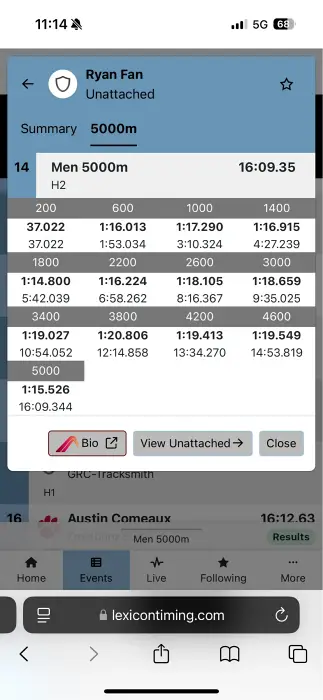
I will say there have been a few times in my life as a runner where I was happy with the race even though I did not run a fast time. The few times I was happy were more tactical races that were slow, and where we ran slow for most of the race, and it ended up being the finish at the end that decided the races. It was high school where I last felt this way, but the point was it was more about the place we finished than the time we ran.
As the day went on, I still wasn’t super happy about the time. But I was very happy about the effort. I was happy about how I competed. I was happy about how I hung tough even though I felt terrible at points and finished strong, in hot and humid conditions. I was happy that I took one step forward in my effort to get better and stayed on pace to run another 80-mile week to take the next step.
And all of this made me realize an essential lesson for the day: the time did not matter.
. . .
For a long time, I have conditioned myself to see success as a runner with how fast I ran. This was not always healthy, especially when I was injured or just in a rut. I have tried to have fun running, which I do in training, but my happiness in my racing has been inherently tied to how fast I run.
But I have matured, and my view has grown a lot more nuanced. Sometimes, it’s not about running fast. Things happen — conditions can get very hot or very cold. Where I live in the mid-Atlantic, it can also get very humid. Life can happen and we can get a lot busier, and injuries and illnesses also happen.
I am in a building phase where the goals change. There were times when I was a lot busier where getting to run at all was an accomplishment, and I just ran to get a break from a very tough job. The goal is to simply get in as many miles as possible over the summer to be in as good of marathon shape as possible for the fall.
Beyond that, however, just being so tied to the time is a habit I’ve had a really hard time breaking out of since I was twelve years old. I have been running for almost 16 years now. I have always tried to run faster and tried to improve myself through times. To me, improving in running has always meant improving in life, and breakthroughs in running have usually also, mentally and emotionally, always felt like breakthroughs in life.
I no longer take poor performances in running as indictments on the rest of my life, as I have a healthier relationship with running to realize I am a lot more than a runner and it’s far more important for my relationships and family life to be going well rather than my running.
However, it took reading Steve Magness’s book for me to embrace, even in my running life, that I am a lot more than a runner. I am a husband, friend, Christian, Asian person, teacher, student, and writer. One race where I ran slow is never going to change the rest of my life, and part of why I’m happy about this slow time is because it was still a good race given the conditions, and I competed well. But even if I didn’t, this emotional breakthrough has helped me realize that it’s not a big deal, that running does not define me, that what matters is I still went out there, did my best, and tried, and I have a lot of other things to turn to as a part of my identity.
This is a lesson I wish I had learned 16 years earlier. When I was in high school, a bad race was all I thought about all day. I used to have a tremendous amount of anxiety for days before the race, and it consumed my life.
Now, it’s just something I do, and I am beyond happy to no longer take running as seriously as I once did. And it’s obviously not a lesson I learned overnight. I used to say it, but now I mean it: it’s not all about the time. It’s not like I don’t try to run fast times, personal bests, and try to move to the next level. It’s a goal I will continue to pursue.
But I have finally internalized that running fast is not everything, and it was liberating to finally realize that.
—
This post was previously published on The Partnered Pen.
***
You may also like these posts on The Good Men Project:
 Escape the Act Like a Man Box Escape the Act Like a Man Box |
 |
 |
 |
Join The Good Men Project as a Premium Member today.
All Premium Members get to view The Good Men Project with NO ADS.
A $50 annual membership gives you an all access pass. You can be a part of every call, group, class and community.
A $25 annual membership gives you access to one class, one Social Interest group and our online communities.
A $12 annual membership gives you access to our Friday calls with the publisher, our online community.
Register New Account
Need more info? A complete list of benefits is here.
—
Photo credit: Ryan Fan, Howard County Striders

