



Dear Other Dad,
Okay, so, maaaybe this is what they call a quarter-life crisis. I’ve got my bachelor’s degree, and I’ve worked in my field for a few years, but I’m… not feeling it anymore? I am contemplating what it means to make a major career change. I don’t think I’ll need more schooling, just a major environmental shift. It’s heartbreaking for me to consider leaving my current field I’m so passionate about. Part of me feels like I could enter a more impactful field, more purposeful to try and make a difference in the world.
Sincerely,
~A Conflicted Creature
Clearly, you’re part of a pattern larger than your own experience — that’s why there’s a nickname for it. For readers who don’t know, a “quarter-life crisis” usually refers to a moment in one’s mid-twenties of serious doubt or dissatisfaction with one’s career and current situation.
It’s an imprecise term (how many of us expect to live to 100, honestly?), as it can happen a little later, too; for my friends, it mostly hit in their early 30’s. One after another, people left their jobs for new ones; some moved across the country or the world; and a few reconfigured their relationships at the same time.
What causes this? When it happened to me, I pegged it to the career I had chosen; most of my friends did the same thing, attributing their unease to the flaws of their specific jobs. In the span of a year, not only did I switch fields whole cloth, but so did my then-husband and a half dozen of my friends. You can imagine my surprise when, eventually, all but one of us returned to the fields we’d left behind. This made me think that there is more to it than the “wrong” career.
As I watched this pattern play out over the following years with more people I knew, I developed a theory. In American culture, we spend a lot of time with the landscapes of our lives outlined with fixed markers set by other people, each leading to a further marked signpost. You go to elementary school for a set amount of time, then it’s middle school, which in turn leads to high school. If you continue to higher ed, you have another four years or so mapped out; grad school can extend that in turn by even more. Whichever route one takes, from 12 to 20 years of life has been mapped in an orderly, sequential way, with set goals and measurable outcomes leading to the start of work and so-called “real” life.
That’s where the rub comes in. Once you have been in your field for a few years, you may have a realization that feels shocking: There’s no next thing. What I mean is that, for many, there is no universally prescribed signpost ahead for the first time since you were six years old. As liberating as adulthood can seem, it can be dizzying to realize it’s all on you, especially if you look at what you’re doing and say, “Can I really do this forever?”
When it happened to me, I called it “hitting the wall”: I slammed up against the feeling that what I was doing wasn’t enough to sustain me, or at least not the way I was doing it. So I left my job for something brand new, stretched some muscles, learned different skills, got good at it — and hated it. I knew within a few months that I had chosen a path that was even less sustainable for me, just differently so. I felt embarrassed and humiliated, considering that I’d been so eager to make the leap. I asked myself how I had gotten it so wrong at my age.
But I came to see that the leap wasn’t wrong at all; in fact, it made my current life possible.
Yes, many of my friends and I returned to our original fields after sojourns away, but a new pattern emerged in the process: we returned better prepared for our futures in those fields because we now knew what we needed, expected, and could or could not accept. Few returned to their past employers, instead choosing to find new positions in the same field, but with clearer vision from the experience. Being away helped me to appreciate why I loved some parts of my work but also helped me name the aspects most likely to grind me down; this served me well in finding the right work situation.
Ever since, my advice to others considering such a move has been to make peace with the idea that the next thing may not be the thing, but it doesn’t have to be. It needs only break the pattern that hamstrings you. As Dot sings in Sunday in the Park with George, “The choice may have been mistaken, the choosing was not.”
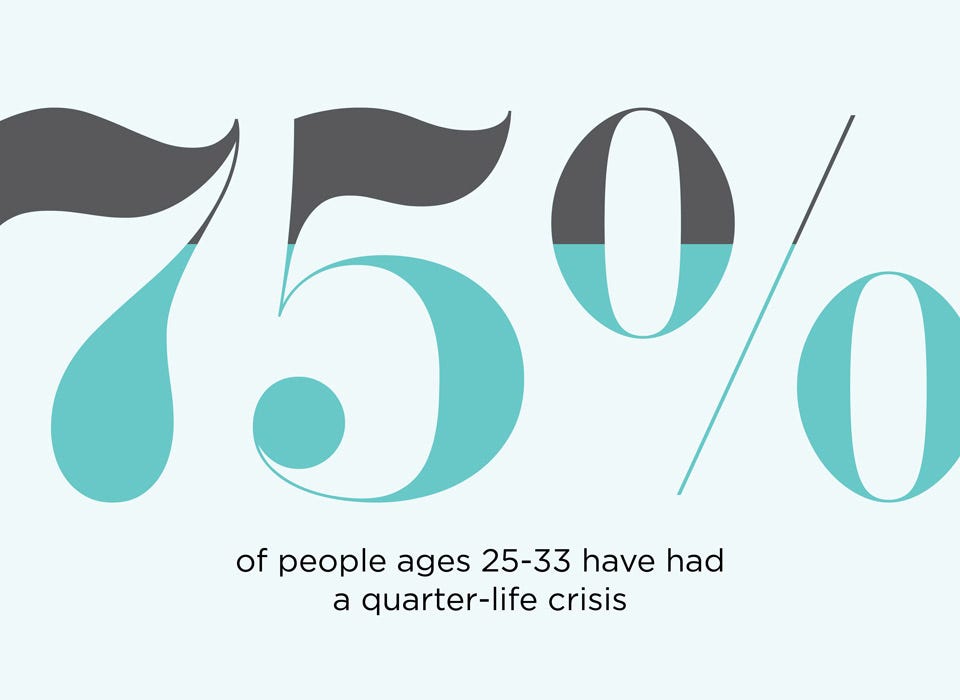
Read about the quarter-life crisis online at Career Contessa
If you are in a placein life where you can still support yourself if you switch fields (which is a privilege not to be taken lightly), I would say look at your choices and try to identify opportunities that will scratch the itch you’re feeling: the desire to make a difference more impactfully. But don’t freight this choice with the weight of forever.
Go in knowing that this could be just a waystation on a road you can’t yet picture, but can be valuable to you even so. Perhaps it will be the thing, and, if so, huzzah! Or perhaps it will buy you time for the universe to open more doors, maybe leading back to where you began or maybe to a third destination entirely.
Take the time you need to examine what feels unsatisfying about your current situation; name those things and name their opposites to come up with a clearer idea of what you seek next. What would “impactful” look like? What does “make a difference” mean? (It might also be worth asking yourself whether could you accomplish those same things by making smaller changes within your current field.)
The good news for you is that you aren’t on the clock. Hitting the wall…having a quarter-life crisis…making the leap — whatever you call this moment, it is unlike the previous phases of your life in that it is not deadline-driven.
You can make your own next signpost for the landscape ahead without feeling you need to map the entire route all at once. Good luck on the journey.
Got a question? Send it to [email protected]
—
This post was previously published on medium.com.
You Might Also Like These From The Good Men Project
 |
 |
 |
 |
Join The Good Men Project as a Premium Member today.
All Premium Members get to view The Good Men Project with NO ADS.
A $50 annual membership gives you an all access pass. You can be a part of every call, group, class and community.
A $25 annual membership gives you access to one class, one Social Interest group and our online communities.
A $12 annual membership gives you access to our Friday calls with the publisher, our online community.
Register New Account
Need more info? A complete list of benefits is here.
—
Photo credit: Christina Morillo for Pexels

