


KEY POINTS
- The discussion of senior friendships is often neglected.
- With shifts in work and lifestyle, there is a change in friendships.
- For thoe most part, seniors prefer depth over quantity in friendship.
Studies have shown that friendships are the strongest predictors of health and longevity in later life, yet friendship is the relationship category we tend to plan for the least (Chopik, 2017). Somehow, we assume our friendships will simply continue the way they did when we were raising kids or in the workforce; however, everything changes in our senior and retirement years.
The paradox is that seniors have more time and self-knowledge than ever before, yet their circle of friends often shrinks as they get older. This happens for many reasons, including widowhood, retirement, relocation, illness and other health challenges, time spent with grandchildren, and the loss of friends who’ve passed away.
The Losses Along the Way
Some friendship losses come with no ritual: a friendship that faded through distance or diverging lives, a falling-out that was never repaired, a friend who is still alive but no longer really “there” because of what’s going on in their life, or a gradual slipping away because one person has experienced cognitive decline (Doka, 1989).
These losses often go ungrieved because there’s no funeral or permission to mourn them.
Losing friends faster than we make new ones can leave many seniors feeling lonely.
How We Change as Friends
As we age, many of us become less patient with superficial connections. We’re often drawn to greater authenticity, directness, and depth. We may have fewer friends, but closer ones. This isn’t decline—it’s a kind of pruning toward what actually sustains us and makes us happy. It can help to stop and ask, “How does this relationship nourish me?” If a friendship isn’t offering you anything, it might be time to let go.
Longitudinal studies of older adults have found that friendship quality matters more than quantity (Chopik, 2017). People who feel unsupported or strained by their friendships tend to fare worse—physically, behaviorally, and emotionally—than those with fewer but steadier ties.
Where New Friendships Come From
Many people believe the myth that deep friendships can’t form after 60. Research says otherwise—proximity and repeated, low-stakes contact matter more than any personality match.
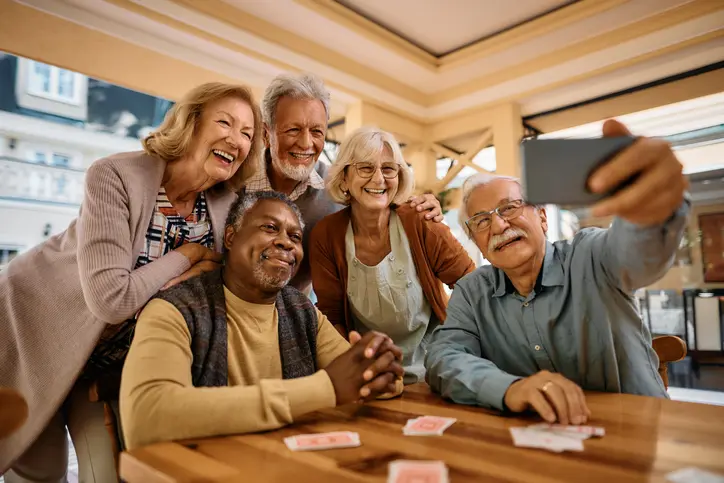
That’s exactly why classes, volunteering, faith communities, and other groups work because they create the repeated contact friendship requires. Sometimes friendship happens because of chemistry; other times, it happens because of logistics—people keep showing up at the same place and the same time. In recent years, for example, many have turned to games like mahjong, canasta, and bridge. Gatherings like these combat loneliness and keep the brain engaged.
The Courage to Make New Friends
In many ways, reaching out to potential new friends can feel riskier to seniors than it did when they were younger. The fear of rejection doesn’t disappear with age. It takes a lot of guts to be the one who initiates—the one who calls, who invites, who says, “Let’s not lose touch” (Liu, 2023).
It’s also more difficult to make friends as we age because there are fewer built-in structures, such as school, work, and young children’s activities, that naturally foster friendships. On the other hand, friendships can sometimes develop more quickly because seniors have less time to spend vetting people. By this stage of life, they also know what they’re looking for in a friend.
Sometimes just contacting someone to say you’re thinking of them can really change their world. Sending greeting cards is one way to stay connected.
Reconnecting and Letting Go
Sometimes reaching out to a friend you’ve lost touch with is a gift to both of you: the person receiving your text or phone call may simply be thrilled to be remembered.
On the other hand, people often outgrow friends or find a relationship draining or one-sided. In these cases, it might be better to end the connection. This is particularly difficult if the other person doesn’t feel the same way. Not every friendship is meant to last a lifetime, although sometimes lovely when it does. There’s no need to feel guilty about letting a friendship go. What matters most is being honest with yourself and the other person.
Strong Ties and Weaker Ties
When it comes to friendship, it’s helpful to distinguish between strong ties and weak ties. Close friends and family are considered strong ties. Weak ties are people we might call acquaintances, such as the woman at the pool, a fellow mahjong player, the person we wave to at the store, or the neighbor we see on our daily dog walk. These connections often center on a shared activity, and the relationship ends once the activity does.
Many seniors have become skilled at these looser connections, which can be surprisingly fulfilling. Studies have shown that older adults tend to be better than younger adults at relating to strangers and acquaintances, perhaps because they’ve developed stronger skills for casual connection—an asset as our inner circle shrinks.
In part, this has to do with no longer needing to impress anyone; it’s simply about being ourselves. Some people find it easier to maintain a wide web of loose, casual friendships.
In Summary
Friendship in the senior years isn’t a consolation prize for what’s been lost. For many women, in particular, it becomes its own late-blooming richness—sometimes more honest and more chosen than the friendships of earlier decades.
References
Chopik, W. J. (2017). Associations among relational values, support, health, and well‐being across the adult lifespan. Personal Relationships, 24(2), 408–422. https://doi.org/10.1111/pere.12187
Doka, K. J. (Ed.). (1989). Disenfranchised grief: Recognizing hidden sorrow. Lexington Books.
Liu, P. J., Rim, S., Min, L., & Min, K. E. (2023). The surprise of reaching out: Appreciated more than we think. Journal of Personality and Social Psychology, 124(4), 754–771. https://doi.org/10.1037/pspi0000402
—
This post was previously published on Psychology Today.
***
You may also like these posts on The Good Men Project:
 White Fragility: Talking to White People About Racism |
 Escape the “Act Like a Man” Box |
 The Lack of Gentle Platonic Touch in Men’s Lives is a Killer |
 |

If you believe in the work we are doing here at The Good Men Project, please join us as a Premium Member today.
All Premium Members get to view The Good Men Project with NO ADS.
Need more info? A complete list of benefits is here.
Photo credit: iStock

