


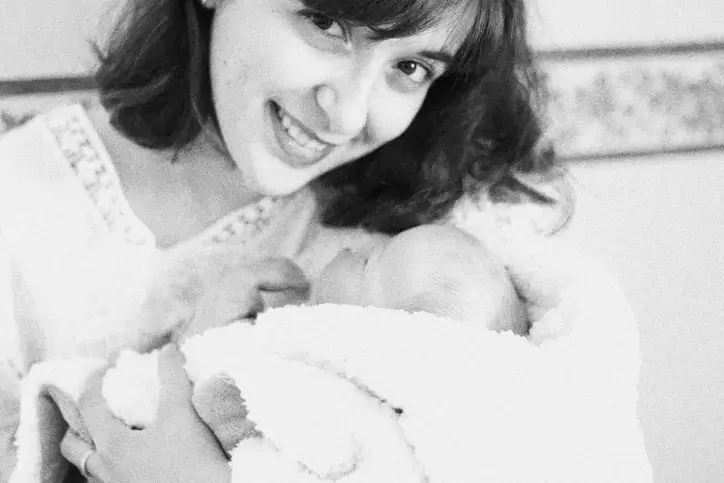
My mother was truly a grand lady. She took great pride in her appearance, making sure every strand of hair was perfectly in place, her eyebrows always carefully shaped, and her outfits chosen with an impeccable eye for detail. Her handbag and shoes always matched, reflecting her elegant style and grace.
With her impeccable sense of style, striking red curls, and vivid green eyes, combined with Dad’s distinguished position as an air marshal and President Sukarno’s trusted right-hand man, she quickly became a prominent and highly respected figure within her social circles.
My mother’s heart was both generous and discerning. If I admired something she owned, she’d say, “Take it, my girl,” never hesitating to give to those she loved. She would have given anyone the shirt off her back.
Yet, she could also be sharply critical, especially of me. If I wore short skirts, red lipstick, or left my hair down, she’d frown and say, “You look like a prostitute. You’re not going out like that.” I’d try to argue, pointing out that miniskirts, red stilettos, and matching lips were the height of fashion, especially after years of wearing bloomers and long skirts at boarding school. But she stood firm.
When my best friend and I eagerly entered “Eve’s Beauty Contest” fresh out of school, I needed her signature to participate. I was seventeen, brimming with excitement, but she tore up the entry form and declared, “No daughter of mine shall ever parade in bathers.” Even though we only wore saris in those contests and Loretta and I were so proud of how we looked, my mother’s word was final, so we never got to enter.
We lived on bustling Cunningham Road in Bangalore, India, a lively street teeming with shops, businesses, and a constant stream of chaotic traffic. Navigating the roads there was always an adventure; crossing meant dodging through a maze of honking cars, buzzing motorbikes, weaving three-wheeler auto rickshaws, and the occasional wandering cow, all with little regard for traffic rules.
I’ll never forget the day we set out for some shopping in an auto rickshaw. Out of nowhere, my mother suddenly shouted, “STOP!” The driver slammed on the brakes, and before I knew it, she had leapt out.
There in the middle of the street, three blind men, hand in hand, were bravely attempting to cross through the madness.
Without hesitation, my petite, spirited mother charged into the traffic, her arms waving and voice commanding, shouting, “Can’t you see these men are blind?”
She brought the hustle of the road to a standstill, caring nothing for her own safety as she escorted the men to the other side. Not only did she save them from danger, but she also gave them a firm lecture about the perils of crossing such a wild road without warning or protection. That day, her fierce courage and compassion were on full display, a true testament to her feisty spirit.
When my mother visited my husband and me in Australia later in our married life during the nineties, she was quick to notice the children zipping around on skateboards. Always one to turn inspiration into action, she suddenly declared, “Order 500 skateboards to be shipped to Bangalore.” When I asked her why, she replied, “Don’t ask.” I assumed she wanted to give them to underprivileged children for Christmas, so I placed the order.
Later, I discovered that my mother had those skateboards explicitly made for the leper colony. She would bravely venture into the pit where these unfortunate souls lived, many dragging themselves along because they had lost their legs or arms to the disease. Thanks to her, they could now glide around on skateboards just like the children.
My mother brought them food and special treats, offering comfort and kindness where there was little else. Medical care was nonexistent, and food was often tossed into the pits because people feared catching leprosy. But Mum, undeterred by the stigma or danger, visited regularly, sharing a warm smile and delicious meals with those in need.
Remarkably, she never contracted the disease herself; surely, she was watched over by God and the angels.
Mum decided to conquer driving, and oh, what a spectacle that turned out to be! She’d drive halfway into the garage, then hop out to squint at the bumper, debating whether the car would squeeze in or take out a wall. Her driving career was the shortest and most dramatic on record: it ended with a bold entrance straight through the wall of the Sholay police station! At least she didn’t have far to go to collect her ticket and wave goodbye to her license, all before she could properly terrorise Bangalore’s roads.
Dad was diagnosed with Alzheimer’s at age 89 and passed away at 93. Throughout those difficult years, despite being close in age to him, my mother insisted on caring for him at home with the help of a maid and a nurse. The strain on her was evident, but she remained steadfast and devoted.
One afternoon, during the usual 4 PM tea time in India, Dad was napping on the sofa. Mum asked if he wanted his cup of tea and dooth pera, his favourite sweet treat. Holding up her fingers, one, two, three, four, she watched for his smile and nod at four. She returned with the sweets, gently shaking him, saying, “Wake up, Alan, or your tea will get cold, and you don’t like cold tea.”
. . .
The day the angels took my mother, she had spent the previous evening watching her favourite serial, “The Bold and the Beautiful” on TV.
Her ayah was massaging her feet and legs, and Mum, ever particular, called out, “Massage properly, Kavita. My skin is itching and dry.” She enjoyed her favourite dinner of roast chicken and vegetables, generously laced with gravy, before going to bed at her usual time.
The next morning, she felt dizzy and fell in the bathroom. My brother helped her back to bed, and she closed her eyes, saying she just needed a short nap before breakfast.
Mum always insisted, “Do not send me away without my hair and makeup done, and wearing my blue salwar kameez from my 70th wedding anniversary.”
When she was peacefully laid to rest in her casket, I asked my brother for her makeup bag and gently did up her face, styling her naturally curly hair by wetting it so it would curl beautifully. Although her body had grown cold in the refrigerated coffin, I gently asked the mortician to carefully cut the dress and place it on her, tucking her rosary beads into her hands.
She wanted to be placed at the feet of Jesus, and that’s what I wrote on her headstone: “May you land at the feet of Jesus dearest Mother.”
She was truly a warrior, and her example instilled in me the strength I carry today. Yet, I often longed for a closer mother-daughter bond, wishing I hadn’t been separated from her by years in boarding school and later by my working life in the big city. The distance left me yearning for more shared moments and a deeper connection.
Oh Mum, I love you deeply, for your unwavering support of others and your ever-graceful way of keeping up appearances. How I wish we had more time together.
Yet, I treasure every moment we shared, and I know she’s up there now, orchestrating the angels with her usual flair.
This piece serves as a follow-up to my recent post, “Keeping up Appearances,” inspired by the thoughtful words of Tracy Cranford, a writer I deeply admire. Her heartfelt comment, “Your mom sounds like a strong and wonderful woman who shaped another strong and wonderful woman”, truly resonated with me. Reflecting on Tracy’s comment, I realised how much these words, and the journey behind them, have not only affirmed my strength, but have also helped heal parts of me I didn’t know still needed mending. Thank you so much, Tracy ♥
. . .
Thank you for reading, dear friends ღ.
—
This post was previously published on Write A Catalyst.
***
From The Good Men Project on Medium
 |
 |
 |
 |

If you believe in the work we are doing here at The Good Men Project, please join us as a Premium Member today.
All Premium Members get to view The Good Men Project with NO ADS.
Need more info? A complete list of benefits is here.
Photo credit: iStock

