


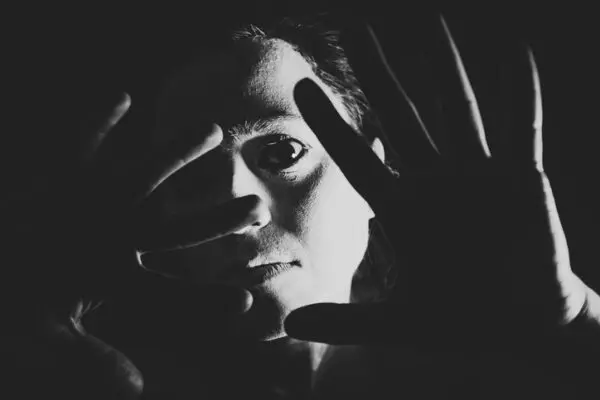
One of the more harmful dynamics in our emotional lives is our capacity to generate fear before anything has even occurred. Fear can become a type of “masking” or “suppressing” emotion, something we choose to feel in place of a feeling we anticipate will hurt us and which we don’t want to face.
So, anticipatory fear often functions as a defense we choose to feel to avoid what we believe will be a worse emotion, so fear becomes a “decoy” emotion to avoid something anticipated to be more painful. Yet, this “pre-emptive” fear and the pain it carries can become a more significant source of suffering than anything we want to avoid.
When I was recently reading No Exit by Sartre, I suddenly realized that it wasn’t so much that “Hell is the other person,” as much as hell is our fear of what the other person can conceivably say or do to harm us. It is not the emotions brought about by cruel statements that seem to cause the worst pain, it is the fear of what others can say that becomes painful when we brace against an experience that may not even occur. We know our vulnerabilities, we know what others can say or do to hurt us and this induces fear to prevent any possible social or interpersonal sting.
This type of pre-emptive fear thus works as a type of masking mechanism. The fear we know we can bear and handle becomes what we choose instead, and by feeling that fear we try to avoid feeling humiliation, anger, shame, grief or other potentially harmful emotions. Yet, without feeling the anticipatory fear (which causes or magnifies pain) we might be able to face the emotions we want to avoid directly and realize they are not only survivable but easily borne or dispensed with.
So fear can be thought of as a “chosen” pain, a pain we prefer because it is familiar and manageable, we know we can handle it and prefer it to other more socially invoked negative emotions. Ironically, this type of fear can even be somewhat comforting because it can feel safer, more familiar, and more controllable than the emotion it is protecting someone from.
There is, in fact, a neurobiology to this: anticipatory fear can become reinforcing when it gives the brain a sense of control over an uncertain threat, making a familiar, predictable fear feel safer than the emotion we fear may follow. Fear can become a psychologically “comforting” pain, because it seems more manageable than, say, shame, humiliation or grief.
Many lives are dominated by fear because we are masking so many of our possible negative emotions because, interpersonally, we have become such emotional threats to each other (which I thought to be a big theme in No Exit). Perhaps this fear exists for some of us as an inner shield that we carry around all the time, a “pain” shield which provides a “comforting” pain to protect us from the pain we feel we need to avoid.
Physical Effects of Anticipatory Fear
Dr. Jonathan Sarno wrote about “anticipatory fear” as a physical event. He argued that fear of back pain, for example, often creates or intensifies the pain. He argued that the body “tightens” because the mind anticipates danger or pain, and that added tension produces real, extra and more intense physical back pain.
The fear becomes the mechanism of increased pain, although it is created as a response to anticipated pain. Sarno’s claim was that anticipatory fear and “catastrophic interpretation” create muscular tension, which then produces extra pain. So fear leads to tension, tension leads to pain, pain leads to more fear and you wind up getting a feedback loop. Catastrophic interpretation, by the way, is the (mis)interpretation of normal bodily sensations or ambiguous situations as signs of imminent disaster, a basic mechanism in panic attacks and anxiety.
Indeed, there is also something called anticipatory anxiety, which is the anxiety we experience in anticipation of a feared event. The distinction is primarily about the nature and timing of the threat, not necessarily whether the person is anticipating an emotion versus a situation.
Namely, for anticipatory fear, the threat would be specific and identifiable, while for anxiety, the threat would be more diffuse or potential. For fear, the timing would be in the present, but for anxiety it would be future-oriented. For anticipatory fear, the response would be acute, while for anxiety it would be sustained apprehension (worry). Finally, for fear, the typical behavior would be escape, fight or avoidance, while for anxiety it would be vigilance and preparation.
Getting back exclusively to anticipatory fear, it becomes a decoy emotion meant to protect a person from confronting something perceived to be more threatening, but, paradoxically, it produces a worse type of pain than the one a person wished to avoid. The basic idea is that the mind generates a pre‑emptive emotion to avoid the direct impact of one perceived to be more threatening. Fear is one of the most common substitutes because it works fast, is overwhelming and it takes up all the mental space that the feared emotion might occupy.
Here’s what’s really insidious: anticipatory fear becomes the dominant experience and the feared emotion, like humiliation, stays unprocessed or unexamined. Your goal is to avoid the pain of humiliation, but the only legitimate way to do it is to allow it, examine it and not mask it. Let it leave for good on its own terms. Pre-emptive fear becomes one of the worst inhibiting factors in our humane development…it stops meaningful emotional introspection.
It’s the same structure as Sarno’s model: the anticipatory state becomes the real suffering, worse than the suffering the person wishes to avoid. And the person never reaches the feared state, which would allow a direct resolution.
It is important to remember that every emotion either carries pleasure or pain with it. Shame, guilt, grief, anger are some “painful” emotions. Love, gratitude, joy, enjoyment are emotions that carry pleasure. For painful emotions, an anticipatory fear often rushes in first and becomes the “safer” pain, the pain we choose, the pain the person feels they can handle…the comfort pain.
Psychology has described related processes in terms of defensive affect, anticipatory shame and social-threat responses. They help explain how we can anticipate an emotionally painful experience and attempt to protect ourselves from it. Fear may become the emotion we experience because it seems faster, more familiar and easier to manage than the deeper emotion underneath it. In this sense, fear can have an “instrumental” role.
Fear Can Become a Default State
Fear can take over a person’s life when it stops reacting to events and starts predicting them, when it becomes the thing a person wakes up with every day to protect the person through the day.
Here I am using “fear” somewhat broadly to describe the anticipatory emotional state that arises before a feared experience occurs. Psychology more commonly uses the term “anticipatory anxiety” for prolonged apprehension about a future threat, and the two can overlap. My concern here, however, is with what happens when this anticipatory state itself becomes a person’s dominant emotional experience.
People with social-threat sensitivity, for example, may live in fear of embarrassment or humiliation before either has occurred. Social anxiety can cause people to anticipate social situations with fear and anxiety well in advance, and in severe cases, they may avoid work, relationships or other situations in which they expect to be judged. The fear becomes the main event while the actual humiliation never even occurs.
Panic disorder is another example of this anticipatory process. The fear of having another panic attack can become highly disabling. People may stop going outside, traveling or doing things they associate with the possibility of another attack. The anticipation itself begins to control their choices and limit their experiences.
Trauma research also shows how responses to threat can become persistent, with people remaining highly alert or physically braced even when an immediate threat is absent. In the framework I am presenting here, this is important because the person is no longer simply responding to something that has happened, as the person is continually responding to the possibility of what might happen and, in some cases, to the possibility of experiencing an emotion they desperately want to avoid.
How Do We Kick This Anticipatory Habit?
First, you can realize or be “mindful” when you fear something that hasn’t even happened. Don’t deny the fear, don’t reject it, don’t brace against it, let it cycle out of your system instead of feeding it. Second, you can overcome this fear by not bracing for what hasn’t happened, because the bracing, or tightening up, is what makes things painful. Recognize that anticipatory fear is an amplifier not a reducer and when you stop tightening up around the fear of an emotion, the emotion you wish to avoid tends to be smaller than the fear you built around it.
That’s the big move. You let the thing underneath show up, humiliation, shame, whatever it is, without trying to dodge it. When you stop dodging, the real source of pain can disappear as the pain is discovered to be in the anticipation, not the emotion itself.
The way out is to stop fearing the emotion and let it arrive. The emotion probably hurts less (if it hurts at all) than the fear of it and you can better analyze the emotion and perhaps not be affected by it.
Let It Be.
You can’t stop people from being petty or insulting. There will always be people who are mean or cruel, and there will always be people who, for whatever reason, try to make others feel small or cause them pain.
We need, however, to realize that fear is no real shield against them. Sometimes the best response is to let people be what they choose to be, within lawful limits, while allowing yourself to experience your own emotions without adding fear to them. I think part of the problem may be that we do not even realize how quickly painful emotions can pass, if we allow them to.
Your response to an insult will not last forever and may cycle out and be forgotten surprisingly quickly. When you allow this, you may discover how little power another person’s attempt to hurt you actually has. Frankly, bravery works. Be gently brave.
You cannot stop another person from being petty or unkind, so let them be. Their behavior belongs to them, your response belongs to you. You don’t have to carry their anger, their insecurity or their cruelty inside yourself and you can simply refuse to give it more of your life than it deserves.
Your “revenge,” if you need it, is freedom. Let them live their lives as they choose and reap the consequences, good or bad, and you can live yours without allowing their behavior to occupy your mind. They are responsible for what they do. You are responsible for what you allow to remain inside you.
Choose Joy.
The important thing is not to allow other people to put you into a world and life of fear, because that may be one of the most painful realms in which to live. When you learn to let things be, to let people say what they will, to let them dislike you, even to let them try to hurt you because you have inadvertently bruised their egos, something unexpected can happen: joy and laughter can return. It really can. Don’t validate malice, but live with joy. It is better than fear and even better than revenge.
—
iStock image

