



The above excerpt sums up H.H. Leonards’ recent book, Rosa Parks Beyond the Bus: Life, Lessons, and Leadership. Leonards, founder and chair of the Mansion on O Street and the O Street Museum Foundation, headquartered in Washington, D.C., took Parks into her home in 1994.
Rosa Parks, the great human being and public citizen, had been robbed in her own home in Detroit. She needed a change of scenery; Leonards provided it. It was an important act of humanity and it has now led to this important book.
The book is about Rosa Parks. With banning books in full swing, a book about Rosa Parks is the antidote to the evil of intellectual bigotry. Who wants to ban a book about Rosa Parks and have to explain why? Yet, I am pretty sure this current crop of desperate bigots would ban this one as well.
For these reasons, Leonards’s book is necessary. There is such a need now for more books about the fight for equal justice in America and about the everyday people doing the fighting.
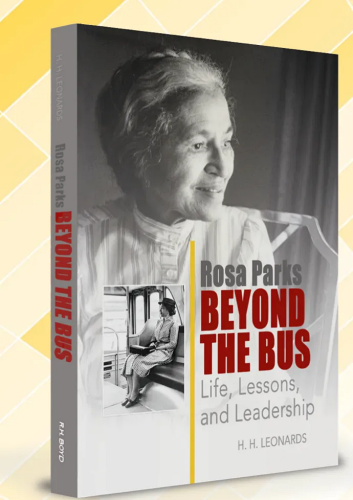
Photo credit: R.H. Boyd Publishing
Leonard tells the reader slowly why Parks is so important and she immediately moves beyond the obvious. Leonards provides us with a view of Parks’s life as a human being with daily struggles and challenges and a personal history that shaped her before and after the Montgomery Bus Boycott of 1955–1956.
The reader will learn more about Parks’ loving husband, Raymond, who helped make much of her work possible. The reader also can learn more about Parks’ distant relationship with her father.
“I believe it is time for the world to celebrate Mrs. Parks beyond the bus — her life, philosophy, and devotion to all people. I am forever grateful to have shared an intimate decade with her.” (Leonards)
Parks becomes a full person in this biography, not the larger-than-life, yet neglected, American citizen. She is more than a Black seamstress who refused to move to the back of a bus in Montgomery, Alabama. As Leonards makes clear, Parks told her she wasn’t tired that day in December 1955, but rather she was tired of “giving in.”
But we also learn Parks’ direct family connections to African American enslavement and the complex racial dynamic that continues to divide America but also brings understanding. And Parks is as American as it comes. The values that America purports to embrace are real to her and she lived them and spoke them.
Who knew that after that struggle, Parks continued to support African American causes and the rights of women? Who knew that she openly aligned herself with Malcolm X and Angela Davis? Who knew that in 1991, she spoke out against the appointment of Clarence Thomas to the U.S. Supreme Court? That she supported reparations for African Americans?
One of the disturbing stories in the book details Parks’s opposition to the exclusion of women from the March on Washington in 1963. While that march is often recognized as a great moment in U.S. history, it was also a demonstration of American sexism and patriarchy by Black men.
Leonards writes that Parks was “dumbfounded” by the fierce opposition of the men to equal participation by women in the protest. It didn’t become a moment of retreat for Parks, but rather it prompted her determination to fight for the rights of all people.
Parks’s work with the NAACP’s investigation of Recy Taylor’s brutal rape in Alabama, in 1944, is another story Leonards includes. Parks wanted to investigate the case and she did. It took nearly seventy years for Alabama lawmakers to apologize for not prosecuting the six white rapists of Taylor. Parks’s work was important to documenting the injustice of the case.
Leonard includes the story a friendship with Mamie Till, the mother of Emmett Till, the fourteen-year-old boy murdered in Money, Mississippi by whites racists. Before Parks ignited the nation by taking her stand, Till’s death left a scar on Black America that had to be confronted. Parks also bonded with South African hero Nelson Mandela. They met in 1990, upon his release from prison. Mandela told the story many times how Parks’ courage helped him as he faced his own moment of destiny.
We also learn that Parks was such a significant public citizen that she lay in honor in the U.S. Capitol Rotunda in Washington D.C., my hometown. Parks was the first woman and only the third private citizen to be given that honor. I stood in that line that night.
How could anyone not try to pay Parks proper respect. She was like all of us — an ordinary person doing extraordinary things. The Rosa Parks story tell us all that we are all the same and that we can all make change. That is how it happens anyway. An ordinary person decides enough is enough.
—
This post was previously published on Writers and Editors of Color Magazine.
***
You may also like these posts on The Good Men Project:
 Escape the Act Like a Man Box Escape the Act Like a Man Box |
 |
 |
 |
Join The Good Men Project as a Premium Member today.
All Premium Members get to view The Good Men Project with NO ADS.
A $50 annual membership gives you an all access pass. You can be a part of every call, group, class and community.
A $25 annual membership gives you access to one class, one Social Interest group and our online communities.
A $12 annual membership gives you access to our Friday calls with the publisher, our online community.
Register New Account
Need more info? A complete list of benefits is here.
—
Photo credit: iStock

