



About a month ago, I got the flu. It knocked me out and incapacitated me for several days and was the worst illness I had gotten for several years. I had a fever and chills for several days, and did not feel like I could function at all. This was problematic for many areas of my life, including as a teacher and law student, but I found it especially problematic as someone training for yet another marathon.
I have a marathon in two weeks, one where I have been increasing the volume and intensity of my training. My goal is to run 2:30 in the marathon, which is an average of 5:43 mile pace. In the fall, I ran 2:35:40, which is an average of 5:56 mile pace, so a five minute personal best, especially at a level where it’s hard to improve by that much, would mean a quite a lot.
Before I got the flu, I had been averaging 70 miles a week of running for at least three months. I thought all the training was all of a sudden ruined. For one week, I only ran 10 miles, and the next week, I still was not 100% and ran about 50 miles, still having congestion when I did run.
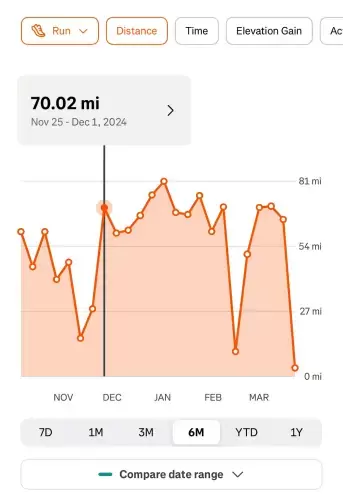
Author’s personal runnign data
Of course, in hindsight, it was ridiculous to think that one week almost completely off and another week where I didn’t feel 100% was a death sentence to my aspirations. But that’s how it felt at the time. I doomscrolled running forums that runners frequent to see various posts of people saying something like “I got the flu and wasn’t the same for a month” or “I got the flu and was never the same,” with most posters saying that even though they felt fine navigating their daily lives, they still felt sluggish and had symptoms on their runs. I have no way to fact check any of these anonymous posters, but the point was that anyone who comes back from the flu should be very slow and cautious in their recovery, and just not expect much.
But I was feeling close to 100% with no symptoms about three weeks later. Since I felt like I had already been out of commission for a bit and needed to dive deep back into my training, I ran 28 miles for my 28th birthday and had no symptoms whatsoever. I did that run while coming through the marathon at 2:58:30, which is around 6:50 pace, with relative ease, which my body needed to be either at or close to 100% to do. I was ecstatic to finally feel normal again, but I did realize that, as a runner who has largely been free of injury or illness, I have taken a lot of being able to run for granted, and I am lucky to be back to chasing my goal.
. . .
Now, with the flu out of the way, I am looking for another breakthrough. When I ran 2:35 in the marathon, I did it off of 60 miles a week for about six months of training beforehand. I only took one or two “down weeks” of about 40–50 miles.
I realized that the long-term consistency of my training was what helped me improve. I ran a personal record of four minutes and 19 seconds, but I knew I could do even better and I got a taste of what it took to become a better runner, and I felt like I unlocked the key to the formula worked particularly for me.
I wanted more. If I wanted to become an even better runner, especially for an event as dependent on aerobic endurance as the marathon, I needed to build more aerobic endurance. To build more endurance, I needed to run more miles.
So after my November marathon, instead of running 60 miles a week, I averaged 70 or more miles a week until the week I got the flu. One week, I ran 80 miles. It wasn’t so much how I could run a ton of miles in one week, but I learned during these training cycles that the important part was whether I could keep up that kind of mileage for months on end. Running 70 miles a week right now is a big deal to me, a much bigger deal than it would have been during high school or college: I work as a teacher during the day and go to law school at night, so I have to be very creative about finding time to run. On many days, I have to run either very early in the morning or very late at night, but being able to manage this uptick has been more challenging to me than it has a lot of people.
I wrote previously about how I’d been stagnant and at a plateau in the marathon for several years. Between November 2021 and November 2024, I ran several marathons, stuck at the same personal record of 2:39:59. More often than not, I completely bombed those marathons too, with a first half on pace and on target and then a second half where I could not keep the pace and my body started breaking.
I used to think the problem was all execution. I may have gone out too fast in the race. Maybe I did not fuel right. Maybe my mindset was not right going in, and I was putting too much pressure on myself. Maybe I shouldn’t
But I learned during this most recent marathon that mindset and execution do matter, but they only get you so far. I learned that training and preparation, particularly for an event as aerobically and taxing on the body as the marathon, is a lot more important. When I bombed the Boston Marathon after several miles of my calves and thighs spasming and having to stop and walk, my friend told me something that was a wake-up call:
“Look, Ryan, you’re not going to get better at the marathon running 40 miles a week.”
It took an outsider’s view for me to realize it. I didn’t even realize I was running 40 miles a week, but I was. It didn’t exactly look like 40 miles a week when you broke down my mileage charts — one week I would run 70 miles, then the next week I would run 20–30 miles based on my schedule getting too busy. The cycle would repeat itself over and over and there was no consistency or rhythm to my training, so I certainly was averaging somewhere around 40 miles a week.
That could make the whole three years where I didn’t improve my marathon personal best seem like a major waste of time, but in that time period, I did improve my personal bests in lower distances like the half marathon. I did build the capacity to be able to handle volume like 70 miles a week without my body breaking down. I learned what my body needed in terms of recovery and fueling.
Another big adjustment I made was working out less. This looks different for different people, but there is an 80/20 rule in running where 80% of weekly training should be done at an easy effort while 20% should be done at a hard record. I’m experienced enough as a runner to know that some weeks, this can look like 65/35 rule or 70/30 rule and that being too rigid on 80/20 was not the most beneficial.
However, the general principle behind the 80/20 rule is that distance runners should be doing far more easy miles than they should hard, intense miles in workouts. For me, it meant that my previous plan of working out twice a week was too much. Two workouts in a week meant that my body was breaking down a bit too much and I may have been overtraining instead of focusing on the easy volume, especially with my busy schedule. So I decided to scale back, which left me feeling much more fresh, and focus that intensity I put in my second workout to the long run.
I have learned that going into a race, but especially the marathon, with too rigid of a goal is more often than not a bad idea. A ton of things can happen. It can be too hot or too windy, or the course could be very hilly, so conditions need to be factored in. I will be happy with anything that’s a personal best, and will just show up to the line that morning to do my best and execute to the best of my ability. But I do genuinely believe that I am currently in 2:30 marathon fitness and will have to prove it on race day. I do genuinely believe I can win that race I am entering, and am going in to compete to the best of my ability.
Specifically, there are some key adjustments I have made to my training to try to improve in the marathon:
Longer and better long runs
One big adjustment that has helped me run more miles is longer, longer runs. On my last training cycle, I used to run 17–18 mile long runs. My longest runs were one 20-mile run and one 22-mile run in that cycle.
But on this cycle, I started doing regular 24-mile long runs. One culminated with me running six miles at marathon pace or faster in the middle of the run.
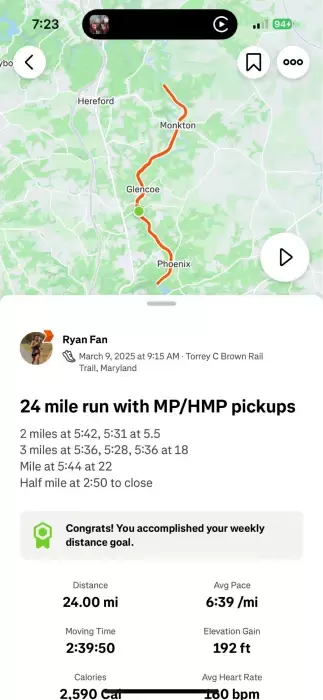
Photo by author
I would also usually incorporate a workout into my long run. There was rarely a long run where I did not put in two to three miles at various points at marathon pace. It started with 5:50 miles but as I got into better shape, I started to put in miles in the low 5:40s or even high 5:30s. It became very reassuring that times that would have felt extremely fast for me on last training cycle were all of a sudden times I started to randomly run in the middle of or at the end of long runs. My decision to run 28 miles may seem arbitrary, but it was also a test of my ability to handle the unique pain felt at the end of the marathon.
To my understanding, the point of longer long runs for a marathon runner is to stay strong during the end of the marathon. If you have run a marathon or know anyone who has done it before, you know it’s a very common phenomenon to start blowing up and breaking down the last six miles. In my most recent marathon, I was able to keep it together until mile 23 or so and just survive until then.
Since I want to be able to maintain my strength for the end of the marathon, my 24-mile long runs would not just be 24 miles at a certain pace, but as I got stronger, I put a big emphasis on putting in the 2–3 mile pickups at the end of the run. As you can imagine, putting in 2–3 miles at 5:45 mile pace would end up significantly more difficult at mile 20 of the run than it was at mile 7, but I understand I got the most “bang out of my buck” from longer long runs by simulating race-like conditions as much as possible. Now, I’m not sitting here recommending 24-mile long runs for everyone. Any time I went that long, it would take me less than three hours. It’s not like the whole run would be fast, but the marathon-pace pickups would make the average pace of the run fast enough to be around seven minutes per mile or faster.
But I am seeing the benefits of those runs now in how any run less than 16 miles feels like an easy run where I don’t have to expend significant energy. I am in the middle of a taper, which is the few weeks before a big race where a runner scales back mileage and intensity to peak during race day. Yesterday, I did a shorter long run of 18 miles with seven miles at marathon pace. I was able to hold a pace in the low 5:40s and high 5:30s the whole time, which was great since this is definitely not something I could have done in my last training cycle.
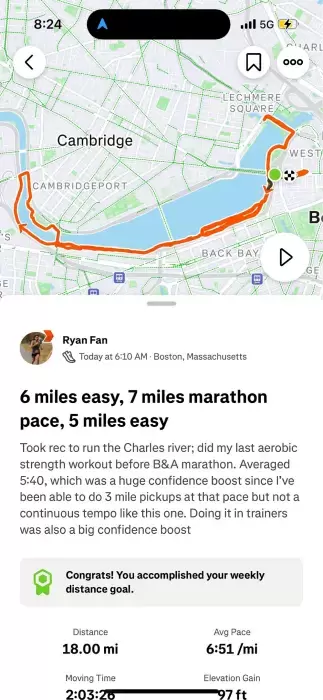
Screenshot by auhtor
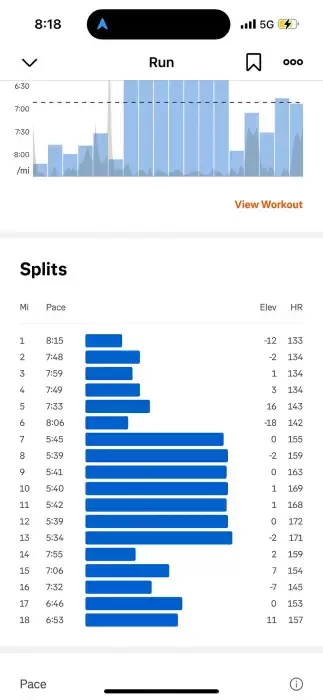
Screenshot by auhtor
So I would point to the long run being the main difference between this training cycle and the last. With my average long run being somewhere between four to six miles longer than the runs of my previous cycle, this added a good amount of miles to the week to help me hit 70 miles, while I would make up the other miles with more reps in a workout or more miles added to easy runs.
All of this could have been too hard and too long once I show up on race day — I don’t know. All I know is I was confident in my ability to handle this kind of intense long run every week given I’ve been a marathon runner for the past six years and I was just coming off a training cycle of a lot of intensity and volume, so this was a slight uptick in the foundation I had already built that felt natural.
Having more fun with running
While my discussion of my long runs is more analytical, my workouts were where I gave myself more leeway to do dumb, but fun things. Most of my workouts were pretty controlled, often mile repeat efforts that were “threshold” pace, which is a pace that is roughly the pace that can be sustained for an hour of running. Sometimes, I would just skimp on my workout in general for the week to just do more easy miles to prepare myself for the long, fast long run at the end of the week.
But I would do workouts with friends and help pace friends while they were working out. These workouts probably weren’t the most beneficial for me, but were a lot of fun and were occasions when I could socialize as well.
For example, I ran an all-out 800 with one of my friends watching and another friend pacing. I thought I was in great shape and able to run a personal best in the 800, despite the glaring weakness that I had done no speedwork to peak for the event. I was relying on sheer aerobic strength and endurance to run an event where there was a ton of speed required. I ended up running a 2:07.1 800, which was a personal best in the 800.
On other days, I would pace my friends’ workouts in the middle of a run. On one occasion, I paced a friend who was significantly faster than me. His goal was eight 800-meter repeats at 2:20, which is a 4:40 mile pace. With my mile personal best very close to 4:40 and my 800 personal best clearly not being much faster than 2:20, I knew it was very unlikely for me to stick through the entire workout. I knew this workout was likely too difficult for me and might tire me for several days. But I was able to get through two reps, which was very difficult, and then shift to just being able to pace the first lap of each rep, with a 70 second 400 for most of the rest of the reps.
There were other track workouts that were just too short to really be beneficial strength sessions. I would pace friends through reps of 400 or 600 at paces that were pretty comfortable for me. On a recent occasion, one of my friends wanted to race 300 meters all out. There were no stakes and it was just for fun. There was a good deal of banter over who would win, and I thought he had a good shot because we had relatively the same amount of speed, even if I had more endurance. But I was able to drop the hammer and make a move that no one could respond to, and continue the banter after the run.
Otherwise, I tried to make easy runs more fun, too. Because of my schedule, my ability to run with people is a lot more limited than it used to be. I don’t live within running distance of my friends, and I have to run at odd hours where people wouldn’t want to meet up. I listen to music and podcasts if I’m running solo. In the mornings, that’s the time when I can catch up on the news and opinion writers I enjoy reading. If I’m running easy and don’t care about the pace, I’ll prefer podcasts. If I’m running harder or am doing a workout, I’ll play music.
Of course, a lot of why running is a lot more fun right now is because it’s going well and I’ve been a lot more fit. But I try to remember I’m still a recreational runner who is doing it as a hobby, not a professional making money doing it, so keeping it serious but recreational is a balance I’m trying to strike.
Mindset shift
There is a part of me that still has some significant self-doubt. Being a great runner (by my standards) was something I always wanted, but never quite achieved. I always knew I was underachieving. There was something that held me back at various points of my life. For a lot of it, it was not sleeping enough, working out too hard, and not finding that overall balance you need as a long-distance runner that people don’t talk about.
If there is any big shift, it’s that I’ve already put in a lot of work over a long period of time, and I can rely on that work, both mentally and physically. It’s not like those exams I’d been studying for just the night before — using the exam analogy, this is an exam I’ve been preparing for for a decade and a half. It took me 15 years as a runner to be able to run 70 miles a week over this long of a period of time. Over that time, I’ve had many failures, tons of bad races, many unforced errors in my training or races where I shot myself in the foot by putting in too many surges or going out too fast.
It’s been a long, slow, and often boring journey to try to run 2:30 and actually have it be a realistic expectation. It has required big sacrifices on my time and energy. I believe I can do it and my confidence as a runner is at an all-time high right now.
But there is always a big difference between believing and seeing it actually happen. When I first started running at 12 years old, I improved my mile time from a 9:50 to a 6:50. At the time, I thought improvement was easy and exponential just by running hard and giving effort, but I, like every new runner, had “blank slate syndrome,” where you improve substantially at something when you’re new and a beginner. But then it took four years for me to improve my mile time from 4:59 to 4:36, a mere 23 seconds. I ran my first marathon in 2:40:07, and would only run 2:39:55 to improve by 12 seconds three years later after multiple attempts. To finally see substantial, four or five minute improvements again is something I know won’t always be the case, as we all get older, the better you become, the harder it is to just make the most marginal of gains.
I think we all want improvement to be a linear, exponential journey, and my journey as an experienced runner has taught me it’s very nonlinear. Injuries, illnesses, bad days, and plateaus that seem to happen for no reason just happen.
But I can try to tie up these lessons in a ribbon, but the reality is when you’re actually experiencing a slump or that nonlinear journey with times, it absolutely sucks. Everything else in my life can be going extremely well, and one marathon where I blew up and had to walk or slow down significantly could completely ruin my day and be a huge shot at my identity as a runner. When I was younger, a bad race was all I could think about for a whole weekend. This is counterbalanced by the unparalleled exhilaration of a good day and personal best, but being as outcome-driven as I have a tendency to have those costs of absolute devastation on a horrible day as much as euphoria on a good one. This is much more balanced than it was when I was younger, but I am still very aware that I struggle to not overthink bad days, especially as a runner.
For the marathon, I think I will understand that even if it does end up being a bad day or a very hot or very windy day where I can’t really run my best time, all those 24-mile long runs, 70-mile weeks, days where I woke up before 5 a.m. to get in a run before work were not a waste of time. It is one step in a longer journey, and sometimes, I don’t see the benefits of the fruits of your labor until much later than I expect. I didn’t see the benefits of the past three years of training as a marathon runner until relatively recently, for example, but learning what not to do as a runner is sometimes just as important as learning what is beneficial to do.
It’s not that I won’t be upset or by a bad day, but I do have a better mental capacity to zoom out and see it in terms of perspective — I didn’t just try very hard, but I tried very hard for a very long period of time to make those physiological and mental fitness benefits lasting and sustainable. I gave this training cycle everything I could give, except for the week I had the flu. Even if this marathon goes poorly, it’s not like I didn’t build a better physiological and mental foundation of aerobic strength and confidence that I’ve never had before.
. . .
For the next cycle, I might try to increase my mileage to 80 miles a week for several months. That will require some more adjustments in my training: I may have occasional days of running twice a day. I think doing that over the summer and over several months for a fall marathon, where conditions are ideal and optimal, would result in even greater improvements.
Beyond the technical adjustments, I think I have taken all the right steps in my training and preparation to be able to take the next step, and I hope my journey can inspire other runners who were in dark places I once was. It has not been easy to get here and there is not a simple story of success, but a winding, nonlinear roller coaster.
—
This post was previously published on Publishous.
***
You may also like these posts on The Good Men Project:
 White Fragility: Talking to White People About Racism |
 Escape the “Act Like a Man” Box |
 |
 |
Join The Good Men Project as a Premium Member today.
All Premium Members get to view The Good Men Project with NO ADS.
A $50 annual membership gives you an all access pass. You can be a part of every call, group, class and community.
A $25 annual membership gives you access to one class, one Social Interest group and our online communities.
A $12 annual membership gives you access to our Friday calls with the publisher, our online community.
Register New Account
Need more info? A complete list of benefits is here.
—
Photo credit: Ryan Fan

