


When people talked plants, I used to boast about how I could kill anything — even the hardiest of plants. Of course, it wasn’t really a boast. I wanted to be good at gardening, but I had tried a few times and failed, and I thought it wasn’t meant for me.
This was my first lesson.
There have been many in the last year since I started taking gardening very seriously indeed. Over those early months of the pandemic, I transformed a walled, patio area into a secret garden out of frustration, boredom, and determination. Then, I began adding houseplants.
I have easily over a dozen different plants in my small outdoor garden and closer to 40 inside. With life outside my doors thrown into chaos, I spent a lot of time with my plants. When anxious, little calms me quicker than putting my hands into the dirt or taking the time to check on each plant to see what it needs. There have been many lessons in the year, but my garden may have taught me more life lessons than anything else lately.
#1 Trying and failing doesn’t mean something isn’t for us.
I had tried to garden on a number of occasions, and I did manage to kill far more than I grew. From this, I drew the conclusion that I just wasn’t good at gardening. I seemed to forget that learning a new skill meant work. Practice would lead to progress — only I seemed to give up after each failure rather than figuring out what I did wrong and trying again.
This applies to jobs, hobbies, and even relationships. When life gets tough, too often we give up. We surrender our dreams. We end the relationship. We resign ourselves to the fact that the hobby we’d love to be good at just isn’t for us.
Sometimes, trying and failing means we haven’t found a good fit, but sometimes it just means that we need to persist. We need to evaluate our priorities and determine how much it matters. If it won’t bother us to quit, we could do that. But if it’s something we love and/or are passionate about, we may just want to keep practicing.
#2 Nurturing others takes practice; nurturing ourselves is intuitive.
Learning to figure out what my plants needs has had a steep learning curve. Some like plenty of water. Some don’t. Some absolutely hate to get their feet wet, which I think is adorable. Some need shade, and some require an abundance of sunshine.
People are just as diverse. We can’t simply nurture the people in our lives with a one-size-fits-all mentality. Learning what other people need to feel loved and cared for is a practice. It’s more than understanding someone’s love language; it also matters that we understand who they are and how they work. Our care should custom fit each person.
Nurturing ourselves, on the other hand, is more intuitive. It often involves unlearning what we think we need and listening more to what our bodies are telling us. We have a society that drives us to work when we need to rest and to fuel ourselves based on the clock rather than hunger or on appearance over nutrition. Even our sleep is more limited than we often require because of endless tasks to be done and the pressure to do them.
Plants let us know when they need more water or less. They respond to their environment. We respond to ours, too. We just have to be paying attention to how we feel. We can practice being more intentional in the way we care for others and more intuitive in the way we care for ourselves.
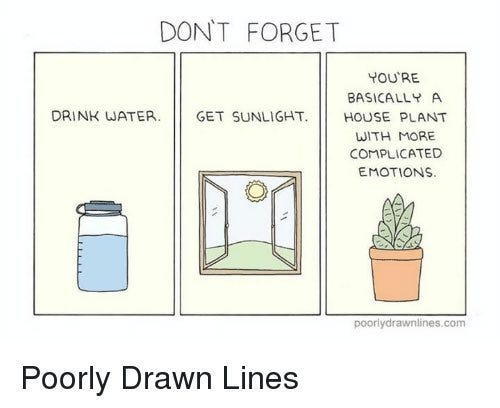
Art by poorly drawn lines (@PDLComics) / Twitter — Check out City Monster, the new graphic novel
Image text: “Don’t Forget- Drink water. Get sunlight. You’re basically a house plant with more complicated emotions.” (By Poorly Drawn Lines on Twitter)
#3 We get what we give.
My garden is thriving. I’m not using magic fertilizer or practicing some kind of ancient ritual to make it so. I am simply paying attention and putting in the effort.
Every day, I walk through my home turning on indoor sun lamps and watering the plants that need it. I check in with each one. I do the same with my outdoor plants, making sure they have everything they need — from plenty of water in the summer to an actual plant blanket to shield it from the coldest temperatures in winter.
Whether we’re talking plants, people, or life, we get out what we put in. Of course, effort alone isn’t enough to make plants or relationships work. But when we invest energy, effort, and attention into our lives, we do see more positive results.
My garden requires me to tune in. My children require that, too. The relationships in my life require it. My goals need that same attention. Every area of our lives need intention and action, and my garden is a daily reminder of that.
#4 Nurturing needs to be consistent, not occasional.
Every day, I have to check in with my plants. If I travel, I have to make sure my plants are cared for in my absence. It matters. It’s a daily routine, not an occasional effort, that gives me healthy, happy plants.
Nurturing — ourselves and others — requires consistency. Without putting in the daily effort to take care of ourselves and our relationships, we can often cause harm. Like plants, people respond to our attention — and to our neglect. So do our own bodies when we don’t take the time for self-care. My houseplants remind me that nurturing cannot be occasional to be effective.
With that being said, over-caring for our plants can cause harm, too. This is particularly important to remember in relationships. Smothering other people and not allowing individuals to have space and time for themselves causes as much damage as neglect.
#5 Growth means outgrowing.
Over the last several months, I’ve figured out the importance of moving plants into larger pots. If that seems like a no-brainer, keep in mind that I used to kill most of what I was supposed to be growing. There was no need to move them to bigger homes. These days, with a thriving garden, I am constantly checking to see what has grown enough that it needs more space.
When we grow as humans, we also outgrow, too. We outgrow people. We outgrow houses. Sometimes, we outgrow interests. We keep expanding, and instead of trying to hold on and keep ourselves small, we can learn to embrace our own expansion.
#6 We grow through what we go through.
I am an imperfect gardener and imperfect human. I’m still learning. Much of my growth has been very plant-like in nature. The quote by Dinos Christianopoulos puts this perfectly: They tried to bury us. They didn’t know we were seeds.
Growth often looks like emerging from darkness, those challenging times in our lives, to emerge into the sun — vulnerable but brimming with potential. I’ve put energy, effort, and attention into my own growth journey — nurturing and learning as I go. The way my garden grows depends entirely on the conditions and my care. That’s how we grow, too.
As children, we may not always get the conditions and care we’d have preferred. As adults, we become responsible for choosing the conditions and care we will receive. Of course, privilege or the lack of it is a factor in the opportunities afforded us. Still, we certainly grow through what we go through, and we get to choose the direction of that growth.
#7 Letting go is an opportunity, not an end.
I have always struggled to let go when things come to an end. My garden has been teaching me that letting go is an opportunity, not an end. My moon flowers have probably taught this lesson best. They bloom for an evening, and then by morning, they are gone. They are exquisitely lovely — and not meant to last forever. I can neither pick them or preserve them. They come to me for a moment, enrich my life, and then leave.
Instead of grieving the moon flowers, I’ve learned to appreciate their transient beauty. I enjoy every single bloom, and when they are gone, I look forward to the next.
Gardens are all about cycles. The seasons change, and my plants change with them. Indoor and outdoor, they are impacted by the changes. I might be able to provide artificial sources of light in winter, but I’ve come to accept that changing seasons will mean changes to growth.
Some won’t make it beyond a single season. Some people don’t either. It doesn’t mean we can’t be fully present, enjoy our time, and move on when it’s done.
This is what I keep telling myself. It’s the lesson that’s the hardest for me to accept and the one I choose to keep practicing until I’ve made progress.
Our gardens are rich in lessons. Every day, I learn a little more. It’s a quiet, meditative practice. I observe the growth in them and the growth in me. I’d like to say it’s making me a better human. I nurture them; they nurture me right back, the way the best relationships do.
These days, I don’t say I’m an expert gardener. I say that I’m a lifelong learner, ready to learn whatever my garden has to teach me.
—
This post was previously published on medium.com.
***

If you believe in the work we are doing here at The Good Men Project and want a deeper connection with our community, please join us as a Premium Member today.
Premium Members get to view The Good Men Project with NO ADS. Need more info?
A complete list of benefits is here.
—
Photo credit: Shelby Miller on Unsplash

