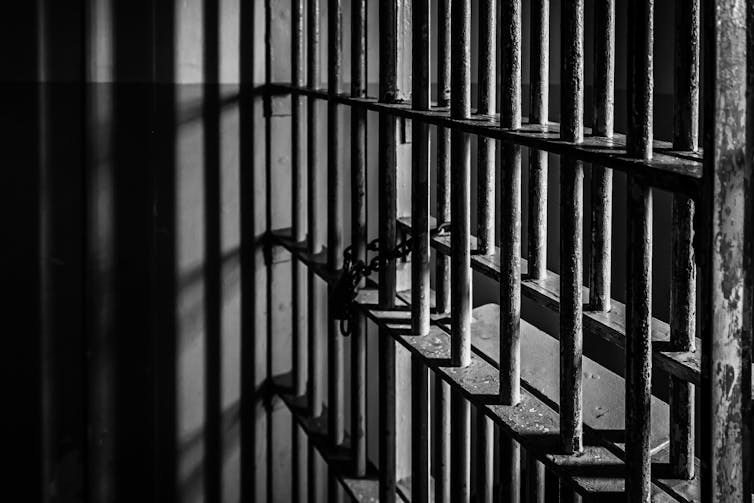
Suicide is, of course, a serious problem more generally. In 2017, it was the 10th leading cause of death in the U.S., claiming the lives of over 47,000 people. Today, it takes twice as many American lives as homicide.
But, as someone who teaches and writes about punishment and imprisonment in the U.S., I find something particularly troubling about prison suicide.
American law recognizes a “special relationship” between the jailer and the prisoner, meaning that jailers have a legal responsibility to protect prisoners from harm – including self harm.
It also can complicate the pursuit of justice. When someone awaiting trial ends their life, crime victims are deprived of the opportunity to have the perpetrator brought to justice. And, when someone who has already been tried and convicted commits suicide, that act impedes the public’s legitimate interest in seeing a punishment fully carried out.
In 2015, the death of Sandra Bland, a young African-American woman who hanged herself in a Texas jail, also made national headlines.
Bland had been stopped for failing to signal a lane change and was arrested and jailed for an alleged assault on a public officer.
The circumstances surrounding her death, like those surrounding Epstein’s death, were mysterious. That mystery was not resolved when Bland’s family filed a wrongful death suit and eventually accepted a monetary settlement of US$1.9 million.
Because families either settle or generally don’t prevail if their case goes to trial, there is little pressure from the courts to address suicides among the incarcerated. And, except in cases where there is notoriety, there is also little public concern about such events.
But data from 2014 shows the magnitude of the suicide problem. In that year, 372 inmates killed themselves in local jails, resulting in a suicide rate of 50 deaths per 100,000 inmates.
A study done by the nonprofit National Center on Institutions and Alternatives found that such suicides are “evenly distributed from the first few days of confinement to over several months of confinement, many suicides occurred during waking hours, most inmates were not under the influence of drugs and/or alcohol at the time of death, and many suicides occurred in close proximity to a court hearing.”
Suicide in jails also arises from the fact that those who are accused of a crime and cannot make bail are first sent there while awaiting trial. As Thomas White, an expert on suicide among incarcerated persons, observes, by the time people are serving their prison sentence, “the shock has worn off.”
The rate at which people kill themselves in jails is, as the AP reported in June, “2 ½ times the rate of suicides in state prisons and about 3 ½ times that of the general population.”
Moreover, because they have fewer staff per inmate and generally worse conditions, those rates are higher in state than in federal prisons.
In jails and prisons at both the state and federal level, the suicide rate was increasing when the Justice Department last reported its data from 2014.
And, as the public learned in the Epstein case, leaving someone alone in a cell is a key driver of jail and prison suicides.
The problem in that case seems to have been a lack of supervision or surveillance, but Epstein was also at risk of suicide because his cellmate had been transferred out of their shared unit in violation of the jail’s procedure. A 2007 report from the Central New York Psychiatric Center notes, “Almost all suicides in state prisons occur in single cells as opposed to in dormitories or double-bunked cells. Suicide is a very private act, and whether it occurs in a hospital, in the free community, or in prison, it almost always occurs when the person is alone.”
As U.S. prisons increasingly turn to isolation as a principle of punishment, or to single-cell disciplinary housing, it should not be surprising that the incidence of suicide would rise.
In my view, the U.S. owes it to those whom it incarcerates to do something about the problem of suicide.
This story has been updated to account for medical examiner’s report on Jeffrey Epstein.
Don’t like ads? Become a supporter and enjoy The Good Men Project ad free
—
What’s Next? Talk with others. Take action.
We are proud of our SOCIAL INTEREST GROUPS—WEEKLY PHONE CALLS to discuss, gain insights, build communities— and help solve some of the most difficult challenges the world has today. Calls are for Members Only (although you can join the first call for free). Not yet a member of The Good Men Project? Join below!
All levels get to view The Good Men Project site AD-FREE.
Register New Account
Please note: If you are already a writer/contributor at The Good Men Project, log in here before registering. (Request a new password if needed).
◊♦◊
ANNUAL PLATINUM membership ($50 per year) includes:
1. AN ALL ACCESS PASS — Join ANY and ALL of our weekly calls, Social Interest Groups, classes, workshops, and private Facebook groups. We have at least one group phone call or online class every day of the week.
2. See the website with no ads when logged in!
3. MEMBER commenting badge.
*** ANNUAL GOLD membership ($25 per year) includes all the benefits above — but only ONE Weekly Social Interest Group and ONE class.
*** ANNUAL BRONZE membership ($12 per year) is great if you are not ready to join the full conversation but want to support our mission anyway. You’ll still get a BRONZE commenting badge, and you can pop into any of our weekly Friday Calls with the Publisher when you have time. This is for people who believe—like we do—that this conversation about men and changing roles and goodness in the 21st century is one of the most important conversations you can have today.
♦◊♦
We have pioneered the largest worldwide conversation about what it means to be a good man in the 21st century. Your support of our work is inspiring and invaluable.
—
The Conversation is an independent news and commentary website produced by academics and journalists, free for the public. Follow on Twitter @US_conversation