


Or Who are you when nobody is watching?
There is a strange question every creator eventually has to face:
Who are you when nobody is watching?
Not when a post gets thousands of likes.
Not when someone shares your work.
Not when an editor says,
“We want this.”
Not when someone tells you that your words changed something for them.
What happens when you create something and nobody sees it?
Who are you then?
I think this is one of the most uncomfortable questions for a creator.
However, this question might never even arise if we understood one simple thing:
We don’t create for someone else. We create, first of all, for ourselves.
We share what is inside us with the world.
But when we create something on demand, it is no longer quite the same thing.
It becomes production.
You can create something out of inspiration and then find someone who wants to buy it.
But when it works the other way around, when you create something because someone asked you to, it becomes commissioned work.
Inspiration doesn’t work on demand.
Inspiration doesn’t really like being monetized.
It likes being shared.
***
Today, many people think that being talented means you should eventually become rich because of your creativity.
Or that you should go viral on social media.
But an artist whose entire apartment is filled with paintings nobody has ever seen can be poor during their lifetime and become famous only after their death.
History knows many examples of this.
Talent isn’t measured in money. Neither is love.
It is something measured by the emotions people experience when they look at a painting or read a poem.
It doesn’t even matter what those emotions are.
What matters is that nobody remains indifferent.
Someone will laugh.
Someone will cry.
Someone might even feel afraid.
And everyone will see something of their own in the same painting.
The most valuable kind of art is the kind that changes people for the better.
The kind of art that helps someone change their life.
***
The internet has quietly taught us to connect creativity with reaction.
You post.
People respond.
Or they don’t.
The numbers move.
You check them.
And if nothing moves, does that mean you’re a bad creator?
Of course not.
I don’t think a real creator’s goal is to become viral.
First of all, because a real creator is usually not for everyone.
They stand out. And precisely because they stand out, they may not appeal to everyone.
Something that becomes widely viral often succeeds because a large number of people can immediately recognize themselves in it.
It is accessible, familiar, easy to understand.
That doesn’t make it less valuable or less talented.
But originality doesn’t always work that way.
Sometimes the very thing that makes something original is the fact that it doesn’t fit neatly into what everyone already knows or likes.
And that is okay.
Everyone has their own priorities and their own joys in life.
***
When we show our creativity to people, we all go through a stage of becoming aware of this.
We learn what worked.
We repeat it.
And eventually, without even noticing, we can start creating with an invisible audience sitting next to us.
I went through that too.
Would they like this?
Would they understand it?
Will this get engagement?
Should I make it shorter?
Should I make it more controversial?
Should I use this word instead?
Maybe I should make another Reel.
Maybe this idea isn’t worth posting.
And somewhere in the middle of all that noise, you can forget the original reason you started creating.
One day, I opened Instagram and thought:
What exactly do I want to say to people?
What exactly do I want to see here?
I realized that I hadn’t been creating for myself for a long time.
I wanted to explain to people how things worked in the twin flame journey, to help those who needed it.
And I had gone so far in that direction that I had lost myself.
I remembered the person I used to be.
When I was just starting my journey, I simply wanted to make something about me.
Not necessarily to be seen.
Not necessarily to be praised.
I simply had something inside me that wanted to come out.
As if something was standing behind me, gently tapping me on the shoulder.
A thought.
A sentence.
An image.
A melody.
A story.
A ridiculous idea that made me laugh.
Something I couldn’t stop thinking about.
That is where I understood that the real relationship between an artist and their creativity begins.
Before the enormous audience you have never even seen.
Before the algorithm that doesn’t know what emotions are.
Before the numbers that change every day.
Before anyone knows your name.
Or doesn’t.
There is just you and the thing you want to create.
***
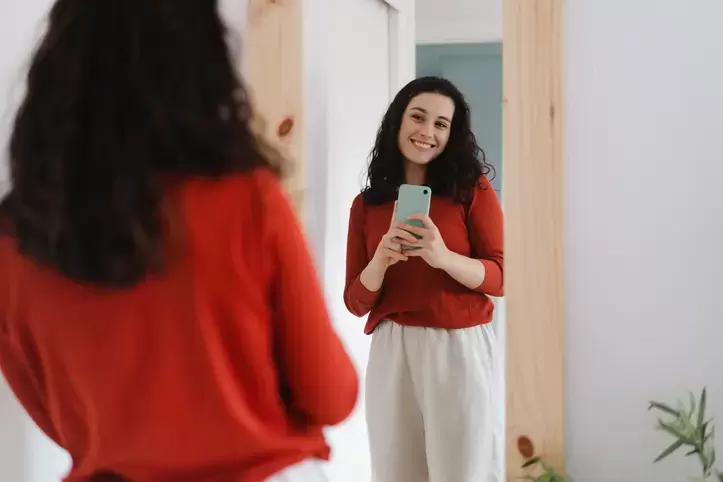
I sat motionless in front of the mirror, my phone in my hand, while Instagram was screaming with notifications.
And I was sitting there trying to understand just one thing:
Where did it all go?
That fragile, almost intimate moment when there were only me and my ideas, with no one standing between us.
I would have given anything to get that moment back.
And so I went into silence.
A place where there were only me and my ideas.
Even my family moved into the background for a while.
I needed to find myself again.
When people love each other, they understand each other’s needs.
I have this strange need:
I love being alone among people.
That is when I start hearing myself again.
And that is when I can create from inspiration, creating exactly what I want to share.
Not something I am trying to sell to other people in exchange for their approval.
And maybe that is the purest version of creativity.
Because when nobody is watching, you can’t perform.
You don’t have to make yourself interesting.
You don’t have to explain your choices.
You don’t have to prove that what you’re doing is valuable.
You can simply make it.
You can simply be yourself, exactly as you are.
***
I think we underestimate how important that is.
Sometimes we create things that will never become content.
A page in a notebook.
A photograph nobody will see.
A painting that will stay in your bedroom.
A paragraph that will never become an essay.
A video you make just because you like the way the light looks.
A dress you put on even though you’re staying home.
I can walk around my house wearing makeup, an evening dress, jewelry, and high heels even when I’m not going anywhere.
I simply want to feel delicious.
I like being beautiful.
A ridiculous little visual that makes you happy for no particular reason.
None of it needs an audience to become real.
It becomes real when you give it life, not when people like it.
Creation does not become meaningful only after someone sees it.
It is already valuable simply because you created it.
***
Sometimes the audience comes later.
Sometimes it never comes.
Sometimes someone writes you a hateful review.
And sometimes something you created for yourself unexpectedly finds thousands of people.
You can never know which one it will be.
That’s why I don’t think the audience should be the reason we create.
An audience can be wonderful.
Of course it is wonderful when someone reads your work and understands it.
It is wonderful when someone writes to you and says,
“This is exactly what I needed.”
It is wonderful when an editor chooses your piece.
It is wonderful when someone buys your book.
I love all of that.
But I don’t want to need it in order to create.
Because the moment I need someone else’s reaction to continue, they become part of my creative process.
And I don’t want to give anyone that much power over something that belongs to me.
I want to be able to write something that nobody understands.
I want to write it simply because I like it and not feel guilty about that.
I want to make something that gets no likes.
I want to have an idea that doesn’t fit the algorithm.
In fact, I like everything that stands out from the crowd.
I want to create something simply because I love it.
And then I want to wake up the next morning and create again.
Maybe that is what creative freedom actually looks like.
Not being free from criticism.
Not being free from failure.
Not even being free from disappointment.
But being free from the need to be witnessed.
Because there is a version of you that exists before the applause.
Before the audience.
Before the approval.
That person is still the artist.
***
And perhaps one of the most important things we can do as creators is not lose that person when people finally start watching.
Because the audience can change.
The numbers can change.
The algorithm can change.
People can love something today and ignore it tomorrow.
But the reason you started creating in the first place can remain.
Maybe the question isn’t:
“What will people think of this?”
Maybe sometimes it should simply be:
“Do I love making this?”
And if the answer is yes—
make it.
Even if nobody is watching.
Even if nobody will ever see it.
Ancient people made drawings on cave walls without ever imagining that centuries later we would protect those things as some of the most precious treasures we have.
The most valuable art is the art that comes from the soul.
The kind you create not to prove something to someone, but to share your happiness or your sadness.
And its value does not depend on other people if it has already made you happy.
—
This post was previously published on Beyond the Ordinary.
***
You may also like these posts on The Good Men Project:
 White Fragility: Talking to White People About Racism |
 Escape the “Act Like a Man” Box |
 The Lack of Gentle Platonic Touch in Men’s Lives is a Killer |
 |

If you believe in the work we are doing here at The Good Men Project, please join us as a Premium Member today.
All Premium Members get to view The Good Men Project with NO ADS.
Need more info? A complete list of benefits is here.
Photo credit: iStock

