


—
An electric vehicle is a means of transport that is approved for use on public roads, paths and squares, as well as trunk roads and, is powered by an electric motor. The electric motor draws its power from a rechargeable storage battery. Charging takes place via suitable charging devices either from the public power supply network or from EV chargers for home.
Electric vehicles can be:
- Pedelecs (bicycles with an auxiliary electric drive to support the crank drive)
- E-bikes (two-wheelers that can also be powered purely electrically)
- Scooters (electric scooters, electrically powered easy cruisers, these are scooters with wheels placed side by side, also known as Segways, as well as electrically powered three-wheel or four-wheel scooters)
- Car with purely electric drive
- Cars with hybrid drive (combination of electric motor/combustion engine)
Depending on the type of vehicle, the associated charging devices are classified according to charging power or charging current. The manufacturer’s information on the charging currents and times as well as the charging modes of the electric vehicles suitable for this must be observed. In principle, the charging time is reduced if a higher charging power is provided.
The electrical installation for supplying a charging device for electric vehicles must be dimensioned for the intended or necessary charging mode. If several charging devices or charging points are supplied from one electrical installation, the simultaneity factor must be taken into account if they are used at the same time, or charging management must be operated.
Charging points and charging facilities
A charging point is the point of the charging facility where an individual electric vehicle is connected.
Charging devices can be:
- Sockets in the fixed installation that are suitable and intended for charging vehicles, taking into account their continuous current carrying capacity
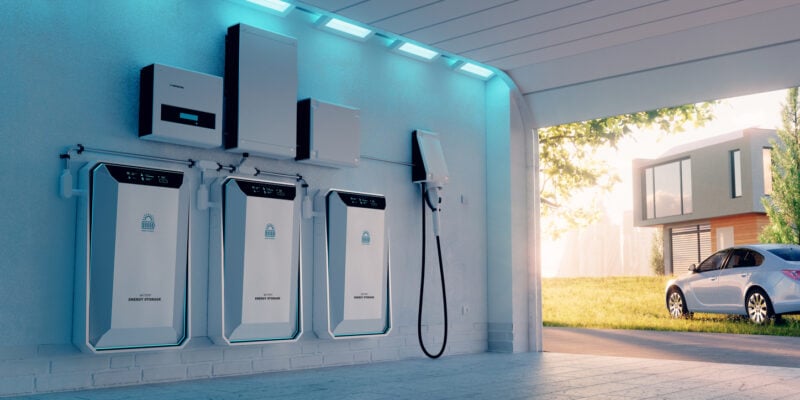
- Charging stations and wall boxes for installation in garages, carports or parking spaces that can supply one or more charging points. Check out wallbox comparison.
Sockets to which electric vehicles with charging modes 1 or 2 are connected are charging points and charging devices at the same time.
Charging modes
The following charging modes with alternating current (AC) are defined below:
Charging mode 1: The electric road vehicle is usually charged in one phase from a socket outlet with earthing contact or from a CEE plug device (three-phase) in the fixed electrical installation. In this charging mode, the vehicle does not query the maximum permissible charging current. The charging current is normatively limited to 16 A.
Charging mode 2: The electric road vehicle is usually charged in a single phase from a safety socket or from a CEE plug device in the fixed electrical installation. The charging line, i.e., the connection between the charging socket (charging point) and the vehicle, is equipped with a control and protection device (IC-CPD, in cable control and protection device). This device monitors, for example, the protective conductor connection between the vehicle and the charging connection (socket). It switches off in the event of danger. The maximum permissible charging current is specified for the vehicle. It must not exceed 32 A.
Note: The technical connection conditions of the grid operator only allow a maximum charging current of 20 A for single-phase operation. The TAB is currently being revised. New specifications for charging devices are foreseeable here.
Charging mode 3: The electric road vehicle is charged from a charging station that is permanently connected to the electrical installation. The vehicle is supplied via a charging line with plugs or a charging line permanently connected to the charging station. The charging station exchanges data with the vehicle to be charged and specifies the maximum permissible charging current. The typical charging current is 32 A.
Charging mode 4: The electric vehicle is charged from a charging station that is permanently connected to the electrical installation. The vehicle is connected to the charging station via a connecting cable with a plug, which exchanges data with the vehicle to be charged. The charge controller is not in the vehicle but in the charging station. The vehicle is supplied with a direct current.
Charging circuits
The charging circuit for an electric vehicle is a final circuit that must not contain any connection points for other electrical consumers.
Loading time
The time it takes to charge an electric vehicle depends on the current available at the charging station, the capacity of the storage battery and the maximum output of the rectifier used in the vehicle. A distinction is made between alternating current and direct current charging.
A safety socket (230 V, 16 A) is generally suitable for charging two- and four-wheel electric vehicles (charging mode 1). However, the loading process takes a lot of time. Since the socket is also not designed for continuous operation, charging is only throttled. A charging process can therefore take between 6 and 8 hours, and even much longer for models with a high battery capacity. With charging mode 2 (3-phase, 400 V), the charging time drops significantly to around 1.5 to 2 hours.
—

