



A lot of people wonder how it is they’ll ever get to where they want to go — a kind of existential freeze where they’re too scared to take any action in any direction.
A state of the most intense suffering that humans can endure.
The truth is, failing is not as bad as this frozen fearful state.
Maslow’s hierarchy of needs comes to mind.
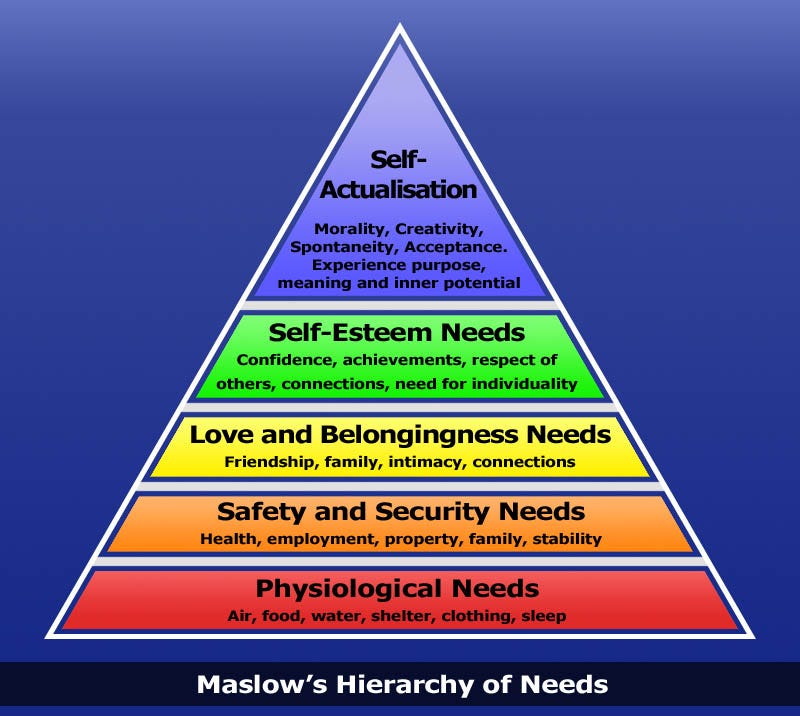
Image from Bill Murray, lifeasimprov.com
Through practice with people’s transformational journeys, what seems to be the case, is either end of the pyramid; physiology, and self-actualisation, are the most compelling and vital to us.
Your body image and your voice.
Self-actualisation is a fascinating concept. Whether you’re able to communicate what’s in your heart.
Most people experience difficulty in this area because of self-esteem, fear, and scarcity mindsets.
It’s natural; it’s not wrong. There’s no point in shaming yourself for your mistakes; this doesn’t take you closer to fulfilment; it brings the opposite.
How do we get out of this state, and begin to take tentative steps out into the big wide world where our fulfilment lies?
Know yourself.
I’m not just referring to the rational mind here either; there are many ways that we discern our environment — somatic imprints, implicit memories, sensory information, alongside integrating wisdom from our prefrontal cortex capabilities.
Most of us are unaware of the somatic information that we process. The stories that interweave there. The memories of smell, touch, taste, hearing, and sight, and bodily sensations.
A full embodied memory is a vibrant and visceral recalling of that state.
You still have an awareness that you’re remembering, which keeps you from being immersed in that memory, yet, the colours and emotions are vibrant. You breathe it in fully.
Think of your body, where are you at with exploring its sensations, and where the emotions lie in your body? Does it flood you with fear? Numbness? Joy? Sadness? Grief?
There aren’t many cultures in the world that celebrate this level of awareness in the body anymore.
I’m taking an audio CD course at the moment called The Somatic Descent and a course called Emotional Resilience Essentials.
There’s so much to our bodies that education doesn’t teach. In fact, we’re taught that we’re only a thinking mind. Anything below the chin is inconvenient, scary, uncontrollable, unpredictable.
That’s correct. The reason is that we have grown in a culture that suppresses emotion. Suppressed emotion is unpredictable, and it does need to be expressed, so it will come out, whether you like it or not. It will come out as a shadow aspect because you’re not aware of it.
Blow up arguments, subtly controlling behaviour, self-sabotage. They’re all the realm of suppressed emotion.
It’s not fair to open up this pandora’s box of generations of energy; that could contain hurt and pain. It could be legitimately scary, and you could be afraid that you’ll disappear into that sea.
If you’re resonating with that then you should seek a therapist of some sort; I’d recommend a mixture of modalities for mental, emotional, physical, and spiritual aspects. It’s a long and patient journey.
One simple thing that you can start with to get in touch with is humming.
‘The Humming Effect’ was researched by Jonathan Goldman. There’s both psychoacoustic, and vibroacoustic research into this theory.
Sound effects the mirror neurones. A significant cue in how we connect to our environment. Proprioception and exteroception mean the way that we ascertain our relationship to the space we’re in, and what is in that space. Some of the same circuitry in the brain helps you to understand your connection to your inner world. Humming is sound emanating from within. It is your resonations; it’s part of the first relationship. It can improve your relationship to yourself; a positive feedback loop.
Please take a couple of deep breaths, deepen them, use your belly to enhance the breathing. Once your relaxed, start making a sound. Hum. Notice what sound comes out of your mouth on the exhale and enjoy the inhale.
Goldman states, and this is the brilliant aspect of it, humming is socially acceptable. You can hum whenever you like, and it’ll help you to build awareness of your body.
We hold so many tensions in our bodies because we are worried that it won’t be socially acceptable to let them out into the free air. The realm of shame. Is it healthy or toxic to you to hold it inside?
Healthy shame allows you to understand that you need community and spirituality and that you’re a finite being. Toxic shame makes you feel that you’re a bad person, that you don’t deserve to have your expressions heard, and your needs met.
An advance of this practice will have you noticing the difference of the tone of the hum, where it sits in your body, how it feels, what resonance is happening within the body.
You start to understand who you are somatically, how your body responds to stimulus. What memories are still relevant to you, and why.
Integrating thoughts
Humming helps us to connect to ourselves, and this will make your life simpler. It’ll allow you to understand more about what fulfils you, you can combine this practice with another one, like journaling the thoughts that arise and what they mean.
It’ll allow you to understand what fulfils you, and what the next small step will be to progress towards that. It’ll allow you to release any control of how to get to that fulfilment and have faith that the next step is the only necessary action.
Humming brings you more into the present moment. The present moment is all we have.
“Acknowledging the good that you already have in your life is the foundation for all abundance.” ~ Eckhart Tolle ~
—
This post was previously published on medium.com.
***

If you believe in the work we are doing here at The Good Men Project and want a deeper connection with our community, please join us as a Premium Member today.
Premium Members get to view The Good Men Project with NO ADS. Need more info?
A complete list of benefits is here.
—
Photo credit: Joshua J. Cotten on Unsplash

