



Sometimes the unexpected can ease tangled thoughts and the morass of negativity. We gain a new perspective, and by comparison, feel a bit embarrassed about our self-indulgent pity party.
“I had the blues because I had no shoes until upon the street, I met a man who had no feet.” — Denis Waitley
The pity party began earlier in the day, after hours of failed artistic experimentation in my art studio. The various painting surfaces and mediums employed refused to produce the effects and aesthetic I envisioned.
Frustration is an insidious emotion because it attracts other negative thoughts. My failed painting experimentation led to rumination about the declining reach of my articles on Medium.com, where I cross-post my blog stories and essays.
I brooded about this, figuring that my effort to write deeper, more resonant articles doesn’t please the algorithms and curation gods, who likely prefer my older self-development pieces and whimsical cartoons.
Whatever the cause, less reach with readers equates to less income. And while I didn’t dive into writing for income, some remuneration is helpful in off-setting online expenses, books, and other related costs.
Entrepreneurial gurus sing the graces of diversification, so I ramped up my fine art paintings (which sold briskly in the past, before I turned to writing).
But alas, my recent turn toward monochromatic image-making (both painting, cartoons, and photography) has forced me to reconsider the paints, substates, and tools I use.
I’m closer to the vision I want to create, but not quite there yet. And I know the aesthetic turn toward black and white image-making will appeal to a smaller audience.
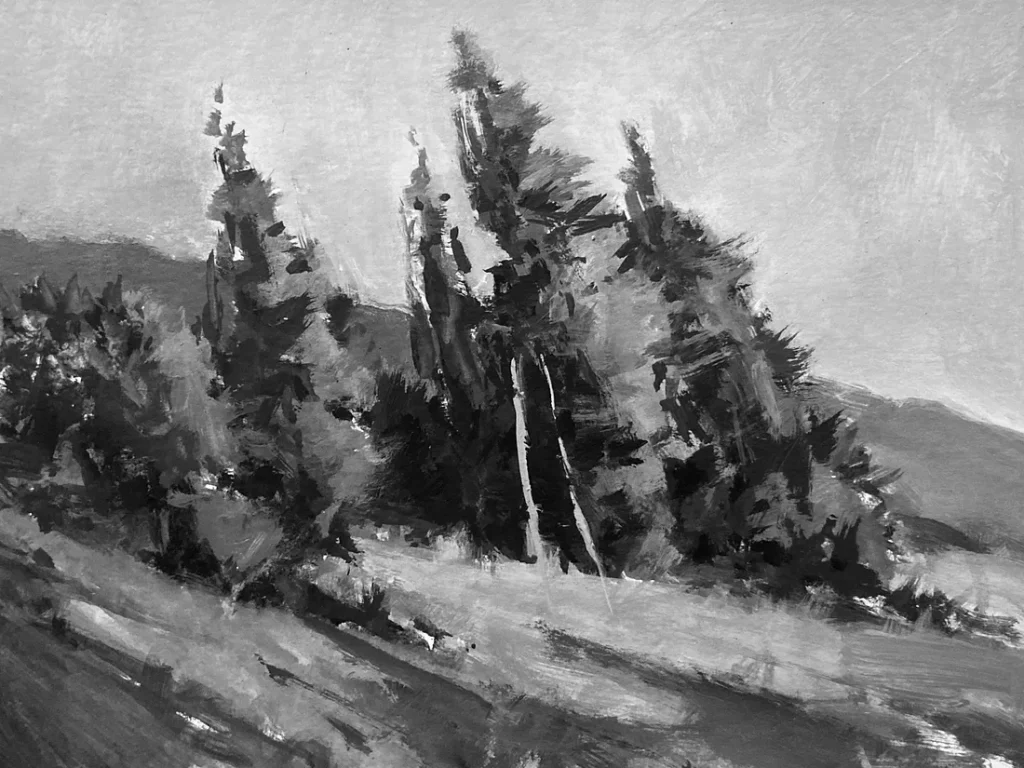
Black and white study of trees. Acrylic on paper by John P. Weiss
All of this creative angst was swirling around in my head when my wife, son, and I sat down for dinner at Applebee’s. That’s when I glanced up from the menu and saw him.
Thorns have roses
The gentleman looked to be around my age. As he stood up, I noticed him unfurl a collapsible white cane, which he tapped gently on the floor.
The woman with the man, presumably his wife, gently grabbed his arm and led him to the exit. They were talking amiably with one another, and I could hear him saying what a nice dinner they had.

Cartoon by John P. Weiss
Something stirred inside me, and I forgot about my little pity party. I realized that I had every freedom, whereas this man’s freedom came at the end of a white cane.
White canes, according to an article from Perkins School for the Blind, “are white because of George A. Bonham. In 1930, Bonham, president of the Peoria Lions Club (Illinois), watched a man who was blind attempting to cross a street. The man’s cane was black and motorists couldn’t see it, so Bonham proposed painting the cane white with a red stripe to make it more noticeable. The idea quickly caught on around the country.”
As the cheerful blind man ambled out of the restaurant, my pity party withered in embarrassment. Blindness and other physical limitations eclipse the frustrations of artistic angst and publishing woes.
“We can complain because rose bushes have thorns, or rejoice because thorns have roses.” — Alphonse Karr, A Tour Round My Garden
I returned to gazing at my menu when our server arrived. She flashed us a big grin and said, “Hey you guys, nice to see you again. I’ll be back to get your orders in a minute.”
I remembered her from previous dinners at Applebee’s, and that she is always pleasant, outgoing, and professional. Even on nights when I witnessed her encounters with rude and impatient customers.
Between our server’s positivity and the jovial blind man, I realized my brooding thoughts were unproductive emotional indulgences.
But even when we know other people have bigger problems, sometimes we can’t help feeling sorry for ourselves.
What is real seldom inhabits the surface
Returning home after dinner, our dogs greeted me with their familiar stare-down and tail wagging. Dog language for “Dad, it’s time for our evening walk.” I gathered their leashes, and off we went into the brisk night air.
During the walk, my thoughts trailed back to the blind man at dinner, our friendly server, and the origins of my creative angst.
It occurred to me that we tend to see things superficially. We focus on the surface, or the title, or the role someone plays, and not who they really are. Also, we focus on our emotions but often miss their deeper roots.
What is real seldom inhabits the surface. It’s hidden within.
In the movie “Elegy” Ben Kingsley plays David Kepesh, an aging literature professor who professes, “I’ve always been vulnerable to female beauty.” He pursues a relationship with one of his former students,Consuela Castillo (played by Penélope Cruz).
Kepesh tells his poet friend George O’Hearn (played by Dennis Hopper) about his affair with Consuela. He muses about their age difference, and sees himself as “the old guy who gave her some culture on the way.”
Later, O’Hearn tells Kepesh that “Beautiful women are invisible.” Kepesh balks and says, “What the hell does that mean?”
O’Hearn replies: “They jump out at you. A beautiful woman stands out…stands apart. You can’t miss her. But we never actually see the person. We see the beautiful shell. We’re blocked by the beauty barrier.”
O’Hearn drives home the point by saying, “We’re so dazzled by the outside, we never make it inside.”
This is not just true of how we see physically attractive people. We tend to see roles, professions, social hierarchy, race, gender, sexual orientation, political party, but not the person behind these superficialities.
“I am aware that I am less than some people prefer me to be, but most people are unaware that I am so much more than what they see.” — Douglas Pagels
Similarly, we tend to focus on the surface of our emotions, like the creative angst I feel over my paintings and writing. We get stuck on the surface of things, failing to understand the roots that stretch far below.
We don’t see what goes on underground
Toward the end of my evening walk with the dogs, we happened upon an old tree in the park. Its jumble of intertwining surface roots reached deep into the ground, becoming a network of life-sustaining tendrils spreading far and wide.
The dogs rolled on the grass, oblivious to my thoughts about roots, origins, and all that feeds who we are today. All that’s real and true behind the many faces we wear, and the many ways others perceive us.
“Consider a tree for a moment. As beautiful as trees are to look at, we don’t see what goes on underground- as they grow roots. Trees must develop deep roots in order to grow strong and produce their beauty. But we don’t see the roots. We just see and enjoy the beauty. In much the same way, what goes on inside us is like the roots of a tree.” — Joyce Meyer
I thought about my difficult day. How my creative angst was less about better paintings and literary success, but rather a touch of regret that I came late to this full-time life of writing and artwork.
Even though I found success and pride in my law enforcement career, there will always be a part of me that wonders. Where would my writing and artwork be today, had I started much earlier?
But then again, without the life experiences and wisdom gained from a lifetime of police work, perhaps my writing would have lacked depth and insight.
An invincible summer
A cheerful blind man in an Applebee’s restaurant gave me perspective about self-pity. The gnarled roots of an old tree reminded me that what’s deep inside matters more than the outside.
Everyone has roots within that carry the story of where they’re from, who they are, and what their dreams contain. We are better as people when we remember that about others.
We reach something close to sainthood when we see past the exterior and help nurture the roots in others. Be it our family members, loved ones, friends, and even strangers.

Cartoon by John P. Weiss
How do we nurture the roots in ourselves? By remembering our earliest dreams. By allowing a bit of the child within to surface. By pursuing our deepest passions, for the joy of it, without concern about approval or financial success.
How do we nurture the roots in others? By giving them our undivided attention. By taking an interest in their lives, passions, and dreams. By showing love, forgiveness, advice, and encouragement.
“When you have once seen the glow of happiness on the face of a beloved person, you know that a man can have no vocation but to awaken that light on the faces surrounding him. In the depth of winter, I finally learned that within me there lay an invincible summer.” — Albert Camus
The power to brighten our own lives and the lives of others has always been within us. The problem is that our insecurities, wounds, and selfish desires compete with the good in our hearts.
Sooner or later we all have bad days. Even when we know others may have it worse, we still suffer in our struggles. How do we get through such days? How do we uplift ourselves, and the people we care about?
By remembering our roots. The good parts within that sustain us, nurture our dreams, help us find our invincible summer, and empower us to awaken the light in others.
Before you go

I’m John P. Weiss, a fine artist, cartoonist, and black & white photographer who writes elegant stories and essays about life. To get the latest artwork, writing, book reviews, and inspiration, join my popular Saturday Newsletter here.
—
This post was previously published on Medium.
***
You Might Also Like These From The Good Men Project
 |
 |
 |
 |
Join The Good Men Project as a Premium Member today.
All Premium Members get to view The Good Men Project with NO ADS.
A $50 annual membership gives you an all access pass. You can be a part of every call, group, class and community.
A $25 annual membership gives you access to one class, one Social Interest group and our online communities.
A $12 annual membership gives you access to our Friday calls with the publisher, our online community.
Register New Account
Need more info? A complete list of benefits is here.
—
Photo by John P. Weiss

