



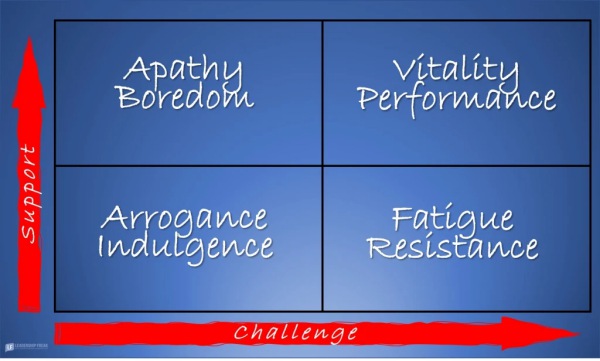
If support is a peach, challenge is broccoli. Peaches are good. Broccoli is good for you.
An abundance of peaches makes people complacent and feeble. But too much broccoli makes people disheartened and frustrated.
The promise of a peach makes broccoli almost enjoyable.
Challenge and Support
Leaders who support too much:
- Don’t want to inconvenience anyone.
- End up doing things by themselves because they don’t ask people to do hard things.
- Feel frustrated because others don’t help.
- Spend too much time helping and not enough time stretching people.
- Encourage dependence.
- Imply, inadvertently, that others are incompetent.
Leaders who challenge too much:
- Pressure people without thinking about current workload.
- Expect performance from weakness. Leaders who challenge too much don’t care about talent, just results.
- Neglect training and development. Just get it done.
- Complain that people don’t rise to higher standards and deliver better results.
- Cause fatigue.
- Invite resistance. The people you continually push – without giving support – eventually push back or leave.

Support is more than holding hands:
USA TODAY reports that 76-percent of parents admitted they still remind their adult children of deadlines, including schoolwork. 74 percent said they made appointments for them, including doctors’ appointments.
Untested people don’t know what they’re made of.
Challenge is more than making demands:
Untested people:
- Believe they are superior when they’re inferior. Challenge humbles.
- Devalue the expertise of others. Challenge enables respect for others.
- Fail to appreciate and anticipate the challenges of high performance. Challenge sheds light on reality.
(Adapted from the Dunning-Kruger Effect)
Challenge that’s comfortable is useless. Challenge that’s overwhelming causes defeat.
Challenge AND support enable people to step into discomfort.
What happens when leaders give too much support?
What happens when leaders give too much challenge?
How might leaders find an effective balance between challenge and support?
Resource material:
‘Snowplow parenting’ is killing kids’ life skills, poll shows (usatoday.com)
How Parents Are Robbing Their Children of Adulthood – The New York Times (nytimes.com)
(PDF) Maintaining High Challenge and High Support for Diverse Learners (researchgate.net)
—
This post was previously published on Leadership Freak with a Creative Commons License.
***
You Might Also Like These From The Good Men Project
 |
 |
 |
 |
Join The Good Men Project as a Premium Member today.
All Premium Members get to view The Good Men Project with NO ADS.
A $50 annual membership gives you an all access pass. You can be a part of every call, group, class and community.
A $25 annual membership gives you access to one class, one Social Interest group and our online communities.
A $12 annual membership gives you access to our Friday calls with the publisher, our online community.
Register New Account
Need more info? A complete list of benefits is here.
—
Photo credit: iStock

